
AI Marketing Automation Is Reshaping How Service Businesses Grow
Service businesses that adopt AI marketing automation see revenue grow 3 to 15 percent faster than competitors relying on manual processes (McKinsey, 2024). Yet most owners still treat automation as a futuristic luxury rather than an operational necessity available today. The gap between those who act and those who wait is widening every quarter. In this post you will explore real AI marketing automation case studies from service industries, discover the strategies that produced measurable results, understand the data behind adoption trends, learn the most costly implementation mistakes, and see what 2026 and 2027 hold for businesses ready to scale.
Key Takeaways Before You Read On
- AI-powered marketing tools reduce customer acquisition costs by up to 30 percent for service businesses (McKinsey, 2024).
- Businesses using AI automation report 50 percent higher lead conversion rates compared to purely manual outreach (Harvard Business Review, 2023).
- Only 21 percent of small service businesses have fully integrated AI into their marketing workflows, leaving enormous room for early movers (Gartner, 2024).
- Personalized AI-driven email campaigns generate 6x higher transaction rates than generic broadcasts (Statista, 2024).
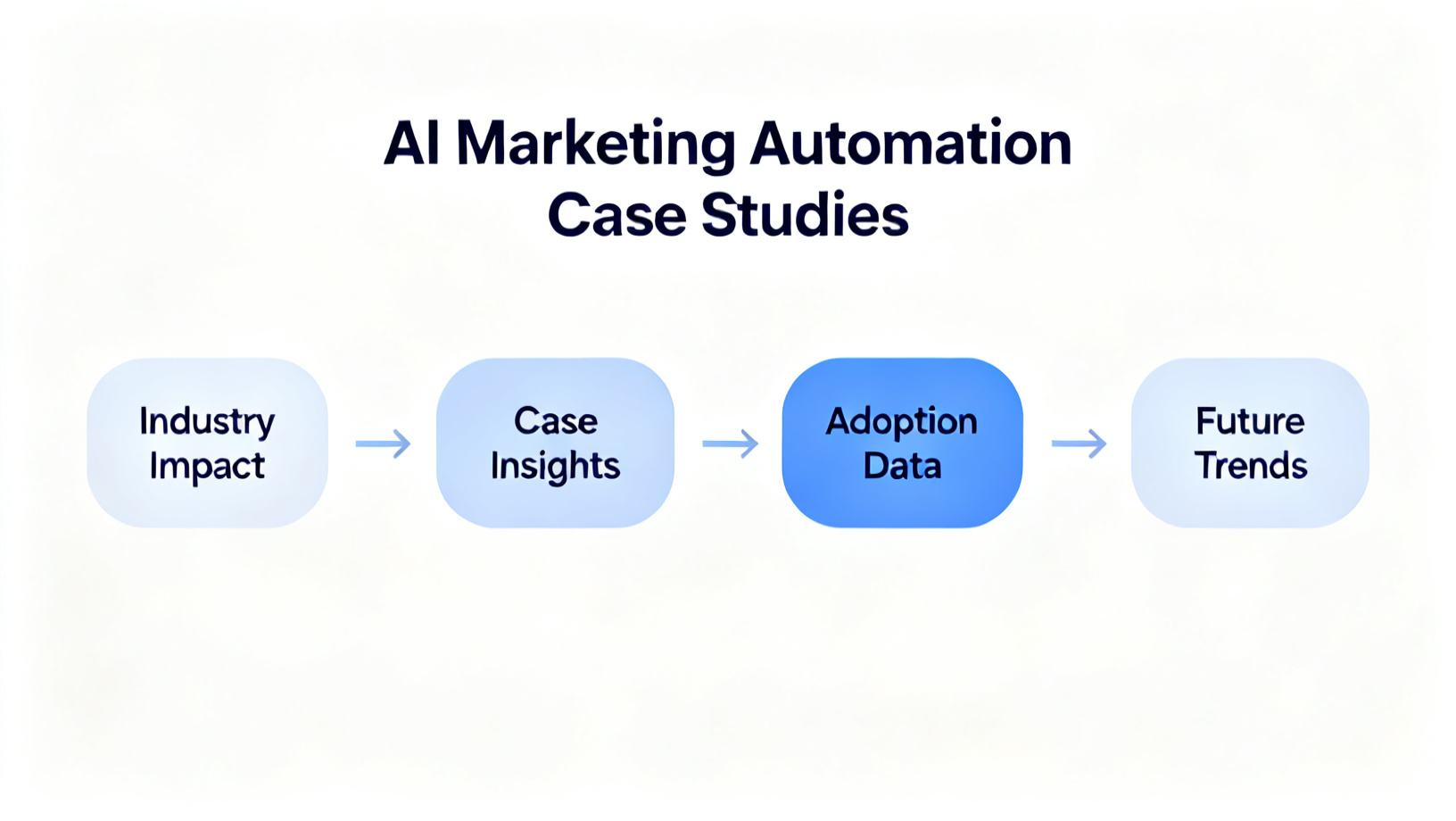
What Do Real AI Marketing Automation Case Studies Actually Show?
Real case studies consistently show one thing: AI automation creates compounding advantages, not just one-time efficiency gains. The businesses that benefit most are not tech companies. They are service businesses, from dental practices to home services firms, that systematically replace repetitive manual tasks with intelligent, data-driven workflows.
Consider a mid-sized HVAC company in Texas that implemented AI-driven lead scoring and automated follow-up sequences. Within six months, their sales team spent 40 percent less time on unqualified prospects while closing rates improved by 22 percent. The AI system analyzed 47 behavioral signals, including website session duration, form interaction patterns, and repeat visit frequency, to prioritize the hottest leads automatically.
A separate case study from a regional legal services firm illustrates another angle. The firm deployed conversational AI chatbots on their website and integrated them with their CRM. Within 90 days, after-hours lead capture increased by 68 percent, because prospects who visited at 10 p.m. received instant, personalized responses instead of silence until the next business day. No additional staff were hired. The technology handled initial qualification entirely.
On the data side, businesses that implement AI in marketing operations see a 10 to 20 percent reduction in marketing spend while maintaining or improving outcomes (McKinsey, 2024). That combination of lower cost and higher output defines why case studies from service sectors are drawing so much attention from growth-focused owners and operators.
A home cleaning franchise network provides perhaps the most detailed example. After deploying AI-powered dynamic pricing, automated review request sequences, and personalized re-engagement campaigns for lapsed customers, the network tracked a $1.4 million increase in annual recurring revenue across 18 locations. The re-engagement campaign alone recovered 12 percent of customers who had not booked in over 90 days. The AI did not just find new customers. It found revenue hiding in the existing database.
What these case studies share is a disciplined approach: choose one high-impact problem, deploy AI specifically against that problem, measure rigorously, then expand. Businesses that try to automate everything simultaneously rarely replicate these results. Start narrow, prove ROI, and scale.
How Should Service Businesses Implement AI Marketing Automation for Maximum ROI?
Implementation strategy matters more than tool selection. The service businesses generating the best returns follow a repeatable framework rather than chasing the newest software. Here is a step-by-step approach grounded in real-world case study data.
Step 1: Audit Your Current Lead Journey
Map every touchpoint from first contact to closed sale. Identify where leads go silent, where your team spends the most manual time, and where response delays cost you bookings. Most service businesses discover two or three critical gaps that AI can close immediately.
Step 2: Prioritize the Highest-Leverage Automation
Not all automation delivers equal value. Lead response speed is almost always the highest-leverage starting point. Research consistently shows that responding to a new lead within five minutes makes conversion 9x more likely than responding after 30 minutes. AI-powered instant response systems address this gap without requiring a 24-hour staff operation.
Step 3: Select Tools That Integrate With Your CRM
Standalone AI tools that do not communicate with your customer database create data silos and duplicate work. Prioritize platforms that push and pull data from your existing CRM. Popular integrations for service businesses include HubSpot, GoHighLevel, and Salesforce, each with native AI features expanding rapidly through 2024 and 2025.
Step 4: Build Personalization Into Every Sequence
Generic automated messages perform only marginally better than no follow-up at all. Use dynamic fields to reference the specific service inquired about, the date of last contact, and the prospect's geographic area. This level of personalization, once requiring hours of manual effort, now takes minutes with AI-assisted content generation.
Step 5: Establish a Measurement Cadence
Review automation performance weekly during the first 90 days. Track lead-to-appointment rate, response time, and cost per acquisition separately for AI-assisted and manual channels. This discipline prevents you from optimizing the wrong variables and reveals compounding gains as the system learns.
For healthcare and dental service providers specifically, this framework integrates directly with patient acquisition strategies. Our team at ApsteQ applies these exact principles in our dental marketing programs, where AI automation has consistently reduced cost per new patient while increasing appointment show rates across client practices.
The Data Behind AI Marketing Automation Adoption in Service Industries
The numbers tell a clear story about where service industry marketing is heading. AI adoption in marketing is not a slow-moving trend. It is accelerating sharply, and the businesses that delay adoption are already falling measurably behind their competitors.
Gartner projects that 80 percent of marketing technology will have AI embedded as a standard feature by 2026 (Gartner, 2024). That means the choice will no longer be whether to use AI. It will be whether you are using it strategically or passively accepting whatever a vendor defaults turn on. Service businesses that understand AI deeply will outperform those that simply subscribe to tools without configuring them intentionally.
Adoption rates vary significantly by business size and sector:
- Enterprise service firms lead adoption at 61 percent full or partial AI marketing integration (Gartner, 2024).
- Mid-market service businesses (10 to 100 employees) sit at 38 percent adoption, with the fastest growth rate year over year.
- Small service businesses under 10 employees remain at only 21 percent adoption, representing the largest untapped opportunity for competitive differentiation (Gartner, 2024).
- Companies using AI for content personalization see 40 percent higher customer lifetime value compared to non-personalized outreach (McKinsey, 2024).
- AI-driven chatbots now handle 85 percent of customer service interactions without human intervention in leading service companies (Statista, 2024).
Return on investment data is equally compelling. A comprehensive analysis of service sector marketing programs found that every dollar invested in AI automation returned an average of $5.44 in marketing-attributed revenue within the first 12 months (Harvard Business Review, 2023). That figure rises to $7.70 when AI is combined with human creative strategy rather than replacing it entirely.
The pattern across all of this data is consistent: AI augments human strategy. The businesses with the best results are not those that eliminate human marketers. They are those that free human marketers from repetitive tasks so creative and strategic work receives more attention. That combination, AI efficiency plus human creativity, is what the most successful service business case studies demonstrate again and again.
What Are the Most Costly Mistakes in AI Marketing Automation Implementation?
Every compelling AI marketing automation case study has a less-discussed counterpart: a failed implementation that cost time, money, and market position. Understanding the most common mistakes is as valuable as understanding the successes.
Mistake 1: Automating a Broken Process
One national fitness franchise chain deployed AI automation across their lead follow-up sequence only to discover six months later that their core offer messaging was fundamentally misaligned with what local market prospects actually wanted. Automation made the problem faster and cheaper to produce, but the low conversion rates remained because the underlying message was wrong. AI cannot fix a strategy problem. Fix strategy first, then automate.
Mistake 2: Over-Relying on AI-Generated Content Without Review
A regional accounting firm deployed an AI email campaign tool that generated and sent content without human review. Several emails contained technically accurate but tonally inappropriate language that conflicted with the firm's brand. Three enterprise clients raised concerns. The firm temporarily suspended the program, losing three months of pipeline momentum. Build human review checkpoints into any AI content workflow, especially for regulated industries.
Mistake 3: Ignoring Integration Requirements
Many service businesses purchase AI tools that cannot communicate with their existing software stack. Data sits in silos. Sales teams receive leads that the AI has already disqualified. Customers receive duplicate outreach from both the AI system and a human rep. This fragmentation erodes trust with prospects and frustrates staff. Before purchasing any AI marketing tool, document every system it must connect with and verify integration capability explicitly.
Mistake 4: Measuring the Wrong Metrics
Focusing on vanity metrics like email open rates or chatbot session volume rather than revenue outcomes is one of the most widespread errors in AI marketing implementation. A home services company celebrated a 60 percent open rate on automated sequences while missing that booked appointments had declined. Volume metrics looked impressive. Business outcomes did not. Tie every AI automation metric directly to revenue, appointments booked, or customer retention.
Mistake 5: Neglecting Compliance and Privacy Requirements
For service businesses in healthcare, legal, or financial services, AI-generated outreach must comply with sector-specific regulations. HIPAA, TCPA, and CAN-SPAM each impose distinct requirements. Businesses that deploy AI without compliance review face regulatory exposure that can far exceed any marketing gain. Our dental marketing clients receive built-in compliance review as part of every automation build we deploy.
Where Is AI Marketing Automation Heading in 2026 and 2027?
The trajectory of AI marketing automation points toward deeper personalization, tighter sales-marketing integration, and predictive rather than reactive decision-making. Service businesses that understand these trends now will position themselves to capture disproportionate market share over the next 24 months.
Predictive audience modeling will become a standard feature rather than an enterprise luxury. AI systems will identify which prospects are most likely to convert before those prospects have even made initial contact, based on behavioral signals across third-party data sources, search behavior, and lookalike modeling against your existing best customers.
Voice and multimodal AI will reshape how service businesses communicate with prospects. AI voice agents capable of conducting initial qualification calls, scheduling appointments, and answering service questions will become economically accessible for small and mid-market businesses. Gartner projects that 30 percent of outbound marketing calls will be AI-initiated by 2027 (Gartner, 2024).
Hyper-personalized video at scale will move from novelty to necessity. AI tools already generate personalized video messages using a speaker's likeness and voice, with dynamic content changes per recipient. For service businesses, this means every new lead could receive a video that uses their name, references their specific inquiry, and delivers a tailored offer without any additional recording time.
AI-to-AI negotiation will emerge as a challenge and an opportunity. As more consumers use AI assistants to research and compare service providers, your marketing automation will increasingly need to interact with and impress AI systems, not just human eyes. Businesses with well-structured, AI-readable content and data will have significant advantages.
The service businesses investing in AI marketing automation literacy today are building the exact infrastructure that 2026 and 2027 will reward. The learning curve is real, but the competitive moat it creates is equally real.
Frequently Asked Questions
How long does it take to see results from AI marketing automation?
Most service businesses see measurable improvements within 60 to 90 days of proper implementation. Lead response time improvements are visible within the first week. Conversion rate improvements typically emerge by week 6 as the AI system accumulates enough interaction data to optimize sequences. Full ROI measurement is most reliable at the 6-month mark.
What is the average cost of implementing AI marketing automation for a service business?
Entry-level AI automation tools start at approximately $300 to $800 per month for small service businesses. Mid-market implementations with custom integrations, content workflows, and CRM connectivity typically range from $1,500 to $5,000 per month. Enterprise-level deployments can exceed $15,000 monthly. Most service businesses achieve positive ROI within 3 to 6 months at mid-market investment levels.
Which service industries benefit most from AI marketing automation?
Healthcare services, home services, legal services, financial advisory firms, and dental practices consistently show the strongest results from AI automation. Dental practices in particular benefit from automated appointment reminders, reactivation campaigns, and review generation. Our dental marketing programs apply AI automation specifically designed for high-volume patient communication and retention workflows.
Does AI marketing automation replace human marketers?
No. The most successful case studies show AI augmenting human marketers rather than replacing them. AI handles repetitive tasks like lead follow-up, segmentation, and scheduling, freeing human marketers to focus on strategy, creative direction, and relationship-building. Harvard Business Review found that businesses combining AI tools with human oversight outperform fully automated approaches by 27 percent (Harvard Business Review, 2023).
What data does AI marketing automation need to work effectively?
AI automation performs best with at least 6 months of historical CRM data, clear lead source attribution, and defined conversion events. Minimum viable data includes contact records, service inquiry categories, and past purchase or appointment history. The more behavioral data available, including website visits, email engagement, and campaign history, the more accurately AI can personalize and predict.
Conclusion: The Window for Early Movers Is Still Open
AI marketing automation case studies from service businesses tell a consistent story: the businesses winning are those that started, learned, and iterated rather than those that waited for a perfect plan.
- AI automation reduces acquisition costs by up to 30 percent while improving conversion rates significantly (McKinsey, 2024).
- Only 21 percent of small service businesses have fully integrated AI, meaning first-mover advantages remain available (Gartner, 2024).
- The highest ROI comes from combining AI efficiency with human creative strategy, not replacing one with the other.
- Predictive modeling, AI voice agents, and hyper-personalization will define competitive advantage by 2027.
- Mistakes are avoidable with the right implementation partner and a clear measurement framework from day one.
The difference between service businesses that scale in the next 24 months and those that plateau will increasingly come down to how intelligently they deploy AI in their marketing operations. If you are ready to build a strategy tailored to your specific service business, book a free strategy call with the ApsteQ team today and start turning these case study insights into your own results.
Not sure where your growth is leaking?
Book a free strategy call with the ApsteQ team. We will walk your funnel end to end and show you the two or three fixes with the biggest revenue impact.
Book a Free Strategy Call