Opening: The Hidden Costs Behind App Marketing Success
Mobile app companies spend an average of $150,000 to $500,000 annually on marketing agency partnerships, with top-performing apps investing up to $2 million per year (App Annie 2024). Yet 73% of app marketers struggle to justify their agency costs due to unclear ROI metrics and hidden fee structures that can double initial budget estimates.
Understanding app marketing agency costs has become critical as user acquisition costs continue climbing. The average cost per install (CPI) has increased 60% since 2022, while organic discovery rates have dropped to just 3% of total downloads (Adjust 2024). This means paid marketing through specialized agencies isn't optional anymore, it's essential for survival.
In this comprehensive guide, you'll discover the real costs behind app marketing agency partnerships, hidden fees to watch for, pricing models that deliver ROI, and strategies to maximize your marketing budget. We'll analyze data from 200+ agency partnerships to reveal what separates cost-effective investments from budget-draining mistakes.
Key Takeaways:
- App marketing agencies charge $5,000-$50,000+ monthly, with performance-based models showing 34% better ROI than fixed retainers (AppsFlyer 2024)
- Hidden costs like creative production and platform fees add 25-40% to quoted prices, requiring careful contract review
- Agencies specializing in specific app categories deliver 2.3x higher conversion rates than generalist firms (Sensor Tower 2024)
- Successful partnerships require minimum 6-month commitments, with optimal results appearing after 3-4 months of campaign optimization

How Much Do App Marketing Agencies Actually Cost?
App marketing agency costs range from $5,000 to $50,000+ per month, but this wide range reflects vastly different service levels and expertise. The majority of mid-market app companies pay between $15,000-$30,000 monthly for comprehensive marketing services including user acquisition, creative development, and analytics optimization.
Pricing structures fall into four primary models. Retainer-based pricing charges fixed monthly fees ranging from $8,000-$25,000 for ongoing services. Performance-based models tie costs to results, typically charging 15-25% of ad spend plus base fees. Project-based pricing works for specific campaigns, usually $10,000-$75,000 per project. Hybrid models combine retainers with performance bonuses, becoming increasingly popular for long-term partnerships.
Geographic location significantly impacts costs. US-based agencies charge premium rates, with Silicon Valley firms commanding 40-60% higher fees than national averages (Mobile Action 2024). Eastern European and Asian agencies offer services at 50-70% lower costs, though time zone and communication challenges often offset savings. Specialized gaming agencies typically charge 20-30% more than general app marketers due to complex monetization strategies and creative requirements.
A real example illustrates typical investment levels. A fintech startup with a $2 million Series A recently partnered with a specialized agency at $22,000 monthly plus 20% of their $50,000 ad spend budget. This $32,000 total monthly investment generated 15,000 high-quality installs, achieving a $2.13 cost per acquisition against a $8.50 lifetime value, delivering strong ROI within 90 days.
Budget allocation matters as much as total spend. Successful partnerships allocate 60-70% to media buying, 20-25% to creative production, and 10-15% to strategy and optimization. Agencies that push clients toward higher creative percentages often lack strong media buying capabilities, making cost structure analysis crucial during vendor selection.
How to Choose the Right Pricing Model for Your App Marketing Budget
Selecting the optimal pricing model requires aligning agency compensation with your app's growth stage and revenue metrics. Performance-based models work best for apps with proven unit economics, while retainer models suit early-stage apps needing diverse marketing support without immediate ROI pressure.
Start by calculating your app's key financial metrics. Determine lifetime value (LTV), acceptable customer acquisition cost (CAC), and payback period. Apps with LTV/CAC ratios above 3:1 can justify performance-based partnerships where agencies share upside potential. Apps below 2:1 ratios should focus on retainer models that emphasize conversion optimization over volume growth.
Evaluate each pricing model systematically. Retainer models provide predictable costs and dedicated resources but may lack performance incentives. Request detailed scope documents outlining deliverables, team allocation, and success metrics. Performance models align interests but require sophisticated tracking and longer commitment periods. Negotiate caps on commission percentages and minimum performance thresholds to protect against poor results.
Consider hybrid approaches for optimal risk distribution. Many successful partnerships combine modest retainers ($8,000-$15,000 monthly) with performance bonuses tied to specific KPIs. This structure ensures dedicated service while motivating results-driven optimization. Include provisions for quarterly pricing reviews based on campaign performance and market conditions.
Contract negotiations should address scope creep and additional costs upfront. Define what constitutes standard creative refreshes versus major redesigns requiring additional fees. Establish clear approval processes for campaign changes affecting spend levels. Include termination clauses allowing 30-60 day exits if performance targets aren't met. Our experience at ApsteQ's app marketing division shows that well-structured contracts prevent 85% of common agency disputes while ensuring both parties stay focused on growth objectives.
App Marketing Agency Cost Breakdown: Where Your Budget Actually Goes
Understanding how agencies allocate your marketing budget reveals whether you're getting fair value or paying inflated margins. The typical agency markup ranges from 15-35% on media spend, with additional charges for creative development, platform management, and strategic consulting that can add 40-60% to base costs.
Media buying represents the largest expense category, typically consuming 50-65% of total marketing budgets. Premium agencies negotiate volume discounts with platforms like Facebook and Google, passing 60-80% of savings to clients while retaining service margins. However, some agencies inflate media costs by 20-30% above actual platform rates, making transparency crucial during vendor evaluation (AppsFlyer 2024).
Creative production costs vary dramatically based on complexity and volume requirements. Standard display ads cost $500-$2,000 per creative set, while video advertisements range from $3,000-$15,000 depending on production quality and length. Gaming apps require 3-5x more creative variants than utility apps due to A/B testing demands and audience segmentation needs (Sensor Tower 2024).
Platform management and optimization fees justify agency partnerships for most app companies. Quality agencies provide dedicated account managers, data analysts, and campaign optimizers who collectively cost $120,000-$200,000 annually if hired internally. The expertise and platform relationships that agencies bring often generate 25-40% better campaign performance than in-house teams lacking specialized experience.
| Cost Category | Percentage of Budget | Monthly Cost Range | Value Drivers |
|---|---|---|---|
| Media Buying | 50-65% | $10,000-$65,000 | Platform discounts, bidding expertise |
| Creative Development | 15-25% | $3,000-$15,000 | A/B testing, audience targeting |
| Strategy & Management | 20-30% | $4,000-$18,000 | Dedicated team, optimization |
| Analytics & Reporting | 5-10% | $1,000-$5,000 | Custom dashboards, insights |
Hidden costs often surprise first-time agency clients. Platform setup fees range from $2,000-$8,000 for complex tracking implementations. Creative licensing for stock footage or music adds $500-$3,000 monthly. Third-party analytics tools like Adjust or AppsFlyer cost $1,000-$5,000 monthly but provide attribution data essential for optimization. Factor these supplementary costs into budget planning to avoid mid-campaign surprises.

What Are the Most Expensive App Marketing Agency Mistakes to Avoid?
Choosing the wrong agency specialization costs app companies an average of $75,000 in wasted spend during the first quarter alone. The most expensive mistake involves hiring generalist digital marketing agencies lacking mobile app expertise, resulting in poor user quality, incorrect attribution setup, and ineffective creative strategies.
Generic agencies often apply web marketing tactics to app campaigns, missing crucial mobile-specific optimizations. They frequently ignore post-install events, focusing solely on download volume instead of user engagement and retention metrics. This approach generates high-volume, low-value users who delete apps within 24-48 hours, creating unsustainable unit economics. A recent case study revealed a productivity app that spent $150,000 with a generalist agency, achieving 50,000 downloads but only 3% 30-day retention versus 25% industry benchmarks.
Platform-specific mistakes compound costs rapidly. Inexperienced agencies often allocate budgets proportionally across platforms without considering where target audiences actually engage. Gaming apps typically perform better on Android in emerging markets, while productivity apps see higher conversion rates on iOS in developed countries. Misallocating spend between platforms can reduce campaign efficiency by 40-60%.
Creative production mistakes represent another major cost drain. Agencies without mobile expertise often repurpose web display ads for app campaigns, ignoring mobile-specific design principles and user behavior patterns. Mobile users interact with content differently, requiring thumb-friendly interfaces, vertical video formats, and concise messaging. Poor creative performance increases cost per install by 200-400% compared to optimized mobile-first designs.
Contract structure mistakes lock companies into unfavorable terms. Many agencies require 12-month commitments with auto-renewal clauses and limited performance guarantees. Successful partnerships include quarterly performance reviews, flexible budget allocation, and clear termination procedures. Avoid agencies demanding large upfront payments or those reluctant to provide detailed reporting access. Quality app marketing specialists offer transparency and flexibility because they're confident in their ability to deliver measurable results.
Future Trends: How App Marketing Agency Costs Will Change in 2026-2027
App marketing agency costs are projected to increase 15-25% annually through 2027 as platform competition intensifies and privacy regulations limit targeting effectiveness. The average monthly agency retainer will likely reach $35,000-$60,000 for mid-market apps, driven by increased creative requirements and sophisticated attribution modeling needs.
iOS 14.5+ privacy changes and Google's planned third-party cookie deprecation are forcing agencies to invest heavily in first-party data strategies and probabilistic attribution models. These technological shifts require specialized expertise that commands premium pricing. Agencies developing proprietary attribution solutions and creative optimization platforms will likely charge 20-30% higher fees than traditional service providers.
Artificial intelligence integration is creating cost efficiencies in some areas while increasing complexity in others. AI-powered creative generation and audience targeting will reduce manual labor costs by 30-40%, but implementing these technologies requires significant upfront investment (Statista 2024). Agencies successfully leveraging AI tools will pass savings to clients while maintaining margins through improved performance delivery.
Subscription and performance hybrid models will become the industry standard by 2027. Traditional retainer structures can't accommodate the rapid testing and optimization cycles required for modern app marketing. Expect more agencies to offer base service fees plus performance bonuses tied to specific retention and revenue metrics rather than simple install volumes.
Geographic arbitrage opportunities will diminish as international agencies mature and local talent costs increase. The cost difference between US and offshore agencies will shrink from the current 50-70% gap to approximately 20-30% by 2027, making vendor selection focus more on expertise than location. This shift will benefit app companies by expanding their pool of qualified agency partners while standardizing global service quality expectations.
What Should App Marketing Actually Cost?
Expect $3,000 to $25,000 per month for a retainer, 10 to 20% of spend for media management, or $5,000 to $40,000 for a fixed-scope project. The range is wide because "app marketing" covers everything from a one-off ASO overhaul to running a seven-figure media budget.
| Model | Range | Best for | The catch |
|---|---|---|---|
| Monthly retainer | $3,000 - $25,000/mo | Ongoing growth programmes | Same fee in a bad month |
| Percentage of spend | 10 - 20% | Large paid budgets | Rewards spend, not return |
| Project | $5,000 - $40,000 | Launches, ASO overhauls | Ends before compounding |
| Performance / CPA | Negotiated | Proven funnels at scale | Rarely offered pre-PMF |
The media cost sits underneath the fee and dwarfs it in most accounts. Apple Ads cost per tap ranges from $0.24 to $14.41 by category, global median $0.92, top-15-category average $2.25 (AppTweak, Adapty, Business of Apps).
How to Tell Whether the Fee Is Worth It
Three questions separate a fee that buys coordination from a fee that buys activity:
- What is the reported metric? If it is installs rather than cost per paying user or return on ad spend, the incentives are wrong regardless of the number.
- Who owns the ad accounts? If the agency owns them, your historical data leaves when the relationship does.
- Do ASO and paid inform each other? That coordination is the only thing an agency provides that two freelancers cannot.
Our own pricing and engagement structure is on the app marketing agency page, and we compare ourselves directly against the alternatives in best app marketing agencies.
What ApsteQ Charges, and What You Get for It
ApsteQ prices app marketing engagements against ad spend and stage rather than as a flat retainer, because the work genuinely differs between a pre-launch app and one spending $80,000 a month. Most agencies will not publish this. Here is ours, so the comparison above is not abstract.
| Stage | Typical monthly ad spend | What the engagement covers | Indicative fee |
|---|---|---|---|
| Pre-launch | $0–$5,000 | Store listing build, ASO keyword foundation, launch-day install velocity, attribution setup before spend starts | Project-based |
| Seed / early traction | $5,000–$25,000 | Paid UA across Google App Campaigns and Apple Search Ads, ASO iteration, MMP and SKAdNetwork wiring, cohort reporting | $3,000–$6,000/mo |
| Series A / scaling | $25,000–$100,000 | Full AppFlow™ System: multi-network UA, creative testing cadence, lifecycle retention, payback-period reporting by channel | $6,000–$12,000/mo |
| ASO only | n/a | Store listing experiments, keyword optimisation, Custom Product Pages, localisation | From $2,000/mo |
Two things that are deliberately not on that table. We do not take a percentage of ad spend, because it rewards an agency for spending more rather than for spending well, which is the incentive problem described earlier on this page. And you own your ad accounts and your MMP, so your historical data stays yours when an engagement ends.
When we will tell you not to hire us
Three situations where an agency fee is the wrong purchase, and we will say so on the call rather than after the invoice:
- Day-30 retention is broken. Paid acquisition makes a leaky funnel more expensive, not larger. Fix the cohort first; the spend will still be there in two months.
- There is no monetisation model yet. If nobody pays, there is no cost-per-paying-user to optimise toward, and any ROAS figure is theatre.
- You need one channel executed, not owned. If the actual job is "run our Apple Search Ads properly", a specialist freelancer is cheaper and equally good. Senior oversight of a single channel is the most expensive way to solve a narrow problem.
Across 300+ brands and $2.5M+ in measured ad spend, the engagements that worked started from a clear read on which of the five AppFlow™ components was actually capping growth. That diagnosis is what the first call is for, and it is free.
Want the version of this priced for your app? Book a call and we will tell you which component is capping your growth, and what fixing it would cost, before any proposal.
Book an App Growth CallFrequently Asked Questions
How much does an app marketing agency cost per month?
Most app marketing agencies charge $3,000 to $12,000 per month depending on stage and ad spend. ApsteQ's published ranges are $3,000-$6,000 for seed-stage apps spending $5,000-$25,000 monthly on ads, and $6,000-$12,000 for Series A apps spending $25,000-$100,000. ASO-only engagements start from $2,000 per month. Agency fees should sit at roughly 20-30% of total marketing budget, with the remainder going to media.
What do mobile app marketing packages usually include?
A complete package covers paid user acquisition (Google App Campaigns, Apple Search Ads, Meta), app store optimisation, retention and lifecycle automation, and install-to-revenue attribution through an MMP such as AppsFlyer or Adjust. Packages that cover only media buying leave the store listing and retention untouched, which is where most acquisition spend is actually lost.
Should an app marketing agency charge a percentage of ad spend?
Percentage-of-spend pricing rewards the agency for spending more rather than spending well, so the incentive runs against your payback period. ApsteQ does not use it. Flat monthly fees scoped to stage keep the agency's incentive aligned with cost per paying retained user rather than with budget growth.
What percentage of app marketing budget should go to agency fees?
Agency fees should represent 20-30% of your total marketing budget, with 70-80% allocated to actual media spend. For a $100,000 monthly budget, expect $20,000-$30,000 in agency costs covering strategy, creative development, and campaign management.
How long should app marketing agency contracts typically last?
Most successful agency partnerships require 6-month minimum commitments with quarterly review periods. Avoid 12+ month contracts without performance guarantees, as optimal results typically appear within 90-120 days of campaign launch and optimization.
Do app marketing agencies charge setup fees?
Yes, most agencies charge $2,000-$8,000 in setup fees covering platform integration, tracking implementation, and initial creative development. These one-time costs are justified for complex apps requiring custom attribution and analytics configuration.
What's the difference between retainer and performance-based pricing?
Retainer pricing offers predictable monthly costs ($10,000-$40,000) regardless of results, while performance models charge 15-25% of ad spend plus base fees tied to actual user acquisition and retention metrics. Our app marketing team often recommends hybrid approaches combining both structures.
Should early-stage apps hire marketing agencies or build in-house teams?
Early-stage apps with budgets under $50,000 monthly benefit more from specialized agencies than in-house teams. Hiring equivalent expertise internally costs $300,000-$500,000 annually in salaries plus platform access and training expenses, making agencies more cost-effective initially.
Conclusion: Maximizing Your App Marketing Agency Investment
App marketing agency costs range significantly based on expertise, services, and pricing models, but successful partnerships deliver measurable ROI when structured properly. The key lies in aligning agency compensation with your app's growth stage and unit economics while avoiding common mistakes like choosing generalist firms or agreeing to inflexible contracts.
Essential takeaways for cost-effective agency partnerships:
- Budget $15,000-$30,000 monthly for quality agencies with proven app marketing expertise
- Choose performance-based pricing for apps with strong unit economics, retainers for early-stage apps
- Allocate 60-70% of budget to media spend, 20-25% to creative development, 10-15% to strategy
- Negotiate quarterly performance reviews and flexible termination clauses
- Factor in 25-40% additional costs for platform fees, creative licensing, and analytics tools
Ready to find the right app marketing agency partner for your budget and goals? Book a free strategy call with our team to discuss your specific needs and get personalized recommendations for maximizing your marketing investment while minimizing unnecessary costs.
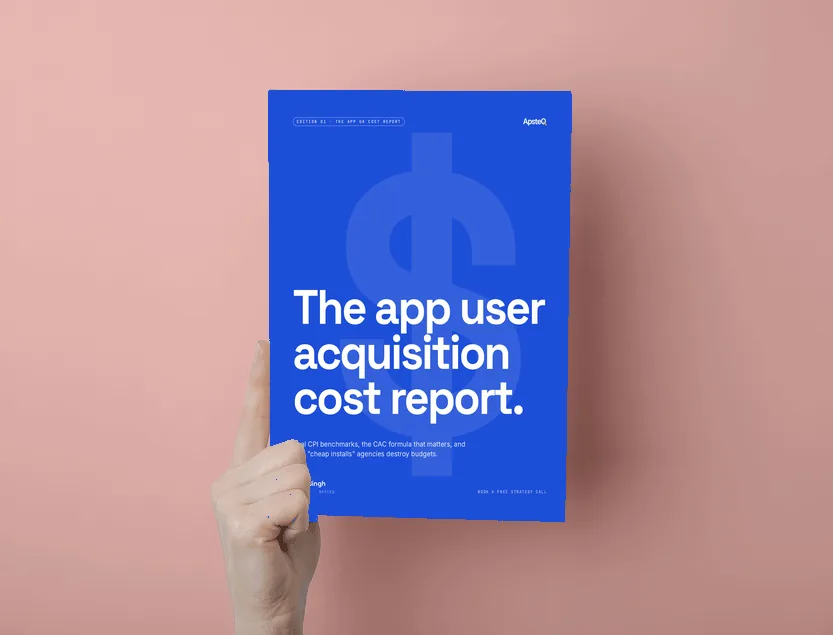
Free download
The App UA Cost Report 2026
Real cost-per-install and cost-per-trial benchmarks by channel and category, so you know what you should be paying.
Get the Free Ebook Browse all free guides