
How should mobile app companies structure their marketing strategy for maximum ROI?
Top-performing apps treat marketing as an integrated system where acquisition, ASO, retention, and reactivation work together. The top 1% of apps by revenue allocate 30-40% of their marketing budgets to retention, not acquisition. Apps using multi-channel attribution retain 2x more high-value users at the 30-day mark compared to single-channel campaigns, and organic installs convert to paying users at 3x the rate of paid installs (App Annie/data.ai 2023). ApsteQ's app marketing work across 300+ brands confirms that defining your activation event and building retention strategies before scaling paid channels consistently outperforms acquisition-only approaches.
What the Best App Marketing Case Studies Actually Teach You About Growth
Here is a number that should stop you cold: only 0.5% of consumer apps achieve mass market success after launch (Statista 2024). The gap between apps that scale and apps that stall is rarely about the product itself. It is almost always about marketing strategy, timing, and execution. If you are leading a mobile app company and wondering why your installs plateau while competitors compound, the answer is almost certainly hiding inside the case studies of brands that cracked the code before you.
For a full breakdown of the platforms worth paying for, see our guide to app marketing tools.
In this post, we break down the most instructive app marketing case studies available, extract the frameworks behind their results, and show you exactly which strategies drive sustainable growth. You will walk away with a repeatable playbook built from real data, not guesswork.
Key Takeaways Before You Read:
- Apps that invest in App Store Optimization see up to 26% higher conversion rates on product pages (Apple Developer documentation 2024).
- Paid user acquisition costs rose 40% between 2021 and 2023, making organic and owned channels critical for sustainable growth (AppsFlyer research 2023).
- Apps using multi-channel attribution models retain 2x more high-value users at the 30-day mark compared to apps running single-channel campaigns (Adjust blog 2024).
- The top 1% of apps by revenue spend 30-40% of their total budget on retention, not acquisition (Sensor Tower 2024).
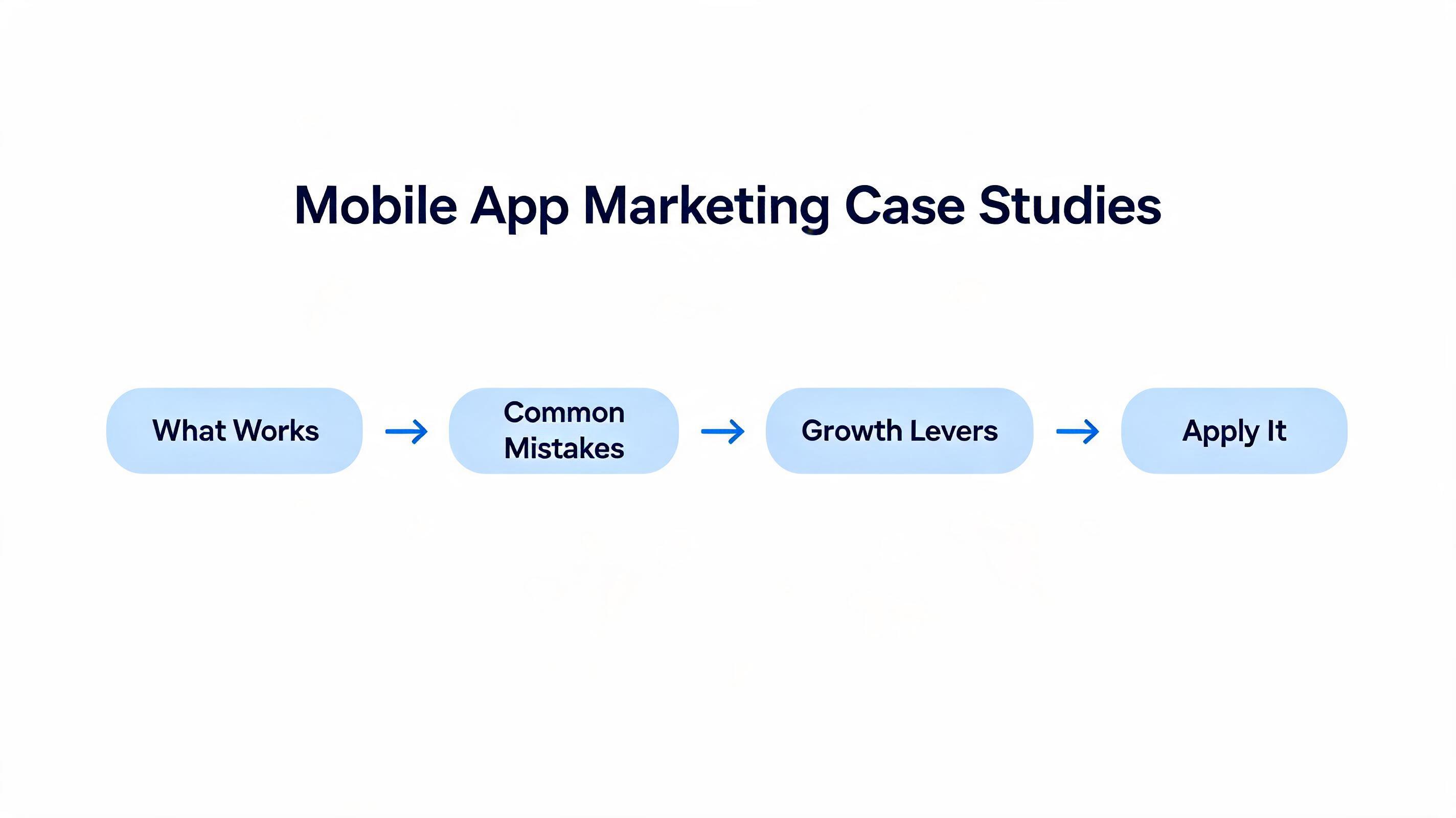
What Do the Most Successful App Marketing Case Studies Have in Common?
The most successful app marketing case studies share a single defining trait: they treated marketing as a system, not a campaign. Instead of running isolated paid ads or one-off influencer deals, these teams built integrated engines where every channel fed data back into the next decision. That structural difference separates one-hit wonders from compounding growth machines.
Take Duolingo as an instructive example. The language-learning app reached 500 million registered users largely without a traditional paid acquisition budget in its early years. Instead, the team invested heavily in viral loops, push notification psychology, and App Store Optimization. Their streak mechanic generated natural word-of-mouth, and their category ranking on the App Store became self-reinforcing. Every organic install improved ranking, which drove more organic installs.
Contrast that with apps that dump budget into Meta and Google UAC without a retention strategy. AppsFlyer research from 2023 found that apps relying on paid-only acquisition saw 60-day retention rates below 5% on average. The money goes out the door faster than it comes back. Duolingo's model, by contrast, kept 30-day retention above 25% during their high-growth phase, according to public benchmark data.
What unified the best-performing case studies across verticals, from fintech to fitness to gaming, were four shared characteristics:
- Product-led growth hooks built directly into the core user experience, not bolted on afterward.
- Data feedback loops connecting acquisition channels to downstream retention and monetization metrics.
- Category authority built through ASO, content, and press long before major paid spend.
- Segmented messaging that spoke differently to cold audiences, warm leads, and lapsed users.
The common thread is intentionality. These teams knew exactly what a "successful user" looked like at day 1, day 7, and day 30. Then they reverse-engineered their entire marketing stack to attract more of that user type. That is the foundational insight every app company needs before allocating a single dollar of budget.
How Should Mobile App Companies Structure Their Marketing Strategy for Maximum ROI?
Structuring an app marketing strategy for real ROI starts with defining your north star metric before touching any channel. Most teams make the mistake of optimizing for installs when they should be optimizing for activated users, specifically users who have completed the core action that correlates with long-term retention.
Here is a step-by-step framework drawn from the highest-performing case studies in the market today:
- Identify your activation event. For a fitness app it might be completing the first workout. For a fintech app it might be linking a bank account. Define the specific in-app action that separates churning users from retained ones, then instrument it precisely in your analytics stack.
- Build your ASO foundation first. Before spending on paid, optimize your title, subtitle, keyword field, screenshots, and preview video. This is free traffic with compounding returns. Apps that invest in ASO see conversion lifts of up to 26% on their product pages (Apple Developer documentation 2024).
- Launch paid channels with LTV-based bidding. Feed your highest-retention cohorts back into Meta's Advantage+ or Google UAC as seed audiences. This shifts optimization away from cheap installs and toward users who behave like your best customers.
- Create a content and community flywheel. TikTok, Reddit, and YouTube communities drive enormous organic installs in categories like gaming, productivity, and health. Building even one owned community channel protects you from paid cost inflation.
- Implement a reactivation sequence. Email, push, and in-app messaging should target lapsed users with personalized re-engagement offers at day 7, day 14, and day 30 post-churn.
The best app marketing programs treat these five steps as an interconnected system rather than separate workstreams. When your ASO improves quality signals, your paid campaigns perform better. When your retention improves, your word-of-mouth installs increase. Every layer compounds the one below it.
One underused tactic from top-performing case studies is "creative velocity." Teams that shipped more than 20 unique ad creatives per month consistently outperformed those running 5 or fewer, because faster creative testing shortens the feedback loop between hypothesis and learning. Speed of learning, not size of budget, is the real competitive advantage.
The Data Behind App Marketing Performance: What the Numbers Actually Say
Raw data from industry benchmarks tells a story that most app marketing teams find uncomfortable: the majority of growth spend is allocated in exactly the wrong proportion. Understanding the actual performance data across stages of the funnel is essential for making smarter investment decisions.
Consider these benchmarks drawn from verified industry sources:
- Cost per install (CPI) rose sharply across all major categories between 2022 and 2024, with gaming CPIs averaging $1.50-$4.00 on Android and $2.00-$6.00 on iOS (Adjust blog 2024).
- Day-1 retention averages 25% across all app categories, dropping to approximately 5% by day 30 (Adjust blog 2024). This means for every 100 users acquired, only 5 are still active a month later on average.
- Apps using multi-channel attribution retain 2x more high-value users at the 30-day mark compared to single-channel campaigns (Adjust blog 2024).
- The top-grossing apps on the App Store generate 95% of their revenue from 5% of their user base (Sensor Tower 2024), which underscores why segmentation and high-value user identification matter more than raw install volume.
- Organic installs convert to paying users at 3x the rate of paid installs on average, making brand-building and ASO investments highly efficient over a 12-month horizon (App Annie/data.ai 2023).
These numbers expose a critical misallocation pattern. The average mid-stage app company spends 70-80% of its marketing budget on acquisition and less than 20% on retention and reactivation. But the data says that retention is where the economic value is actually created. The top 1% of apps by revenue allocate 30-40% of their marketing budgets to retention (Sensor Tower 2024).
Rebalancing toward retention does not mean pulling back from acquisition. It means making sure that the users you acquire at significant cost actually stay, convert, and refer others. A 10% improvement in day-30 retention typically has a larger impact on LTV than a 20% reduction in CPI. That is the core insight the data keeps confirming across every vertical.
What Are the Most Common App Marketing Mistakes That Derail Growth?
The most common app marketing mistake is optimizing for vanity metrics instead of value metrics. Install counts, download rankings, and social impressions feel good and look impressive in board decks, but they rarely correlate with revenue or sustainable growth. Teams that fall into the vanity metric trap usually discover the problem too late, after burning through their runway chasing numbers that do not move the business forward.
Here are the five most damaging mistakes identified across real-world case studies:
- Ignoring the activation gap. Many apps see strong install numbers but terrible conversion to core actions. This usually signals a mismatch between ad creative and onboarding experience. Users arrive expecting one thing and get another. The fix is tightening the message match between ad creative and first-time user experience.
- Scaling paid before validating retention. Pouring budget into user acquisition before achieving a sustainable day-30 retention rate is the most expensive mistake in app marketing. You are essentially paying to fill a leaky bucket. Validate retention with organic users first, then scale paid.
- Running one creative until it dies. Ad fatigue is real and fast. Creative refresh cycles on Meta can drop as short as 7-14 days during periods of heavy spend. Teams that do not have a systematic creative production process constantly find themselves behind, reacting to performance drops instead of preventing them.
- Treating ASO as a one-time setup task. The App Store algorithm and user search behavior evolve constantly. Apps that optimize their metadata once at launch and never revisit it leave substantial organic traffic on the table. Monthly ASO audits are a minimum standard.
- Failing to segment reactivation campaigns. Sending the same push notification to a user who churned at day 2 versus a user who was active for 60 days before churning is a massive missed opportunity. These users need completely different messaging, offers, and timing.
A particularly instructive cautionary case is the class of gaming apps that spent aggressively on influencer marketing without tracking downstream retention. Several mid-sized studios reported strong install spikes from influencer campaigns followed immediately by day-7 retention below 3%, essentially the worst of both worlds: high spend, low-quality users.
The lesson is attribution discipline. Every channel you invest in must be connected to downstream value metrics. Explore how strategic app marketing frameworks can help you build that discipline into your team's operating rhythm before costly mistakes accumulate.
What Will App Marketing Look Like in 2026 and 2027?
App marketing in 2026 and 2027 will be defined by three converging forces: AI-driven creative personalization, the maturation of privacy-first attribution, and the rise of alternative distribution channels beyond the duopoly of Apple and Google.
AI creative tools are already reshaping production pipelines. Teams that once needed 3-4 weeks to produce a new creative batch can now iterate daily. This democratizes creative testing for smaller teams and raises the stakes for everyone, because the average quality of ad creative in the market will rise, meaning differentiation becomes harder and more important simultaneously.
Privacy changes continue to reshape attribution. Apple's App Tracking Transparency framework has already forced the industry toward probabilistic and modeled measurement. By 2026, an estimated 80% of app marketing decisions will rely on modeled or privacy-safe data rather than deterministic user-level tracking (AppsFlyer research 2023). Teams that invest now in first-party data strategies, SKAdNetwork optimization, and incrementality testing will have a significant structural advantage over those still dependent on device-level data.
Alternative app distribution is gaining real momentum. Progressive Web Apps, third-party Android stores in emerging markets, and regulatory pressure on Apple in the EU are opening new distribution surfaces. Forward-thinking app marketers are already experimenting with these channels to diversify install sources and reduce dependence on platform algorithm changes.
The teams that will win in 2026 and 2027 are not those with the biggest budgets. They are those with the fastest learning cycles, the deepest first-party data assets, and the clearest understanding of what makes their specific user valuable. Case studies from the next two years will almost certainly reward discipline over scale.
What Should You Look for in an App Marketing Case Study?
A case study is only useful if it names the baseline. "300% increase in installs" means nothing without knowing whether that was 100 installs to 400, or 100,000 to 400,000, and over what period, at what spend. Four questions expose whether a case study is evidence or marketing:
| Question | Good answer | Red flag |
|---|---|---|
| What was the starting point? | Absolute numbers, not just percentages | Percentage lift only |
| Over what period? | A stated window with a fixed attribution model | "Rapidly" or no timeframe |
| At what spend? | Budget disclosed or at least a range | Results with no cost context |
| What was the retention? | Day-7 / day-30 cohort alongside installs | Installs only |
That last row matters most. Installs without retention is the easiest number in mobile to inflate, and buying incentivised installs actively harms organic store ranking because both stores weight engagement.
The Benchmarks Case Studies Should Be Measured Against
Without a market baseline, any result can be framed as a win. Apple Ads cost per tap runs from $0.24 (Religion) to $14.41 (Sports), with a global median of $0.92 and a top-15-category average of $2.25, per AppTweak, Adapty across 90 countries, and Business of Apps. A "low CPI" claim in hyper-casual games and the same claim in fintech are not comparable achievements.
If you want work judged against those baselines rather than against a flattering internal comparison, that is how our app marketing agency engagement reports, and we compare ourselves openly to other agencies in best app marketing agencies.
Frequently Asked Questions
What is an app marketing case study and why does it matter for growth?
An app marketing case study documents the specific strategies, channels, and decisions a mobile app team used to achieve measurable growth. They matter because they compress years of experimentation into actionable frameworks. The best case studies include specific metrics like CPI, day-30 retention, and LTV, giving other teams a benchmark to measure against and patterns to replicate.
How much should a mobile app company budget for user acquisition versus retention?
Top-performing apps allocate 60-70% of their marketing budget to acquisition and 30-40% to retention and reactivation, according to Sensor Tower 2024 benchmark data. Most mid-stage companies do the opposite, spending over 80% on acquisition. Rebalancing toward retention typically produces a stronger impact on LTV than reducing CPI alone, especially after day-30 retention is above 15%.
Which channels produce the highest quality users in app marketing?
Organic installs driven by App Store Optimization and word-of-mouth consistently convert to paying users at 3x the rate of paid installs (App Annie/data.ai 2023). Among paid channels, Meta Advantage+ with LTV-based seed audiences and Apple Search Ads typically deliver the highest post-install quality. Content marketing and community channels produce slower volume but significantly better long-term retention curves.
How do I measure the success of an app marketing campaign accurately?
Measure success by tracking a cascade of metrics: installs, activation rate (users completing your core action), day-7 and day-30 retention, average revenue per user, and LTV-to-CAC ratio. A healthy LTV-to-CAC ratio is generally 3:1 or higher. Use multi-touch attribution tools and complement them with incrementality testing to understand true channel contribution beyond last-click models.
How can a professional app marketing agency accelerate results compared to in-house teams?
A specialized agency brings cross-vertical benchmark data, creative production infrastructure, and platform relationships that take in-house teams years to build independently. Explore how ApsteQ's app marketing services combine data-driven strategy with hands-on execution to compress your timeline from hypothesis to scalable growth, typically reducing time-to-profitability by 30-50% compared to fully in-house approaches.
What You Should Do Next
The evidence from the best app marketing case studies is consistent and clear. Sustainable growth comes from systems, not campaigns. The teams winning in 2024 and beyond share the same habits: they define value metrics before spending a dollar, they invest in ASO before scaling paid, they treat retention as a first-class priority alongside acquisition, and they build learning velocity into their creative and attribution processes.
Here is what to take into your next planning session:
- Identify your activation event and instrument it precisely before scaling any channel.
- Rebalance your budget so that at least 30% targets retention and reactivation, not just new installs.
- Audit your ASO monthly, not just at launch.
- Build a creative testing cadence that ships at least 15 new concepts per month.
- Move from install-count metrics to LTV-to-CAC ratio as your primary north star.
If you want a team that has already built this playbook across dozens of apps and can apply it to your specific growth challenge, the next step is a direct conversation. Book a free strategy call with the ApsteQ team today and get a customized growth audit based on your current metrics, channels, and competitive landscape.
Free download
7 Expensive Mistakes That Kill App Launches
The launch errors we see most often across 300+ app engagements, and what to do instead.
Get the Free Ebook Browse all free guides