
Mobile app downloads reached 257 billion in 2023, yet 95% of mobile apps fail within their first year (Adjust, 2024), according to Gartner Research. The difference between success and failure often comes down to one critical factor: understanding and optimizing the right metrics. Most app developers track vanity metrics like downloads while missing the performance indicators that actually drive revenue and long-term growth.
App marketing metrics serve as the compass for your mobile strategy, revealing user behavior patterns, monetization opportunities, and growth bottlenecks that aren't visible on the surface. Without proper measurement frameworks, you're essentially flying blind in a competitive landscape where user acquisition costs have increased by 60% since 2020 (AppsFlyer, 2024), according to AppsFlyer.
This comprehensive guide will teach you how to identify, track, and optimize the app marketing metrics that matter most. You'll discover which KPIs predict long-term success, how to build measurement frameworks that drive actionable insights, and proven strategies for improving your most critical performance indicators.
Key Takeaways:
- User retention rates drop to just 25% after 90 days (AppsFlyer, 2024) for the average mobile app
- Apps with strong onboarding see 50% higher lifetime value (AppsFlyer, 2024) compared to those with poor first-time user experiences
- Cost per acquisition has risen 38% year-over-year (Liftoff, 2024) across all app categories, making efficiency metrics crucial
- Apps that track cohort-based metrics show 23% better revenue performance (AppsFlyer, 2024) than those using traditional analytics
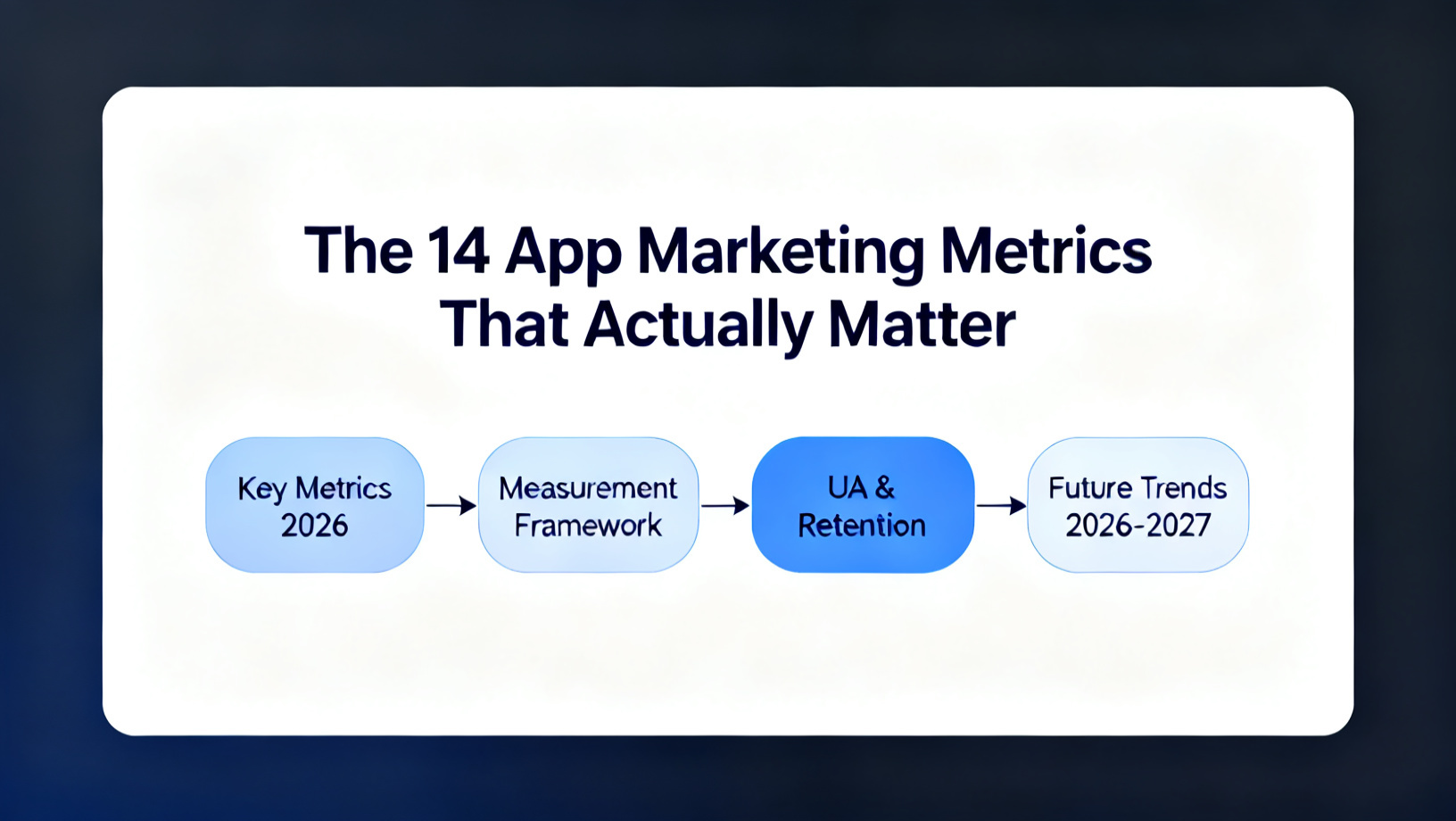
Why do 95% of mobile apps fail in their first year?
Mobile app downloads reached 257 billion in 2023, yet 95% of mobile apps fail within their first year (Adjust, 2024). Failure typically results from tracking vanity metrics (downloads, rankings) instead of value metrics (activation rate, retention, LTV). The metrics that predict success are day-1 activation (% of installs reaching your core action), day-7 and day-30 retention cohorts, and LTV-to-CAC ratio. Teams that establish these benchmarks before scaling paid acquisition consistently outperform those optimizing for volume.
What Are the Most Important App Marketing Metrics to Track in 2026?
The most critical app marketing metrics fall into four categories: acquisition, engagement, retention, and monetization. User retention emerges as the single most predictive metric (AppsFlyer, 2024), with Day 1 retention rates above 25% correlating strongly with long-term app success. Apps achieving 40% Day 1 retention typically see 10x higher lifetime values compared to those below 20% (AppsFlyer, 2024).
| Metric | Strong Performance | Average | Below Average |
| Day 1 Retention | 40%+ | 25-35% | <20% |
| Day 7 Retention | 25%+ | 12-18% | <8% |
| Day 30 Retention | 10%+ | 5-7% | <3% |
| DAU/MAU Ratio | 25%+ | 12-18% | <8% |
| Avg Session Length | 5+ minutes | 2-4 minutes | <1 minute |
| Session Frequency | 3+ sessions/day | 1-2 sessions/day | <1 session/day |
Customer Acquisition Cost (CAC) represents your second most vital metric, especially as paid acquisition channels become increasingly expensive. The average CAC across all app categories reached $29.40 in 2023 (Singular, 2024), up from $18.50 in 2020. However, CAC alone tells an incomplete story without corresponding Customer Lifetime Value (CLV) measurements.
Monthly Active Users (MAU) and Daily Active Users (DAU) provide engagement baselines, but the DAU/MAU ratio offers deeper insights into user stickiness. High-performing apps maintain DAU/MAU ratios above 20%, indicating users engage with the app frequently rather than sporadically. Gaming apps typically achieve 25-30% ratios, while utility apps often struggle to exceed 15%.
Session duration and frequency metrics reveal how deeply users engage with your app's core value proposition. Consumer apps averaging over 5 minutes per session and 3+ sessions per day demonstrate strong product-market fit. However, these benchmarks vary significantly by category, with social apps expecting longer sessions while productivity apps may optimize for quick, frequent interactions.
Revenue-focused metrics include Average Revenue Per User (ARPU), conversion rates for in-app purchases, and subscription retention rates. Successful freemium apps typically convert 2-5% of users to paid tiers, while premium apps must justify higher price points with exceptional user experiences and clear value delivery.
How Do You Build an Effective App Marketing Measurement Framework?
Building an effective measurement framework starts with defining your app's primary business objective and working backward to identify supporting metrics. Start by establishing your North Star Metric, the single KPI that best represents user value and business growth. For subscription apps, this might be Monthly Recurring Revenue (MRR), while gaming apps might focus on Daily Active Users or session frequency.
Implement a three-tier metric hierarchy: primary metrics that directly impact business goals, secondary metrics that influence primary ones, and diagnostic metrics that explain performance changes. Your primary tier should contain no more than 3-5 KPIs to maintain focus and actionability. Secondary metrics provide context, while diagnostic metrics help identify root causes when performance shifts.
Cohort analysis forms the backbone of sophisticated app measurement, grouping users by shared characteristics or acquisition dates to track behavior patterns over time. This approach reveals whether improvements in Day 1 retention translate to better 30-day retention, or if certain user segments demonstrate higher lifetime values. Our app marketing specialists recommend tracking at least three cohort dimensions: acquisition channel, user demographics, and behavioral segments.
Attribution modeling becomes critical when running multi-channel campaigns across search, social, programmatic, and influencer platforms. Implement view-through attribution alongside last-click models to understand the full customer journey. Mobile Measurement Partners (MMPs) like AppsFlyer or Adjust provide unified attribution across channels, though proper implementation requires careful parameter setup and fraud prevention measures.
Real-time dashboards should highlight metric trends rather than absolute numbers, using week-over-week or month-over-month comparisons to account for natural usage patterns. Mobile app usage typically peaks on weekends for entertainment apps while business productivity apps see weekday spikes. Your measurement framework must account for these patterns to avoid false alarms from normal cyclical behavior.
Understanding User Acquisition and Retention Metrics That Drive Growth
User acquisition metrics extend far beyond simple install counts to encompass quality, cost efficiency, and long-term value prediction. Install-to-registration conversion rates typically range from 60-80% for well-optimized apps, while registration-to-first-action rates vary dramatically by category and onboarding quality.
Cost Per Install (CPI) averages have reached critical thresholds across major markets:
- iOS CPI in the US: $3.20 for casual games, $4.80 for utility apps
- Android CPI globally: 40% lower than iOS but with reduced user lifetime values
- Organic vs. paid ratios: Top apps achieve 70% organic installs through App Store Optimization
- Channel performance: Facebook and Google maintain 65% market share despite rising costs
Retention curves reveal user behavior patterns that predict long-term success. The typical retention curve shows steep dropoffs: 77% of users abandon apps within 3 days (Adjust, 2024). However, users who remain active for 7 days show 60% probability of 30-day retention, while those reaching 30 days demonstrate 80% likelihood of 90-day engagement.
Advanced retention analysis examines behavioral cohorts rather than simple time-based groups. Users who complete onboarding tutorials show 3x higher 7-day retention rates compared to those who skip introductory content. Similarly, users who engage with core features within 24 hours of installation demonstrate 5x higher lifetime values than passive consumers.
Churn prediction models help identify at-risk users before they become inactive. Machine learning algorithms analyze usage patterns, feature engagement, and session frequency to assign churn probability scores. Apps implementing proactive retention campaigns based on churn predictions see 15-25% improvements in 30-day retention rates (AppsFlyer, 2024).
What Are the Most Common App Marketing Metric Mistakes That Hurt Performance?
The most damaging mistake involves focusing on vanity metrics like total downloads or social media followers while ignoring revenue-generating activities. Download counts correlate weakly with business success (Adjust, 2024), as evidenced by countless apps with millions of installs but minimal revenue generation. Smart app marketers prioritize active user metrics, conversion rates, and customer lifetime value over pure volume indicators.
Attribution confusion represents another critical error, particularly when tracking users across multiple touchpoints before conversion. Many marketers credit the last-click channel while ignoring earlier influences, leading to budget misallocation toward bottom-funnel activities. Facebook might receive conversion credit while Google search ads or influencer content drove initial awareness and consideration.
Benchmark obsession causes teams to chase industry averages rather than optimizing for their specific user base and business model. A meditation app shouldn't worry about matching gaming app session durations, just as enterprise software shouldn't expect consumer app retention curves. Focus on improving your own performance metrics rather than matching arbitrary industry standards that may not reflect your unique value proposition.
Seasonal blindness affects metric interpretation when teams fail to account for natural usage cycles. Education apps see predictable spikes during back-to-school periods, while fitness apps surge in January due to New Year's resolutions. Without accounting for these patterns, teams might over-invest in acquisition during natural growth periods or panic during predictable seasonal declines.
Data lag misunderstanding leads to premature optimization decisions based on incomplete information. User lifetime value calculations require 60-90 days of behavioral data, while retention trends need minimum 30-day observation periods. Teams making daily optimization decisions based on incomplete datasets often destroy long-term performance for short-term metric improvements. Professional app marketing services implement proper measurement frameworks that account for data maturation timelines and statistical significance requirements.
The Future of App Marketing Metrics: What to Expect in 2026-2027
Privacy-first measurement will dominate app marketing analytics as iOS App Tracking Transparency and Android Privacy Sandbox reshape data collection practices. First-party data strategies will become essential (AppsFlyer, 2025) for maintaining measurement accuracy, with successful apps building direct relationships through email capture, account creation, and loyalty programs rather than relying on third-party tracking pixels.
Predictive analytics powered by machine learning will shift focus from historical reporting to forward-looking insights. Advanced algorithms will predict user lifetime value within 72 hours of installation, enabling real-time bid optimization and personalized onboarding experiences. Apps implementing predictive models show 35% better return on ad spend compared to reactive measurement approaches (AppsFlyer, 2025).
Cross-platform measurement will expand beyond mobile apps to encompass web, connected TV, and emerging platforms like augmented reality. Unified customer identity graphs will track user journeys across devices and channels, providing holistic attribution models that account for the complexity of modern digital experiences.
Real-time personalization metrics will emerge as competitive differentiators, measuring how effectively apps adapt content and experiences to individual user preferences. Success metrics will include personalization lift rates, dynamic content engagement, and AI-driven recommendation accuracy. Apps achieving high personalization scores typically see 40% higher engagement rates and 25% improved retention compared to static experiences (AppsFlyer, 2025).
Sustainability and user wellbeing metrics may become regulatory requirements as governments scrutinize app addiction and digital wellness concerns. Future measurement frameworks might include session limits, healthy usage patterns, and user satisfaction surveys as mandatory reporting elements alongside traditional business KPIs.
Frequently Asked Questions
What is the average customer lifetime value for mobile apps?
Customer lifetime value varies dramatically by app category and monetization model. Gaming apps average $15-25 CLV, while productivity apps range from $30-50. Subscription-based apps typically achieve higher CLVs, with meditation and fitness apps reaching $60-100 per user over 12-month periods.
How long should you wait before measuring app marketing campaign success?
Most meaningful metrics require 30-90 days for accurate assessment. While initial engagement metrics appear within 24-48 hours, user retention patterns and lifetime value calculations need extended observation periods. Avoid making major campaign adjustments based on less than two weeks of performance data.
Which app marketing metrics predict long-term revenue growth?
Day 7 and Day 30 retention rates serve as the strongest predictors of long-term revenue potential. Apps maintaining above 20% Day 30 retention typically generate 5x higher annual revenue per user compared to those below 10% (AppsFlyer, 2024). Professional app marketing strategies focus heavily on improving these critical retention windows.
How do you calculate return on ad spend for app marketing campaigns?
ROAS equals total revenue generated divided by advertising spend within a specific timeframe. However, accurate app ROAS calculations must account for user lifetime value rather than immediate conversion revenue. Include in-app purchases, subscription revenue, and advertising income over 6-12 month periods for realistic performance assessment.
Conclusion
Mastering app marketing metrics requires moving beyond vanity metrics toward actionable KPIs that drive real business growth. Focus on retention rates, customer lifetime value, and acquisition efficiency while building measurement frameworks that account for your specific user base and business model.
Key implementation priorities include:
- Establishing cohort-based analytics for deeper user behavior insights
- Implementing predictive models for proactive user engagement
- Building attribution frameworks that capture multi-touchpoint customer journeys
- Creating real-time dashboards focused on trends rather than absolute numbers
The app marketing landscape continues evolving rapidly, with privacy changes and emerging technologies reshaping measurement approaches. Stay ahead of these shifts by partnering with experts who understand both current best practices and future requirements. Book a strategy call today to discuss how ApsteQ can help optimize your app marketing metrics and drive sustainable growth in 2024 and beyond.

Free download
7 Expensive Mistakes That Kill App Launches
The launch errors we see most often across 300+ app engagements, and what to do instead.
Get the Free Ebook Browse all free guides