Most Apps Fail Before They Ever Launch. Here's How to Fix That.
Over 65% of apps downloaded are abandoned after just one use, and many never recover from a weak launch (Statista 2024). The problem is rarely the product itself. Most mobile app companies pour months into development, then treat launch day as a surprise party, hoping users will somehow show up. They do not. Without a structured pre-launch strategy, you are essentially dropping your app into a 5-million-app ocean and hoping it floats.
In this guide, you will learn exactly how to build an app pre-launch strategy that generates real installs, earns early reviews, and positions your product for algorithmic visibility from day one. We cover audience building, beta testing frameworks, ASO groundwork, paid acquisition timing, and the most common mistakes that cost companies thousands in wasted spend.
Key Takeaways Before You Read On:
- Apps that invest in pre-launch marketing see up to 3x higher day-7 retention rates compared to those that skip it (AppsFlyer Research 2024).
- The average cost-per-install for US app campaigns runs $3.50 to $5.00 for iOS and $1.50 to $3.00 for Android (Adjust Blog 2024).
- Apps with at least 50 ratings in their first 30 days rank significantly higher in App Store search results (Sensor Tower 2024).
- Pre-registration campaigns on Google Play can capture 20-40% conversion lifts on launch day installs (Google Play Console Docs 2024).
What Exactly Is an App Pre-Launch Strategy, and Why Does It Determine Your Survival?
An app pre-launch strategy is the structured set of activities you execute in the 60 to 90 days before your app goes live. It determines whether launch day generates momentum or silence. Most teams treat it as optional. It is not optional. It is the difference between ranking on page one and being permanently invisible.
The core components are audience development, App Store Optimization groundwork, beta testing, press outreach, and paid media warm-up. Each one serves a distinct purpose. Audience development means you have real humans waiting to download on day one. ASO groundwork means the algorithm already understands what your app does. Beta testing means you ship a stable product with social proof attached. Press outreach means there are third-party voices amplifying your message. Paid media warm-up means your creative assets are tested before budget scales.
The data here is striking. Apps that invest in pre-launch marketing see up to 3x higher day-7 retention rates compared to those that do not (AppsFlyer Research 2024). That retention advantage compounds. Higher retention improves your App Store ranking, which lowers your cost-per-install, which makes paid campaigns more efficient. The entire funnel improves downstream because of what you did upstream.
Consider a real-world example. Duolingo, now the world's most downloaded education app, did not simply submit to the App Store and wait. Before its public launch, the team ran an extended beta with hundreds of thousands of users via a simple landing page. That beta gave them a baseline of engagement data, a pool of reviewers, and media stories to pitch. The result was a ranked position from day one, not month six.
Even for smaller app companies without Duolingo's resources, the principles hold. A 60-day pre-launch sprint with a modest $5,000 budget can generate a waitlist of 2,000 to 5,000 qualified users, enough to seed your ratings, stress-test your onboarding, and give algorithm signals that your app deserves organic exposure.
The deeper problem is that most mobile app companies confuse development milestones with go-to-market milestones. Finishing the code is not the same as being ready to launch. Pre-launch is its own product phase, and it deserves its own timeline, budget, and dedicated team ownership.
How Do You Build a 90-Day App Pre-Launch Strategy Step by Step?
A 90-day pre-launch strategy works in three phases: foundation (days 1 to 30), audience building (days 31 to 60), and activation (days 61 to 90). Each phase has specific deliverables. Skip a phase and the others underperform.
Phase 1: Foundation (Days 1 to 30)
Start with your App Store listing before the app is even approved. Write your title, subtitle, and keyword field using tools like Mobile Action or Sensor Tower's keyword research. Your primary keyword cluster should target phrases with high search volume and moderate difficulty. Lock in your screenshots and preview video. These assets take longer than most teams expect, and poor visuals directly reduce conversion on your store page.
Build a pre-launch landing page with a clear value proposition, a single call to action (email capture or pre-registration), and basic tracking via a UTM-structured URL. Keep it simple. One headline, three benefit bullets, and one button. Tools like Unbounce or even a Webflow template work well here.
Phase 2: Audience Building (Days 31 to 60)
This is where most of your marketing spend belongs. Run low-budget social ads ($500 to $1,500) on Meta and TikTok to drive email signups. Use TestFlight for iOS beta and Google Play's Open Testing for Android. Recruit beta users from your email list, Reddit communities, and niche Facebook groups. Aim for at least 200 active beta testers. Their feedback will catch onboarding friction before it costs you ratings.
Simultaneously, begin outreach to app review blogs, tech journalists, and relevant podcasts. Personalize every pitch. Journalists receive hundreds of generic press releases. A 3-sentence personalized pitch with a demo link converts far better.
Phase 3: Activation (Days 61 to 90)
Scale your email list promotion. Send a launch countdown sequence (7 days, 3 days, 1 day, launch day) with incentives for early reviewers. Set up Google Play pre-registration, which triggers automatic installs on launch day for everyone who registers. Coordinate your press coverage so articles drop on launch day or within 48 hours.
For a deeper breakdown of paid acquisition timing and channel strategy, explore how our team structures go-to-market campaigns through our app marketing services. The paid activation layer during pre-launch is where many companies leave significant install volume on the table.
Pre-Launch Benchmarks Every App Company Should Know Before Setting Budgets
Setting a pre-launch budget without benchmarks is guessing. Guessing with marketing budget is expensive. The data below gives you realistic targets for US market campaigns across the most common app categories.
First, understand where installs come from during launch windows. Organic search accounts for approximately 65% of all App Store discoveries (Sensor Tower 2024). That means ASO is not a secondary concern. It is the highest-leverage pre-launch investment you can make. Every dollar spent on keyword research and screenshot optimization pays dividends for months.
Second, know your category benchmarks for cost-per-install. The average CPI for US iOS campaigns ranges from $3.50 to $5.00, while Android CPIs run lower at $1.50 to $3.00 (Adjust Blog 2024). But CPIs alone do not tell the full story. A $4.50 install that retains for 30 days is worth dramatically more than a $1.80 install that churns on day two.
Third, pre-registration on Google Play is underused. Campaigns using pre-registration see 20 to 40% higher day-one conversion rates (Google Play Console Docs 2024), because users have already expressed intent before the app ships.
Key pre-launch performance benchmarks to track:
- Email list size: Target 1,000+ subscribers before launch for a consumer app, 300+ for a B2B tool.
- Beta tester reviews: Aim for 50 to 100 ratings in the first 7 days post-launch.
- Day-1 install velocity: 500+ installs in the first 24 hours signals algorithmic traction.
- Press mentions: 3 to 5 earned media placements on launch week amplify organic discovery.
- Landing page conversion rate: A well-optimized pre-launch page should convert at 25 to 40% of visitors to email signups.
| App Category | Avg. iOS CPI (USD) | Avg. Android CPI (USD) | Target D7 Retention (%) |
|---|---|---|---|
| Gaming | $4.20 | $1.80 | 20-25% |
| Health and Fitness | $4.80 | $2.50 | 30-35% |
| Finance and FinTech | $6.50 | $3.20 | 35-40% |
| Productivity | $3.90 | $2.10 | 28-33% |
| Social Networking | $5.10 | $2.80 | 25-30% |
Use these benchmarks to pressure-test your pre-launch budget. If your category CPI is $4.80 and you want 1,000 installs in week one, plan for at least $5,000 in paid spend, plus additional budget for creative production and platform fees.
What Are the Most Expensive Pre-Launch Mistakes App Companies Make?
The most expensive pre-launch mistakes are not about spending too much. They are about spending in the wrong order, skipping foundational steps, and launching before the product is actually ready for public scrutiny. These errors cost companies not just money, but reviews they cannot recover from.
Mistake 1: Launching Without a Ratings Strategy
The App Store and Google Play both use early rating velocity as a ranking signal. Companies that launch without a plan to generate their first 50 ratings often find themselves invisible in search. The fix is simple: build a structured in-app review prompt using Apple's SKStoreReviewAPI or Google's in-app review API, trigger it after a user completes a meaningful action (not on first open), and supplement with direct outreach to your beta tester list asking for honest reviews.
Mistake 2: Spending on Ads Before the Store Page Converts
This is one of the most common and costly errors. Teams allocate $10,000 to $20,000 in paid campaigns, drive traffic to an App Store listing with generic screenshots and a weak description, and wonder why their CPI is double the benchmark. Paid spend should never scale until your store page conversion rate is measured and optimized. Use Apple's Product Page Optimization tool or Google Play's Store Listing Experiments to A/B test before you scale.
Mistake 3: Ignoring Platform-Specific Requirements
iOS and Android are different markets with different user expectations, review timelines, and algorithm mechanics. Apple's review process averages 1 to 2 days but can spike to a week during high-volume periods. Google Play's review can take 3 to 7 days for new apps. Teams that submit on their target launch date, rather than 10 to 14 days before, frequently miss their own launch windows. Build that buffer in.
Mistake 4: No Post-Launch Plan Beyond Day One
Pre-launch strategy should not end the moment the app goes live. The first 30 days post-launch are algorithmically critical. You need a content cadence, a push notification strategy, an update schedule, and a paid media plan ready to execute on day two, not day thirty. Many app companies exhaust their energy on launch day and go quiet during the exact window that determines long-term ranking.
Our team has helped multiple companies course-correct after weak launches. The patterns repeat constantly. If you are building a go-to-market plan and want an expert review, learn more about our approach through ApsteQ's app marketing programs, which include pre-launch audit services.
What Will App Pre-Launch Strategy Look Like in 2026 and 2027?
The pre-launch playbook is evolving faster than most app companies realize. Three forces are reshaping it: AI-powered creative testing, platform-native discovery features, and the rising cost of paid acquisition in saturated categories.
By 2026, AI creative tools will be standard in pre-launch workflows. Teams are already using tools like Meta's Advantage+ and Google's Performance Max to auto-generate and test ad variants at scale. This shifts the competitive advantage from creative production speed to creative strategy, the ability to brief AI tools with the right positioning, audience signals, and brand constraints.
App Store search is also changing. Both Apple and Google are expanding their AI-powered recommendation surfaces, similar to how TikTok's For You Page distributes content based on behavior rather than search intent. Apps with strong early engagement signals will surface algorithmically even without explicit keyword searches. This makes in-app behavior optimization a pre-launch priority, not just a post-launch one.
On the paid side, CPIs are projected to continue rising in high-competition verticals. Global mobile advertising spend is expected to exceed $400 billion by 2027 (Statista 2024), which means more dollars chasing the same install inventory. Companies that build owned audiences (email lists, social communities, content channels) before launch will face a structural cost advantage over those who rely entirely on paid acquisition.
The companies winning in 2026 and 2027 will treat pre-launch as a product discipline, not a marketing afterthought. They will instrument their beta environments the same way they instrument production. They will treat waitlist subscribers as early customers, not just leads. And they will use the 90 days before launch to build the kind of algorithmic trust that sustains visibility long after the launch-week noise fades.
Frequently Asked Questions
How long should an app pre-launch strategy take?
A minimum viable pre-launch strategy requires 60 days. 90 days is the industry standard for consumer apps targeting competitive US markets. Anything shorter limits your ability to build a meaningful beta tester pool, complete App Store Optimization research, and generate earned media before launch day. Enterprise or B2B apps may require up to 6 months given longer sales cycles.
How much should a mobile app company budget for pre-launch marketing?
A realistic pre-launch budget for a US consumer app ranges from $10,000 to $30,000, depending on category competitiveness. Roughly 40% should go toward paid social for audience building, 30% toward creative production, 20% toward ASO tools and research, and 10% toward PR outreach. Tighter budgets should prioritize ASO and email capture over paid ads.
What is the most important pre-launch metric to track?
Email list conversion rate on your pre-launch landing page is the single most important early signal. A well-optimized page should convert at 25 to 40%. If you are below 15%, your value proposition or audience targeting needs adjustment before you invest in driving more traffic. This metric predicts install intent better than social follower counts or ad impressions.
Should I use Google Play pre-registration for my Android launch?
Yes, always. Google Play pre-registration is a free tool that allows users to opt in before your app is live, triggering automatic installs on launch day. Campaigns using pre-registration see 20 to 40% higher day-one conversion rates (Google Play Console Docs 2024). It also signals category intent to the Play algorithm, which can boost early organic ranking in search results.
How does an app marketing agency help with pre-launch strategy?
A specialized agency brings benchmarked data, tested frameworks, and platform relationships that in-house teams typically lack. At ApsteQ, our app marketing team handles ASO audits, beta recruitment, paid media warm-up, and press coordination as an integrated pre-launch sprint. Companies working with a specialized partner typically launch with 3 to 5 times more day-one installs than solo launches.
Final Thoughts: Pre-Launch Is Where App Success Is Won or Lost
The evidence is consistent and clear. Apps that invest in structured pre-launch strategy outperform those that skip it on every metric that matters, from retention rates to organic ranking to long-term revenue. The tactics are not complicated. They require discipline, lead time, and a willingness to treat marketing as seriously as engineering.
Before your next launch, make sure you have covered these fundamentals:
- ASO keyword research and store page optimization completed at least 30 days before launch.
- A pre-launch landing page capturing emails with a target of 1,000+ subscribers.
- A beta testing cohort of at least 200 active users providing feedback and early reviews.
- Google Play pre-registration active and promoted for at least 4 weeks.
- A press outreach list with personalized pitches sent 2 to 3 weeks before launch.
- Paid media creative tested at low budget before scaling on launch week.
If you want an expert team to build and execute this plan alongside you, book a free strategy call with the ApsteQ app marketing team. We will audit your current pre-launch setup, identify the gaps, and build a 90-day roadmap tailored to your app, category, and budget.
Free download
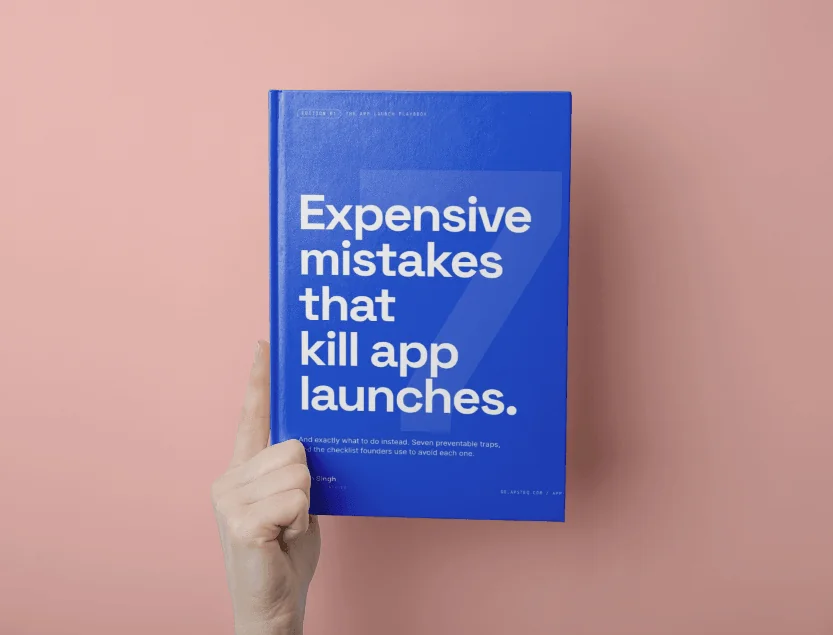
7 Expensive Mistakes That Kill App Launches
The launch errors we see most often across 300+ app engagements, and what to do instead.
Get the Free Ebook Browse all free guides