Why Most Apps Never Get Discovered: The App Store Optimization Crisis
Here is a number that should stop every mobile app company in its tracks: 65% of all app downloads begin with a direct App Store search (Apple Developer documentation, 2023). Yet the majority of apps launched each year receive fewer than 1,000 downloads in their lifetime. The gap between visibility and obscurity comes down to one discipline most teams still treat as an afterthought: App Store Optimization.
ASO is not a one-time checkbox. It is an ongoing, data-driven practice that determines whether your app surfaces when users search, whether your icon earns a tap, and whether your listing converts browsers into loyal users. In this guide, you will learn the core strategies that move the needle in 2025, the benchmarks that separate top-performing apps from the rest, the mistakes that quietly kill organic growth, and the emerging trends reshaping how stores rank and recommend apps.
Key Takeaways
- 65% of downloads start with App Store search, making keyword optimization your highest-leverage acquisition channel (Apple Developer documentation, 2023).
- Apps with optimized screenshots and preview videos see conversion rate lifts of 25-35% on their store listing pages (Sensor Tower, 2024).
- The average top-ranking app targets between 100 and 200 keyword variants across title, subtitle, and keyword fields (Mobile Action, 2024).
- A/B testing your store listing can reduce cost-per-install by up to 40% when run continuously over 90 days (AppsFlyer research, 2023).
What Is App Store Optimization and Why Does It Directly Drive Revenue?
App Store Optimization is the practice of improving every element of your app's store listing to increase organic visibility and convert more impressions into installs. Think of it as SEO for the App Store and Google Play, except the stakes are higher because you are competing in a marketplace with over 5 million combined listings.
The mechanics work on two levels. First, discoverability: the algorithms at Apple and Google evaluate your metadata, including your title, subtitle, keyword fields, and the text within your description, to determine which searches your app should surface for. Second, conversion: once a user lands on your listing, your icon, screenshots, preview video, ratings, and review sentiment determine whether they install or bounce.
Both layers compound each other. A well-ranked app that fails to convert wastes impression potential. A beautifully designed listing buried on page four of search results generates no traffic at all. The top three organic search results on the App Store capture roughly 60% of all clicks for that query (Sensor Tower, 2024), which means ranking improvements translate almost directly into download volume.
Consider the real-world example of a mid-sized fitness app that invested eight weeks in a structured ASO overhaul. The team rewrote the title to include its highest-volume keyword, refreshed all screenshots with clear benefit-focused captions, and responded to every review from the previous 90 days. Within six weeks of launch, organic installs increased by 47% with zero additional paid spend. The app had not changed a single line of code.
Revenue follows visibility. Apps that rank in the top 10 organic positions for even one competitive keyword generate an average of 3x more revenue per month than apps outside the top 25 (App Annie / data.ai, 2023). This is not correlation; it is the direct result of sustained ASO investment. Every dollar your team puts into optimizing your store listing compounds over time in a way that paid user acquisition simply cannot replicate. Paid campaigns stop the moment your budget runs out. A well-optimized listing keeps working every hour of every day.
How Do You Build an ASO Keyword Strategy That Actually Ranks?
Building a keyword strategy that ranks requires a systematic process, not guesswork. The goal is to identify terms with meaningful search volume, realistic competition levels, and strong relevance to your app's core value proposition. Here is how to approach it step by step.
Step 1: Seed Keyword Research. Start by listing every problem your app solves. Not features, but problems. If you build a budgeting app, your seeds include "save money," "track spending," "household budget," and "debt payoff." These seed terms form the foundation of your keyword universe.
Step 2: Expand with Competitive Intelligence. Use tools like Mobile Action or Sensor Tower to identify which keywords your top three competitors rank for that you currently do not. This competitive gap analysis often surfaces high-intent terms your own team would never brainstorm organically. Look specifically for keywords where competitors rank between positions 5 and 15, because those represent achievable targets.
Step 3: Score and Prioritize. Evaluate each keyword across three dimensions: search volume (how often users search for it), difficulty (how strong the competing apps are), and relevance (how directly it connects to your app's core function). Build a simple scoring matrix and prioritize the top 30 to 40 terms for immediate implementation.
Step 4: Distribute Keywords Strategically. On the Apple App Store, your title carries the most algorithmic weight, followed by the subtitle, then the 100-character keyword field. Never repeat a keyword across all three fields, because the algorithm reads them collectively. On Google Play, your title, short description, and long description all feed the indexing algorithm, so natural repetition of key phrases two to three times within the description is appropriate.
Step 5: Iterate Every 30 Days. Keyword performance shifts with market trends, seasonal behavior, and competitor moves. Set a monthly cadence to review your rankings, swap out underperforming keywords, and test new candidates. This discipline separates apps that sustain rankings from apps that spike and fade.
For app companies looking to pair ASO with broader growth strategies, exploring professional app marketing services can help you integrate keyword performance data with paid acquisition and retention campaigns for a unified growth engine.
ASO Benchmarks Every Mobile App Company Should Know in 2026
Data tells the story better than opinions. Understanding where your app stands relative to industry benchmarks is the fastest way to identify where your ASO investment should go next. Here are the numbers that matter most right now.
Conversion rate, defined as the percentage of store listing visitors who install the app, varies significantly by category. The median conversion rate across all app categories on the Apple App Store is approximately 26% (Adjust blog, 2024). Games tend to convert higher when preview videos are present, while utility and productivity apps rely more heavily on ratings volume and recency.
Ratings and reviews have an outsized impact that many teams underestimate. Apps with an average rating below 4.0 stars see install rates drop by more than 50% compared to apps rated 4.5 and above (AppsFlyer research, 2023). This means your in-app review prompt strategy is not a product decision. It is a growth decision. Timing your prompt to moments of demonstrated user success, immediately after a user completes a goal or reaches a milestone, dramatically improves the quality and volume of reviews you receive.
Icon design alone can shift conversion by double digits. A/B tests conducted on Google Play Experiments show that icon changes produce an average conversion lift of 11-23% (Google Play Console docs, 2024). Simple, high-contrast icons with a single dominant visual element consistently outperform cluttered, text-heavy designs across almost every category.
Key performance benchmarks by element:
- Title click-through rate: Top apps achieve 8-12% CTR from search impressions to listing views.
- Screenshot conversion lift: Benefit-focused captions on screenshots improve install rate by 25-35% (Sensor Tower, 2024).
- Review response rate: Apps that respond to at least 50% of reviews see measurably higher ratings over a 90-day period.
- Keyword ranking velocity: New metadata typically takes 7-14 days to index and reflect in rankings on both stores.
- Preview video impact: Apps with a preview video see 13-19% higher conversion rates compared to screenshot-only listings.
| ASO Element | Median Benchmark (%) | Top Quartile (%) | Primary Lever |
|---|---|---|---|
| Store Listing Conversion Rate | 26% | 38-45% | Screenshots + Preview Video |
| Keyword Field Utilization | 72% | 98-100% | Full 100-char keyword field use |
| Average Star Rating | 3.8 stars | 4.5-4.9 stars | In-app review prompt timing |
| Icon A/B Test Conversion Lift | 11% | 20-25% | Contrast + single focal point |
| Review Response Rate | 18% | 60-75% | Developer response cadence |
What ASO Mistakes Are Quietly Destroying Your Organic Growth?
Most ASO failures are not dramatic. They are quiet, persistent errors that compound over months until your organic funnel is a fraction of what it should be. Recognizing these mistakes early can save significant budget and time.
Mistake 1: Keyword Stuffing the Title. It is tempting to pack your app title with every high-volume keyword possible. "Budget Tracker, Money Manager, Expense Log, Finance Planner" is not a title. It is a spam signal. Both Apple and Google have tightened their guidelines on keyword-stuffed titles, and apps that violate these guidelines face suppression or removal from featured placements. Your title should lead with your brand name, followed by one or two highly relevant descriptive keywords, and nothing more.
Mistake 2: Setting and Forgetting Metadata. App store algorithms are not static. Competitor apps update their metadata regularly, seasonal search trends shift keyword volumes, and algorithm updates change weighting models. Teams that perform one metadata update at launch and never revisit it consistently see their rankings erode over six to twelve months. Build a quarterly ASO review into your product roadmap as a non-negotiable.
Mistake 3: Ignoring Localization. If your app is available in multiple countries, generic English metadata is leaving enormous organic volume on the table. Localized store listings outperform non-localized equivalents by an average of 26% in conversion rate (Mobile Action, 2024). This is not just translation. It requires adapting screenshots to show culturally relevant UI, rewriting descriptions to reflect local search behavior, and adjusting keywords to match terms native speakers actually use.
Mistake 4: Treating Screenshots as Feature Galleries. Screenshots are not product demos. They are advertisements. Every screenshot should communicate a specific user benefit, not a feature list. "See your spending at a glance" outperforms "Dashboard view" every time. Use captions, sequential storytelling across the screenshot set, and lifestyle imagery to anchor the benefit to an emotional outcome.
Mistake 5: Neglecting the Review Ecosystem. Leaving negative reviews unanswered sends a damaging signal to both the algorithm and prospective users. A professional, empathetic response to a one-star review can actually convert skeptical browsers into installs, because it demonstrates that the team is responsive and accountable.
For app companies trying to avoid these pitfalls while managing limited internal resources, working with a specialized agency that understands both the technical and creative dimensions of growth can accelerate results significantly. Explore how expert app marketing support can build and maintain your ASO foundation at scale.
The Future of ASO: What 2026 and 2027 Will Demand from App Companies
App store optimization is entering a new era shaped by artificial intelligence, behavioral signals, and personalized discovery. Understanding where the discipline is heading gives forward-thinking app companies a meaningful head start.
AI-Powered Personalized Search Results. Both Apple and Google are increasingly using machine learning to personalize search results based on individual user behavior, device context, and engagement history. This means two users searching the same keyword may see a different order of results. The implication for ASO is significant: behavioral signals like session length, return rate, and feature engagement are becoming ranking inputs alongside traditional metadata. Apps with strong in-app engagement metrics are projected to receive algorithmic ranking boosts of 15-25% by 2026 as both stores deepen their behavioral ranking models (Adjust blog, 2024).
Visual and Voice Search Expansion. Google Play is actively testing visual search features that allow users to find apps by describing what they look like or scanning visual content. Simultaneously, voice-driven discovery on smart devices is growing. App companies need to start incorporating natural language phrases and conversational keyword patterns into their metadata now, because optimizing for "best app to track calories" beats optimizing for "calorie tracker" in a voice search context.
App Clips and Instant Apps as Discovery Vectors. Apple App Clips and Google Instant Apps allow users to experience a lightweight version of your app before installing it. Conversion rates for users who interact with an App Clip before installing are approximately 3x higher than cold listing visitors (Apple Developer documentation, 2023). As these features become more prominent in search results and shared links, building an App Clip experience will shift from optional to essential for competitive categories.
Privacy-First Attribution Changes. As third-party data becomes scarcer, organic channels including ASO become more valuable relative to paid. Companies that build strong organic ASO foundations today will have a structural cost advantage in a market where paid acquisition costs continue to rise.
Frequently Asked Questions
How long does it take to see results from App Store Optimization?
Most teams see initial ranking movement within 7 to 14 days of updating metadata, as both Apple and Google index new information on roughly that schedule. Meaningful conversion improvements from screenshot and icon updates typically appear within 4 to 6 weeks of a properly structured A/B test. Full organic growth impact from a comprehensive ASO overhaul generally takes 60 to 90 days to stabilize.
What is the difference between ASO on the Apple App Store versus Google Play?
The Apple App Store indexes your title, subtitle, and a 100-character keyword field that is invisible to users. Google Play indexes your title, short description (80 characters), and the full long description up to 4,000 characters. This means Google Play rewards natural keyword repetition within the description, while Apple rewards strategic keyword distribution across three distinct metadata fields without any repetition between them.
How many keywords should my app target at launch?
At launch, focus on 30 to 50 high-relevance, medium-competition keywords rather than chasing hundreds of long-tail terms simultaneously. Build your keyword field to 100% utilization from day one, prioritizing terms with a difficulty score below 6 on a 10-point scale. As your app accumulates ratings and installs, gradually test higher-competition terms every 30 days and expand your indexed keyword universe to 100 to 200 variants over 6 months (Mobile Action, 2024).
Does responding to app reviews actually improve ASO rankings?
Yes. Both Apple and Google factor developer responsiveness and overall rating trajectory into their ranking algorithms. Apps that respond to at least 50% of reviews, especially critical ones, consistently show rating improvements over 90-day periods. Higher ratings directly influence conversion rate and keyword ranking. Responding within 48 hours of a negative review is considered best practice and signals quality to prospective users reading your listing.
How does ASO work alongside paid user acquisition for app growth?
ASO and paid acquisition work best as a unified strategy. Strong organic rankings lower your effective cost-per-install across all channels by improving the baseline conversion rate of your store listing. For app companies building a full-funnel growth strategy, integrating ASO with paid campaigns through professional app marketing services ensures paid traffic benefits from optimized creative and metadata, compressing blended acquisition costs by 20 to 40% over time (AppsFlyer research, 2023).
Conclusion: Turn App Store Optimization into Your Strongest Growth Channel
App Store Optimization is not a marketing luxury. For mobile app companies competing in a market with over 5 million listings, it is the foundation of sustainable, profitable growth. The evidence is clear and the tactics are proven. Here is what to act on immediately:
- Audit your current metadata against competitor keyword gaps and rebuild your title, subtitle, and keyword fields with scored, prioritized terms.
- Refresh your screenshots to lead with user benefits, add captions, and run an A/B test on both your icon and primary screenshot set.
- Implement an in-app review prompt strategy timed to moments of demonstrated user success.
- Respond to reviews consistently and build a monthly ASO iteration cadence into your product workflow.
- Prepare for AI-driven personalized rankings by investing in in-app engagement quality alongside metadata optimization.
Every week without an optimized listing is organic growth you will never recover. If you are ready to build an ASO strategy that compounds over time and integrates with your broader growth goals, book a free strategy call with the ApsteQ team today. We will audit your current listing, identify your highest-leverage opportunities, and build a roadmap that turns the App Store into your best-performing acquisition channel.
Free download
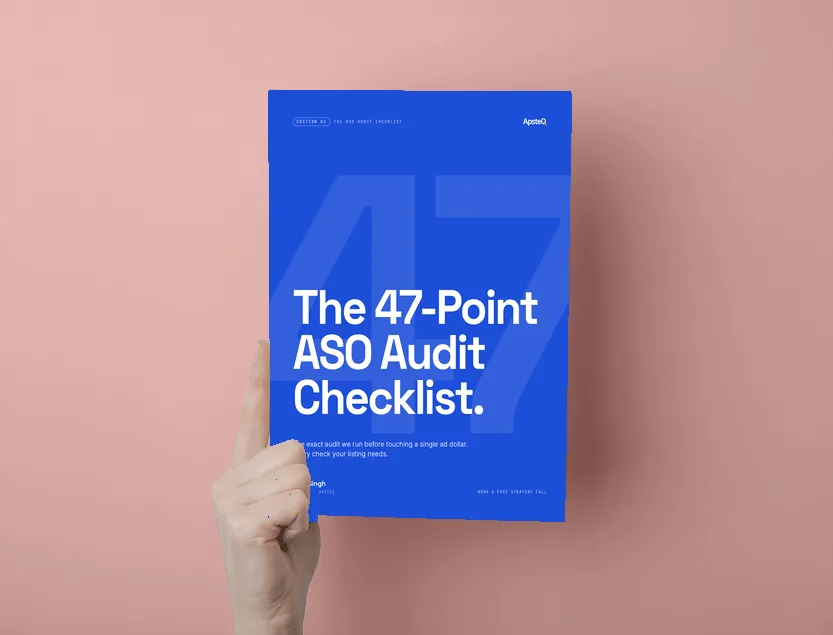
The 47-Point ASO Audit Checklist
The exact checklist we run before touching any app store listing. Find the gaps costing you organic installs.
Get the Free Ebook Browse all free guides