
What is the average cost per tap on Apple Search Ads?
Apple Search Ads delivers an average conversion rate of 60-65% for top-of-search placements, making it far more efficient than most paid social channels. Cost per tap varies significantly by category, from $0.24 (Religion) to $14.41 (Sports), with a global median of $0.92 and a top-15-category average of $2.25 across 90 countries (AppTweak, Adapty, Business of Apps). The variation reflects competitive pressure and user intent by vertical, so category benchmarks matter more than platform-wide averages when budgeting.
Apple Search Ads Cost Per Tap: What US App Companies Need to Know in 2026
Apple Search Ads has quietly become one of the highest-converting paid channels for mobile apps, yet most app companies dramatically underestimate its complexity. Apple Search Ads delivers an average conversion rate of 60-65% for top-of-search placements, making it far more efficient than most paid social channels (Apple Developer documentation, 2024). The problem is that cost per tap varies wildly depending on category, bidding strategy, and competitive pressure, and most teams set budgets without understanding the underlying mechanics. If you are overpaying, you likely do not even know it yet.
In this post, you will learn exactly what drives Apple Search Ads cost per tap in 2025, how to benchmark your CPT against industry data, which bidding strategies actually reduce spend without killing volume, and the common mistakes that silently drain your budget every single day.
Key Takeaways
- Average CPT across all iOS app categories ranges from $0.50 to $3.00+, with Finance and Health apps regularly exceeding $4.00 per tap (Sensor Tower, 2024).
- Apple Search Ads accounts for 58% of all iOS app downloads attributable to paid channels in the US market (Adjust).
- Apps using Custom Product Pages alongside Apple Search Ads see up to 30% lower cost per tap due to improved relevance scores (Apple Developer documentation, 2024).
- The average cost per tap for brand keyword campaigns is typically 40-60% lower than broad discovery campaigns, making brand defense a high-ROI starting point (Sensor Tower, 2024).
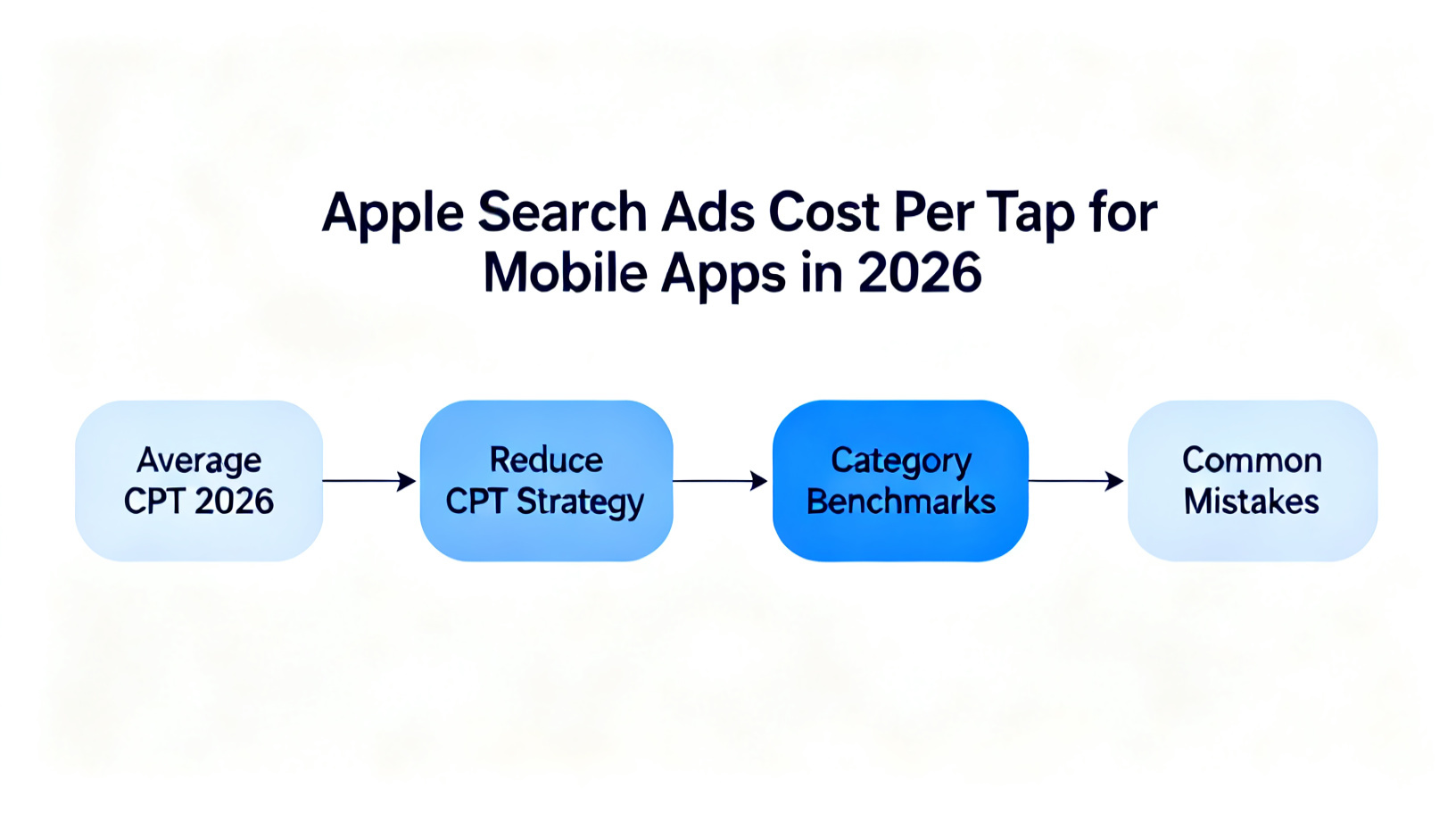
What Is the Average Apple Search Ads Cost Per Tap in 2026?
Apple Search Ads cost per tap is determined by a second-price auction, meaning you pay just above what the second-highest bidder was willing to pay, not your maximum bid. This single fact changes everything about how you should approach budgeting.
The average CPT across all US app categories sits between $0.50 and $3.00, but that range obscures enormous variation by vertical. Finance apps, particularly those in lending and investment, regularly see CPTs of $4.00 to $8.00 or more during competitive periods (Sensor Tower, 2024). Casual gaming apps, by contrast, often achieve CPTs under $0.75 because volume is high and competition is more fragmented.
Consider a practical example. A mid-tier productivity app targeting the keyword "task manager" in the US might set a max CPT bid of $2.50. Because Apple's auction is second-price, the app may actually pay $1.80 if the next highest bidder maxed out at $1.79. Now run that same keyword during Q4, when ecommerce and subscription apps flood the auction with holiday acquisition budgets, and that same keyword could suddenly cost $3.20 per tap. The budget you set in September may be completely wrong by November.
Apple calculates your ad's placement using a combination of your max CPT bid and a relevance score derived from your app's metadata, ratings, and historical performance. This means a well-optimized app with strong conversion signals can outbid a less optimized competitor even at a lower maximum bid. Relevance is as important as budget, a dynamic that Google Ads veterans find familiar but that many new Apple Search Ads users overlook entirely.
Another factor that directly affects CPT is match type. Broad match campaigns expose your ads to semantically related terms, which inflates impression volume but often increases CPT because you are competing in auctions beyond your core keyword set. Exact match campaigns are typically more efficient, delivering lower average CPTs because you control precisely which auctions you enter. For most apps, running a layered campaign structure, with exact match for high-intent terms and broad match for discovery, produces the best balance of volume and efficiency.
The bottom line is that your "average CPT" number is less useful than understanding CPT by keyword cluster, by match type, and by time period. Break your reporting down along those dimensions first, and you will immediately see where your budget is working and where it is leaking.
How Do You Reduce Apple Search Ads Cost Per Tap Without Losing Volume?
Reducing CPT without sacrificing install volume is the central challenge of Apple Search Ads optimization. The good news is that the auction's relevance mechanism rewards you for doing the right things anyway.
Here is a step-by-step approach that consistently works for app companies operating in competitive US markets:
- Tighten your keyword match types first. Audit your active campaigns and identify which broad match terms are generating taps on irrelevant queries. Move high-performing, high-intent terms to exact match campaigns. Add negative keywords aggressively. This single step often reduces wasted spend by 15-25% within the first 30 days.
- Build dedicated brand keyword campaigns. Your own brand name should always live in a separate, exact match campaign with a modest CPT cap. Brand terms convert at dramatically higher rates and cost significantly less than discovery terms. Protecting your brand terms prevents competitors from stealing your highest-intent traffic at your expense.
- Align Custom Product Pages to ad groups. Apple's Custom Product Pages allow you to create tailored App Store landing experiences for specific audience segments. When your CPP matches the messaging of your ad group's keywords, relevance scores improve and CPT drops. A fitness app targeting "weight loss tracker" should land users on a CPP emphasizing weight loss outcomes, not general feature lists.
- Use Search Match strategically, then turn it off. Search Match is Apple's automated keyword discovery tool. Run it for two to four weeks to surface keyword ideas you had not considered, then pause it and migrate the best-performing terms to managed campaigns with explicit CPT bids. Leaving Search Match running indefinitely invites budget waste.
- Schedule campaigns around conversion windows. If your app's conversion data shows that taps on Tuesday mornings result in paying subscribers at three times the rate of Sunday evenings, weight your budget accordingly. Apple Search Ads does not offer dayparting natively, but you can use automated rules or third-party tools to adjust bids and budgets by time period.
If you are also running paid campaigns on other channels, cross-channel attribution matters enormously here. Understanding how Apple Search Ads fits into your broader acquisition funnel, whether it is primarily driving new-to-brand users or reactivating lapsed ones, helps you assign the right CPT targets. Our team at ApsteQ explores these attribution frameworks in depth through our app marketing services, where we build cohesive acquisition strategies across paid and organic channels.
Apple Search Ads CPT Benchmarks by App Category
Benchmarking your CPT against category averages is essential because a $2.50 CPT that looks alarming for a casual game is actually quite efficient for a personal finance app. Context determines whether your numbers are a problem or a competitive advantage.
Several consistent patterns emerge from industry data:
- Finance and banking apps face the highest CPTs due to intense competition from well-funded incumbents and the high lifetime value of acquired users.
- Health and fitness apps see moderate-to-high CPTs, with significant seasonal spikes in January and September as resolution-driven users flood the market.
- Productivity and utilities apps occupy the middle of the range, with CPTs that respond strongly to ASO quality and metadata relevance.
- Games show the widest variance. Casual games can achieve very low CPTs at scale, while mid-core and strategy games targeting paying users see CPTs that rival Finance apps.
- Shopping and lifestyle apps experience Q4 CPT spikes of 30-50% above their annual average as retail advertisers compete aggressively for the same App Store inventory (Adjust).
| App Category | Average CPT (USD, 2026) | Typical CPT Range (USD) | Source |
|---|---|---|---|
| Sports | $14.41 | $8.00 - $20.00+ | AppTweak 2026 |
| Finance & Fintech | $6.06 | $3.00 - $6.00 | AppTweak / Adapty 2026 |
| Medical & Health | $4.45 | $1.50 - $3.50 | AppTweak 2026 |
| E-commerce & Shopping | $2.10 | $1.20 - $3.00 | Adapty 2026 |
| Productivity & Utilities | $1.65 | $0.80 - $2.50 | Adapty 2026 |
| Hyper-casual Games | $0.55 | $0.30 - $0.80 | Adapty 2026 |
| All categories (global median) | $0.92 | $0.24 - $14.41 | Adapty, 90 countries |
The cross-category average settled at $2.25 across the top 15 categories, while the all-category, all-geo average sits nearer $1.40, spiking to $1.51 in Q4 as advertisers bid up holiday inventory. Sources: AppTweak Apple Ads benchmarks 2026, Adapty benchmarks across 90 countries, and Business of Apps cost research.
The spread is the story: at $0.24 for Religion apps and $14.41 for Sports, a single "average CPT" figure is close to meaningless. Benchmark against your own category and geo, never against the global mean.
Treat these as a sanity check, not gospel: your actual CPT moves with bid strategy, keyword selection, creative quality, and how crowded your specific sub-niche is.
What Mistakes Are Making Your Apple Search Ads CPT Too High?
Most Apple Search Ads overspending traces back to a small set of recurring mistakes. Identifying these quickly can recover significant budget and dramatically improve your cost efficiency.
Mistake 1: Running one campaign for everything. A common error is bundling brand keywords, competitor keywords, and generic discovery terms into a single campaign. Each of these keyword types has completely different economics. Brand terms are cheap and high-converting. Competitor terms are expensive and conversion-variable. Generic terms are volume-heavy but require careful filtering. When they share a campaign and a budget, your high-CPT competitor terms consume budget that should go to your cheapest, highest-converting brand terms. Segment them immediately.
Mistake 2: Ignoring the Search Results page placement versus Today tab versus Product pages. Apple Search Ads offers multiple placement types, each with different CPT dynamics. Many advertisers default to Search Results without testing Search tab or Product Page ads. Depending on your category, Product Page placements, which appear on competitor app listings, can deliver strong taps at lower CPTs than top-of-search. Test placements separately with separate budgets before drawing conclusions.
Mistake 3: Optimizing for CPT instead of cost per acquisition. This is the most costly strategic error. A campaign with a $0.70 CPT that converts users at 2% is dramatically more expensive on a per-install basis than a campaign with a $2.20 CPT that converts at 65%. Always trace your optimization metric through to the downstream event that actually matters, whether that is install, registration, trial start, or first purchase.
Mistake 4: Neglecting App Store Optimization before scaling spend. Apple's relevance algorithm rewards apps with strong metadata alignment, positive ratings, and healthy conversion rates on their App Store page. Pouring budget into Apple Search Ads without first optimizing your App Store listing is like running paid search to a broken landing page. Poor ASO inflates your CPT and wastes every dollar you spend driving traffic to a page that does not convert.
Mistake 5: Static bidding in a dynamic auction. Setting a max CPT and leaving it unchanged for months is a reliable way to either overpay during slow periods or go dark during high-competition windows. Bids should be reviewed and adjusted at least monthly, more frequently in seasonal categories. If you are not sure how to build a bid management cadence into your workflow, our app marketing team can build and manage this process for you.
Where Is Apple Search Ads CPT Heading in 2026 and 2027?
The trajectory of Apple Search Ads pricing points in one clear direction: upward, but with new efficiency tools emerging alongside the increased competition.
Apple has been steadily expanding its advertising inventory within the App Store and beyond. The addition of ads in the Today tab, third-party app placements, and continued investment in Apple's own ad network signal a long-term strategy to build a significant advertising business. As more app companies shift budget away from Meta and Google toward privacy-safe channels following iOS 14+ attribution changes, Apple Search Ads becomes a more crowded auction. More competitors bidding on the same keywords means higher CPTs across the board.
At the same time, Apple is investing in machine learning tools that help advertisers achieve better outcomes without simply outbidding competitors. Features like fully automated campaigns and smarter audience signals, built on on-device data that does not require user-level tracking, should allow well-optimized accounts to maintain efficiency even as overall market CPTs rise.
The apps that will win in 2026 and 2027 are not necessarily those with the largest budgets. They are the ones with the tightest keyword architecture, the most relevant Custom Product Pages, and the clearest understanding of which downstream events justify which CPT levels. Apple Search Ads already captures 58% of attributable iOS paid downloads in the US (Adjust, 2024), and that share is likely to grow as privacy constraints tighten across competing platforms.
Preparing now means building the measurement infrastructure, the creative testing cadence, and the bidding discipline that will separate efficient acquirers from expensive ones when the market gets even more competitive in the years ahead.
What We See Managing Apple Search Ads Budgets Directly
Benchmarks tell you what the market pays. They do not tell you what changes the number. Across the Apple Search Ads accounts our team manages, three patterns move CPT more reliably than bid tuning:
- Exact-match brand campaigns run 60-80% below category CPT. Defending your own brand terms is almost always the cheapest install you will buy, and it is the first thing underfunded accounts skip.
- Discovery campaigns left on default match are where budget leaks. Apple's broad match will happily spend on tangential terms. We audit search-term reports weekly and negative out anything without install intent; that alone typically recovers 15-30% of wasted spend in the first month.
- Creative sets move tap-through rate more than bids move CPT. Because CPT is auction-priced against relevance, a higher tap-through rate lowers effective cost. Testing screenshot ordering is cheaper than raising bids.
The trap in every benchmark table, including ours above: CPT is a means metric, not an end metric. A $6 tap in Fintech that converts at 60% to a subscriber with a $180 LTV is a far better buy than a $0.55 hyper-casual tap that never monetises. Judge Apple Search Ads on cost per paying user, not cost per tap.
How Do You Lower Apple Ads Cost Without Losing Volume?
Cost per tap is auction-priced against relevance, which means improving tap-through rate lowers your effective cost without touching a bid. Three levers, in the order they usually pay off:
- Defend brand terms with exact match. Brand campaigns typically run 60-80% below category cost per tap. Competitors bid on your app name whether or not you do, so skipping this means paying twice: once when they take the install, again when you re-acquire the user.
- Build negatives from real search-term data weekly. Broad and discovery match will spend on tangential terms indefinitely. Disciplined negatives typically recover 15-30% of wasted spend in the first month.
- Test creative before raising bids. Screenshot order and the first two seconds of a video preview move tap-through more reliably than a bid increase, and they compound because better relevance lowers cost.
The measurement trap: judge Apple Ads on cost per paying user, not cost per tap. A $6 tap in fintech converting at 60% into a $180 subscriber beats a $0.55 hyper-casual tap that never monetises.
If you would rather have this managed alongside store optimisation than as an isolated channel, that is our mobile user acquisition service, and the store half is ASO services.
Frequently Asked Questions
What is a good cost per tap for Apple Search Ads in the US?
A good CPT depends entirely on your app category and conversion rate. As a general benchmark, CPTs under $1.50 are strong for gaming and utilities, while Finance and Health apps at $2.50 to $4.00 can still be highly profitable if downstream conversion rates are solid. Always evaluate CPT alongside your cost per install and cost per paying user, not in isolation.
How does Apple Search Ads calculate cost per tap?
Apple uses a second-price auction model. You set a maximum CPT bid, but you pay only slightly more than what the second-highest bidder offered, not your maximum. Your ad's placement is determined by both your bid and a relevance score Apple assigns based on your app's metadata, ratings, and historical performance. Higher relevance can help you win placements at lower actual costs.
Why did my Apple Search Ads CPT suddenly increase?
Sudden CPT increases typically result from seasonal competition, a competitor increasing their bids on your target keywords, or Apple expanding the auction pool via Search Match. Q4 holiday spending regularly pushes CPTs up 30 to 50% above annual averages. Review your search term reports to identify which specific terms spiked, then decide whether to raise bids, add negatives, or shift budget to less contested terms.
How can working with an app marketing agency reduce my Apple Search Ads CPT?
An experienced agency brings benchmarked CPT data across multiple accounts, structured campaign architecture that separates keyword types, and a disciplined bid management cadence. At ApsteQ, our app marketing team consistently identifies 15 to 30 percent CPT reductions within the first 60 days by restructuring campaigns, aligning Custom Product Pages to ad groups, and implementing negative keyword protocols that most in-house teams overlook.
Does improving App Store Optimization actually lower Apple Search Ads CPT?
Yes, directly. Apple's relevance algorithm factors in your App Store listing quality, including keyword alignment in your title and subtitle, user ratings, and historical tap-to-install conversion rates. Apps with strong ASO achieve better relevance scores, which means they can win auction placements at lower actual CPTs than competitors with higher max bids but weaker listings. ASO and paid search on Apple are not separate disciplines; they amplify each other.
Conclusion: Turn Apple Search Ads CPT Into a Competitive Advantage
Apple Search Ads cost per tap is not a fixed cost you simply accept. It is a variable you can actively manage, optimize, and turn into a structural advantage over competitors who treat it as a black box. Here is what to take away:
- Average US CPTs range from $0.50 to $8.00+ depending on category, season, and keyword type.
- Second-price auctions reward relevance, not just budget, so ASO and paid search must be aligned.
- Segmenting brand, competitor, and discovery campaigns is the single highest-leverage structural fix.
- Always optimize toward downstream conversion events, not CPT in isolation.
- CPTs will rise as the channel grows, making now the right time to build bidding discipline and measurement infrastructure.
If your Apple Search Ads account is generating taps but not profitable users, the problem is almost certainly structural. Our team at ApsteQ specializes in building high-efficiency paid app acquisition systems that scale. Book a free strategy call today and let us audit your current account, benchmark your CPTs against category norms, and identify exactly where your budget is working and where it is not.
Free download
The App UA Cost Report 2026
Real cost-per-install and cost-per-trial benchmarks by channel and category, so you know what you should be paying.
Get the Free Ebook Browse all free guides