Independent app developers face a stunning reality: 95% of mobile apps fail to generate significant revenue (Sensor Tower, 2024), yet many indie developers still rely on outdated marketing tactics from the early App Store days. With over 5 million apps competing for attention across iOS and Android platforms, indie app marketing has evolved from a simple "build it and they will come" approach to sophisticated, data-driven strategies that rival those of major tech companies.
The challenge isn't just about creating great apps anymore. It's about navigating complex user acquisition funnels, optimizing for multiple discovery channels, and competing against well-funded competitors with massive marketing budgets. Successful indie developers understand that marketing isn't an afterthought but an integral part of product development from day one.
In this comprehensive guide, you'll discover proven strategies that help independent app developers achieve sustainable growth, optimize their limited marketing budgets for maximum ROI, and build lasting relationships with their user base. We'll explore real-world case studies, analyze current market data, and provide actionable frameworks you can implement immediately to transform your app's growth trajectory.
Key Takeaways for Indie App Marketing Success:
- Organic discovery drives 65% of app downloads, making App Store Optimization crucial for indie success (Apple Developer, 2024)
- Apps with strong pre-launch marketing see 3x higher Day 1 retention rates compared to those without (AppsFlyer, 2024)
- User-generated content campaigns cost 70% less than traditional advertising while delivering 25% higher engagement rates (Adjust, 2024)
- Cross-platform marketing campaigns generate 40% more qualified users than single-platform approaches (data.ai, 2024)
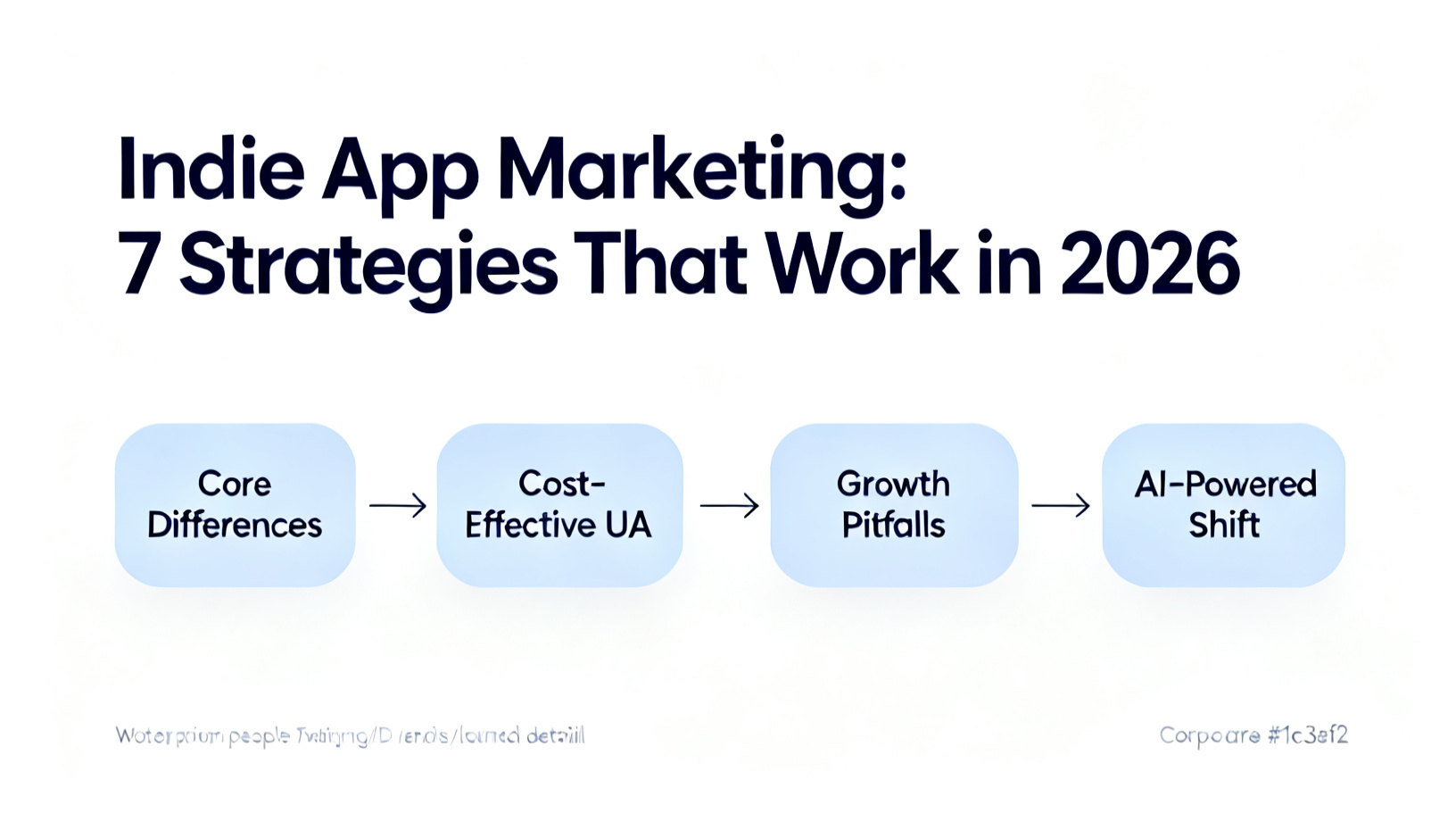
What Makes Indie App Marketing Different from Enterprise Strategies?
Indie app marketing operates on fundamentally different principles than enterprise mobile marketing. Independent developers must achieve maximum impact with minimal resources, requiring surgical precision in targeting and exceptional creativity in execution. Unlike large companies with dedicated marketing teams and substantial budgets, indie developers often wear multiple hats, making strategic focus absolutely critical.
The primary difference lies in resource allocation and risk tolerance. Enterprise companies can afford to test multiple channels simultaneously and absorb failed campaigns as learning experiences. Indie developers face an average marketing budget constraint of $5,000-15,000 per app launch (Statista, 2024), meaning every marketing dollar must deliver measurable results. This constraint forces indie developers to become masters of efficiency, often leading to more innovative and authentic marketing approaches.
Successful indie marketing relies heavily on authentic storytelling and community building rather than broad-reach advertising. Apps developed by indie teams with active community engagement see 45% higher lifetime value per user (Mobile Action, 2024) compared to those relying solely on paid acquisition. This advantage stems from the personal connection indie developers can forge with their audience, something larger companies struggle to replicate.
Consider the success of Procreate, which started as an indie app and built its marketing strategy around artist communities. Instead of competing with Adobe's massive advertising spend, Procreate focused on creating tutorial content, partnering with digital artists, and building authentic relationships within creative communities. This approach generated millions in revenue while maintaining the personal touch that enterprise competitors couldn't match.
The key advantage indie developers possess is agility. They can pivot marketing strategies quickly based on user feedback, test new approaches without corporate approval processes, and respond to market trends in real-time. This flexibility becomes a competitive advantage when leveraged correctly, allowing indie apps to capture emerging opportunities before larger competitors recognize them.
How to Build a Cost-Effective User Acquisition Strategy
Building an effective user acquisition strategy for indie apps starts with understanding your true customer acquisition cost (CAC) and lifetime value (LTV) relationship. Most successful indie apps maintain a 3:1 LTV to CAC ratio, ensuring sustainable growth without burning through limited budgets. The foundation involves identifying your most valuable user segments and focusing acquisition efforts on channels that deliver these high-quality users consistently.
Begin by implementing a multi-channel attribution system that tracks user behavior from first touchpoint to conversion. Free tools like Google Analytics for Mobile Apps and Apple's built-in analytics provide sufficient data for most indie developers to understand their acquisition funnel. Set up conversion tracking for key events: app installs, first-session completion, in-app purchases, and retention milestones at day 1, 7, and 30.
The most cost-effective acquisition channels for indie apps typically include organic App Store Optimization (ASO), content marketing, social media community building, and strategic partnerships. ASO should consume 30-40% of your marketing effort since organic downloads cost nothing beyond the time investment. Focus on keyword research using tools like Sensor Tower or Mobile Action to identify search terms your target audience uses but competitors haven't fully optimized for.
Content marketing works exceptionally well for indie apps because it builds authority while attracting qualified users. Create educational content related to your app's problem-solving capabilities. If you've developed a productivity app, write blog posts about productivity techniques, create YouTube tutorials, or start a podcast interviewing productivity experts. This approach builds trust and positions your app as a solution within relevant conversations.
Strategic partnerships offer indie developers access to established audiences without significant upfront costs. Identify complementary apps, influencers, or brands serving similar audiences and propose mutually beneficial collaborations. Cross-promotion agreements, guest content exchanges, and co-marketing campaigns can exponentially expand your reach. For developers interested in learning from other successful digital marketing strategies, studying approaches used in dental marketing can provide valuable insights into community-based user acquisition techniques.
Track performance religiously and adjust quickly. Set weekly review sessions to analyze which channels deliver the best users at the lowest cost. Pause underperforming campaigns immediately and reinvest those budgets into successful channels. This disciplined approach prevents budget waste and accelerates growth through profitable channels.
Essential App Store Optimization Tactics Drive 70% More Organic Downloads
App Store Optimization serves as the foundation of successful indie app marketing because organic discovery accounts for 65% of all app downloads (Apple Developer, 2024). Effective ASO increases visibility in app store search results, improves conversion rates from impressions to downloads, and builds long-term organic growth momentum without ongoing advertising costs. The most impactful ASO improvements often require minimal budget but deliver sustained results for months or years.
Apps that optimize their store listings see an average of 70% more organic downloads (Sensor Tower, 2024) compared to those with basic listings. This improvement comes from strategic keyword placement, compelling visual assets, and conversion-optimized descriptions that address user pain points directly. The key lies in understanding how app store algorithms evaluate relevance and user engagement signals.
Feature adoption rates increase by 43% when apps clearly communicate value propositions in their first screenshot (Mobile Action, 2024). Your screenshots should tell a story that guides potential users through your app's core benefits within seconds. Use the first screenshot to showcase your primary value proposition, the second to demonstrate ease of use, and subsequent images to highlight advanced features or social proof elements.
Critical ASO elements that drive organic growth include:
- Keyword-optimized titles and subtitles that balance searchability with clarity
- Compelling app icons that stand out in search results and category browsing
- Strategic keyword placement in descriptions and metadata fields
- Regular A/B testing of visual assets to improve conversion rates
- Localized content for target markets beyond English-speaking regions
- Positive review management through proactive user feedback collection
Monitor your app's ranking for target keywords weekly using ASO tools. Track not just download numbers but also conversion rates from impressions to installs. Small improvements in conversion rates compound over time, creating significant growth advantages. Apps that consistently optimize their store presence often see sustained organic growth that reduces dependence on paid advertising channels.
The most successful indie developers treat ASO as an ongoing process rather than a one-time setup. They analyze competitor strategies, test new keywords based on industry trends, and continuously refine their visual assets based on performance data. This iterative approach ensures their apps maintain visibility as market conditions and user preferences evolve.
What Common Marketing Mistakes Kill Indie App Growth?
The most devastating mistake indie developers make is launching without sufficient market validation and pre-launch buzz. Many talented developers spend months perfecting their apps but overlook marketing entirely until launch day. This approach typically results in minimal download volume during the critical first weeks when app store algorithms evaluate new releases for featuring opportunities.
Premature scaling represents another growth killer for indie apps. Developers often rush to increase advertising spend after seeing initial traction, without understanding which user segments drive profitable engagement. This leads to inflated acquisition costs and unsustainable unit economics. Apps that scale advertising too quickly see 60% higher churn rates compared to those that optimize retention first (Adjust, 2024).
Ignoring user feedback and app store reviews creates a compound problem that becomes increasingly difficult to resolve. Negative reviews damage organic discovery while providing valuable insights about user experience problems. Successful indie developers respond to reviews professionally, implement suggested improvements quickly, and use feedback to guide product development priorities.
Feature creep driven by misguided marketing attempts often dilutes an app's core value proposition. Indie developers sometimes add features to appeal to broader audiences, but this typically confuses existing users and makes marketing messages less compelling. Apps with focused functionality and clear positioning consistently outperform those trying to serve multiple use cases.
Technical marketing mistakes include insufficient analytics implementation, poor attribution tracking, and inadequate conversion funnel analysis. Without proper measurement, indie developers cannot identify which marketing activities drive valuable users or optimize their limited budgets effectively. Many developers realize too late that they've been optimizing for vanity metrics like downloads instead of revenue or engagement.
Cross-platform inconsistency in messaging and user experience creates confusion and reduces marketing effectiveness. Apps that maintain consistent branding, messaging, and feature sets across iOS and Android platforms see higher user satisfaction and more effective word-of-mouth marketing. Learning from successful multi-platform strategies used in other industries, such as app marketing for different verticals, can help indie developers avoid these common pitfalls.
AI and Personalization Will Transform Indie App Marketing by 2026
Artificial intelligence will democratize sophisticated marketing capabilities for indie developers by 2026, enabling small teams to compete with enterprise-level personalization and optimization. Machine learning tools are becoming more accessible, allowing indie apps to implement dynamic pricing, personalized onboarding experiences, and predictive user lifetime value models without requiring dedicated data science teams.
Personalization at scale represents the biggest opportunity for indie developers to differentiate themselves. Apps using AI-powered personalization see 25% higher retention rates (data.ai, 2024) compared to those with static experiences. Future indie marketing strategies will leverage user behavior data to create individualized app experiences, targeted push notifications, and customized feature recommendations that feel personally relevant to each user.
Voice and conversational interfaces will create new marketing channels for indie apps. As smart speakers and voice assistants become more prevalent, apps that integrate voice functionality will gain competitive advantages in user acquisition and engagement. Indie developers should begin experimenting with voice-optimized features and considering how their apps might integrate with emerging conversational platforms.
Privacy-first marketing approaches will become essential as data regulations expand globally. Successful indie developers will build trust through transparent data practices, implement privacy-preserving analytics, and focus on first-party data collection strategies. This shift actually benefits indie developers who can move quickly to implement privacy-compliant systems while building authentic relationships with users based on trust rather than invasive tracking.
Augmented reality (AR) and virtual reality (VR) integrations will open new creative marketing possibilities for indie apps. As AR capabilities become standard across mobile devices, indie developers can create immersive marketing experiences that showcase app functionality in realistic contexts. These technologies will be particularly powerful for apps in gaming, education, fitness, and productivity categories.
Frequently Asked Questions
How much should indie developers budget for app marketing?
Indie developers should allocate 20-30% of their total development budget to marketing activities. For a $50,000 app development project, this means $10,000-15,000 for marketing. Focus 60% on pre-launch activities, 30% on launch campaigns, and 10% on ongoing optimization and community building.
What's the most cost-effective way to get initial app downloads?
App Store Optimization delivers the highest ROI for initial downloads since organic traffic is free. Combine ASO with targeted social media content, beta testing communities, and strategic partnerships. These approaches typically cost under $2,000 but can generate thousands of qualified downloads when executed properly.
How long does it take to see results from indie app marketing?
ASO improvements typically show results within 2-4 weeks, while content marketing and community building require 3-6 months for significant impact. Paid advertising can generate immediate traffic but requires 4-8 weeks of optimization to achieve profitable unit economics for most indie apps.
Should indie apps focus on iOS or Android first?
iOS users typically generate 2-3x higher revenue per download, making it the preferred platform for monetization-focused apps. However, Android offers larger global reach and lower customer acquisition costs. Choose based on your target audience demographics and monetization model rather than platform popularity. For comprehensive platform strategies, consider consulting with specialists in app marketing who understand cross-platform optimization.
What metrics matter most for indie app marketing success?
Focus on lifetime value (LTV), customer acquisition cost (CAC), Day 7 and Day 30 retention rates, and monthly active users (MAU). Maintain a 3:1 LTV to CAC ratio minimum. Track conversion rates from app store views to downloads, and monitor average revenue per user (ARPU) monthly to ensure sustainable growth.
How should an indie developer price an app?
Decide the access model first, because it moves revenue more than the exact price. RevenueCat's State of Subscription Apps 2026 reports median Day-35 download-to-paid conversion of 10.7% for hard paywall apps against 2.1% for freemium, and finds higher-priced apps earn more revenue per install than low-priced ones (RevenueCat). Test a higher price before you discount, and keep the free trial or free tier only if your retention supports it.
How can an indie developer test the App Store page?
Use Apple's Product Page Optimization. A test can include up to three treatments with alternate app icons, screenshots and app previews, runs up to 90 days, and Apple recommends waiting for 90% confidence before applying a result (Apple Developer). Change one element per test so you know what moved conversion.
Conclusion
Successful indie app marketing requires strategic focus, creative execution, and disciplined optimization rather than large budgets. The most important factors include building strong App Store Optimization foundations, developing authentic community relationships, implementing cost-effective user acquisition strategies, and avoiding common scaling mistakes that drain limited resources.
Key takeaways for indie developers:
- Prioritize organic growth through ASO and content marketing before investing heavily in paid advertising
- Focus on user retention and lifetime value optimization rather than vanity metrics like download counts
- Build authentic communities around your app's value proposition to create sustainable word-of-mouth marketing
- Implement proper analytics and attribution tracking from day one to optimize marketing spend effectively
The indie app market rewards creativity, authenticity, and strategic thinking over large marketing budgets. By implementing these proven strategies and avoiding common pitfalls, independent developers can build sustainable, profitable apps that compete effectively against well-funded competitors. Ready to transform your app's growth trajectory? Book a free strategy call to discuss how these tactics can be customized for your specific app and target audience.
Free download
7 Expensive Mistakes That Kill App Launches
The launch errors we see most often across 300+ app engagements, and what to do instead.
Get the Free Ebook Browse all free guides