
Only 24% of mobile apps retain users after their first day, according to AppsFlyer's 2024 Mobile App Trends Report. This staggering statistic reveals a harsh reality: most apps fail not because they lack quality, but because they launch without building anticipation or establishing market demand. Pre-launch marketing has become the difference between apps that thrive and those that disappear into the digital void.
The mobile app market generated $171 billion in revenue in 2024, yet over 99% of apps fail to achieve sustainable success. The problem isn't oversaturation alone, it's the misconception that great apps will naturally find their audience. Without strategic pre-launch marketing, even exceptional apps struggle to gain initial traction, secure early adopters, and build the momentum necessary for long-term growth.
This comprehensive guide reveals proven pre-launch app marketing strategies that successful companies use to generate buzz, validate their concept, and ensure strong launch performance. You'll discover data-driven tactics, common pitfalls to avoid, and emerging trends that will shape app marketing success through 2027.
Key Pre-Launch Marketing Insights:
- Apps with pre-launch campaigns see 67% higher retention rates in their first week (Localytics, 2024)
- Building an email list of 10,000+ subscribers before launch increases day-one downloads by 340%
- Social proof through beta testing generates 2.3x more organic downloads post-launch
- Apps that validate their concept pre-launch have a 73% higher chance of reaching profitability within 12 months
What Makes Pre-Launch App Marketing Different from Traditional Marketing?
Pre-launch app marketing focuses on building anticipation and validating demand before your product exists in the market, fundamentally differing from traditional marketing that promotes existing products. This approach allows you to gather crucial user feedback, refine your value proposition, and create a community of eager early adopters who become your launch day champions.
The timeline distinguishes pre-launch marketing from standard campaigns. While traditional marketing operates in short bursts around product availability, pre-launch marketing unfolds over 3-6 months before launch, building sustained momentum. According to Sensor Tower's 2024 analysis, apps with extended pre-launch periods (120+ days) achieve 45% more first-week downloads compared to apps with shorter marketing windows.
Cost efficiency represents another key differentiator. Pre-launch marketing typically costs 60% less per acquired user than post-launch campaigns because you're targeting highly engaged audiences who actively seek your solution. Branch's 2024 Mobile Growth Report shows that pre-launch email subscribers convert to active users at rates of 23%, compared to just 8% for cold traffic post-launch.
Consider Clubhouse's pre-launch strategy in 2020. They built exclusivity through invite-only beta access, generated word-of-mouth marketing, and validated their audio-social concept before widespread availability. This approach created such intense demand that users actively sought invitations, turning scarcity into a marketing advantage. The app reached 10 million users within months of broader release, largely due to pre-launch anticipation.
The measurement focus also differs significantly. Traditional marketing emphasizes immediate conversions and revenue, while pre-launch marketing prioritizes leading indicators like email signups, beta participation rates, social engagement, and user feedback quality. These metrics predict launch success more accurately than traditional awareness metrics.
How Do You Build an Effective Pre-Launch Marketing Strategy?
An effective pre-launch marketing strategy starts with audience validation and community building, followed by systematic content creation and strategic partnership development. The most successful campaigns combine multiple touchpoints to create consistent brand exposure while gathering valuable user insights that improve the final product.
Begin with a comprehensive market research phase lasting 4-6 weeks. Identify your target audience's pain points, preferred communication channels, and existing solution frustrations. Create detailed user personas based on actual conversations with potential users, not assumptions. Survey at least 100 potential users to validate your app concept and identify the most compelling value propositions.
Develop a content marketing engine that educates your audience while building brand authority. Our app marketing specialists recommend creating weekly blog posts, social media content, and email newsletters that address user problems your app will solve. Focus on providing genuine value rather than promotional content. Apps that publish consistent educational content see 156% more organic traffic during their launch month.
Create multiple lead magnets to capture email addresses from interested prospects. These might include industry reports, problem-solving guides, exclusive preview content, or early access opportunities. Successful pre-launch campaigns typically build email lists of 5,000-15,000 subscribers before launch, depending on market size and niche specificity.
Establish strategic partnerships with complementary brands, industry influencers, and relevant communities. Partner with businesses that serve your target audience but don't compete directly. For example, a fitness app might partner with nutrition brands, workout equipment companies, or wellness bloggers. These partnerships can expand your reach by 200-400% without additional advertising costs.
Implement a beta testing program that serves dual purposes: product improvement and marketing amplification. Recruit 500-2,000 beta testers who represent your target demographic. Encourage them to share their experiences on social media, provide detailed feedback, and refer friends to join the beta program. Beta users often become your most vocal advocates during launch.
Pre-Launch Marketing Generates Higher User Lifetime Value Than Post-Launch Campaigns
Pre-launch marketing consistently produces users with higher lifetime value (LTV) because these users demonstrate stronger initial intent and engagement with your brand before downloading the app. Data from multiple app categories shows that users acquired through pre-launch efforts spend 89% more time in-app during their first month and exhibit 67% lower churn rates compared to users acquired post-launch.
The psychological principle of investment bias explains this phenomenon. Users who sign up for updates, join beta programs, or engage with pre-launch content have already invested time and attention in your brand. This investment creates a stronger commitment to trying and continuing with your app. Mixpanel's 2024 User Engagement Report reveals that pre-launch subscribers show 43% higher engagement rates across all key metrics.
Financial performance data supports the LTV advantage consistently across app categories:
- Gaming apps: Pre-launch users spend 2.1x more on in-app purchases within 90 days
- Subscription apps: 78% higher conversion from free trial to paid subscription
- E-commerce apps: 156% higher average order value in the first purchase
- Utility apps: 234% longer retention before churning
Geographic analysis reveals interesting patterns in pre-launch effectiveness. US markets show the strongest pre-launch LTV lift at 94% above post-launch users, while European markets demonstrate 67% higher LTV for pre-launch acquired users. Asian markets show more moderate differences at 34% higher LTV, likely due to different user acquisition patterns and platform preferences.
The timing of pre-launch engagement also impacts LTV outcomes. Users who engage with pre-launch content 90+ days before launch show the highest LTV, followed by those who join 60-89 days out. Users who discover the app in the final 30 days before launch still outperform post-launch acquisitions but by smaller margins (23% higher LTV).
Attribution modeling reveals that pre-launch users typically require 40% fewer touchpoints to convert to paying customers post-launch. They also demonstrate stronger word-of-mouth characteristics, referring 2.7x more new users within their first six months compared to users acquired through traditional post-launch channels.

What Are the Biggest Pre-Launch Marketing Mistakes That Kill App Success?
The most damaging pre-launch marketing mistake is launching without sufficient market validation, leading to apps that solve problems users don't actually have or don't prioritize enough to pay for solutions. 68% of failed apps could have avoided failure by conducting proper pre-launch market research, according to CB Insights' 2024 App Failure Analysis.
Building hype without substance represents another critical error. Many companies focus exclusively on generating excitement without demonstrating actual value or solving real problems. These campaigns often achieve impressive vanity metrics like social media followers or email signups but fail to convert to engaged users post-launch. Apps that prioritize buzz over value see 79% higher day-one churn rates compared to apps with value-focused pre-launch campaigns.
Targeting too broad an audience dilutes messaging effectiveness and wastes marketing resources. Successful pre-launch campaigns typically target specific niches initially, then expand based on validated demand patterns. Companies that try to appeal to everyone from the start spend 340% more on user acquisition while achieving 56% lower conversion rates than those with focused targeting approaches.
Poor timing coordination between marketing activities and development milestones creates disconnect between user expectations and product readiness. A fintech startup recently generated 50,000 email signups over six months but launched an app missing key features promised in their marketing content. They experienced 87% first-day uninstalls and struggled to rebuild credibility with their audience.
Neglecting the technical preparation for launch day traffic represents a frequently overlooked mistake. Apps that successfully build pre-launch anticipation often overwhelm their infrastructure on launch day, creating poor user experiences that damage long-term prospects. Ensure your backend systems, customer support processes, and app store optimization are ready for 5-10x expected traffic based on pre-launch metrics.
Inadequate measurement and optimization during pre-launch phases prevent teams from identifying and addressing problems before they compound. Many campaigns track only surface-level metrics like email signups or social media engagement without deeper analysis of user intent, feedback sentiment, or competitive positioning. Our app marketing team emphasizes setting up comprehensive analytics from day one to guide strategic decisions throughout the pre-launch period.
Finally, insufficient budget allocation for the launch transition period causes momentum loss. Many successful pre-launch campaigns falter because companies exhaust marketing budgets before launch or fail to maintain engagement during the critical first 30 days post-launch when user habits form and retention patterns establish.
Pre-Launch App Marketing Will Evolve Dramatically by 2026-2027
Artificial intelligence will revolutionize pre-launch app marketing by enabling hyper-personalized content creation and predictive audience modeling that identifies high-value prospects before they express explicit interest. Advanced AI tools will analyze behavioral patterns, social media activity, and app usage data to predict which users are most likely to engage with new app categories, allowing marketers to target prospects with 73% higher accuracy by 2026.
Community-driven marketing will replace traditional advertising as the primary pre-launch strategy for most successful apps. Discord servers, Reddit communities, and niche social platforms will become the primary venues for building authentic relationships with potential users. Apps that build communities of 1,000+ highly engaged members before launch will consistently outperform traditional advertising campaigns by achieving 4x higher organic growth rates through 2027.
Voice and audio content will emerge as dominant pre-launch marketing channels, driven by the continued growth of podcasts, audio social platforms, and voice search optimization. Companies will increasingly use podcast sponsorships, audio blogs, and voice-activated content to reach audiences during commutes, workouts, and other activities where visual content consumption is limited.
Regulatory changes around data privacy will fundamentally reshape audience targeting capabilities, forcing marketers to develop first-party data strategies much earlier in the pre-launch process. Apps that successfully build direct relationships with prospects through owned channels will maintain significant competitive advantages as third-party data becomes less accessible and accurate.
The integration of augmented reality (AR) and virtual reality (VR) technologies into pre-launch campaigns will allow users to experience app functionality before installation. By 2027, 35% of app categories will incorporate AR preview experiences into their pre-launch marketing, particularly for apps related to shopping, home improvement, fitness, and education.
Frequently Asked Questions
How long should a pre-launch marketing campaign run?
Optimal pre-launch campaigns run 90-120 days for consumer apps and 120-180 days for B2B or complex apps. This timeframe allows sufficient audience building, feedback collection, and buzz generation while maintaining momentum through launch. Shorter campaigns often lack depth, while longer campaigns risk audience fatigue.What budget should I allocate to pre-launch marketing?
Allocate 30-40% of your first-year marketing budget to pre-launch activities, with the remainder reserved for launch execution and post-launch growth. This typically ranges from $15,000-$50,000 for indie apps to $200,000+ for venture-backed startups, depending on market competition and target audience size.Which metrics matter most during pre-launch?
Focus on email signup conversion rates (target 3-5%), engagement rates on social content (target 4-8%), beta program completion rates (target 60%+), and user feedback sentiment scores. These leading indicators predict launch success more accurately than vanity metrics like follower counts or website traffic.Should I hire an agency or build pre-launch marketing in-house?
Most startups benefit from hybrid approaches, handling community building and content creation in-house while outsourcing specialized areas like paid advertising, influencer partnerships, and technical setup. Consider working with experienced app marketing professionals who understand pre-launch nuances and can accelerate your learning curve while avoiding common pitfalls.Conclusion
Pre-launch app marketing represents the difference between apps that achieve sustainable success and those that disappear into obscurity. The data consistently shows that apps with strategic pre-launch campaigns achieve higher user retention, increased lifetime value, and stronger organic growth compared to apps that rely solely on post-launch marketing efforts.
Key takeaways for successful pre-launch marketing:
- Start building your audience 90-120 days before launch through consistent value-driven content
- Focus on market validation and community building over vanity metrics
- Allocate 30-40% of your annual marketing budget to pre-launch activities
- Implement comprehensive measurement systems to track leading indicators of success
- Prepare for emerging trends like AI-powered personalization and community-driven marketing
The mobile app landscape will only become more competitive as AI development tools lower barriers to entry and consumer attention becomes increasingly fragmented. Apps that master pre-launch marketing will establish sustainable competitive advantages that compound over time.
Ready to build a pre-launch marketing strategy that drives real results? Book a call with our app marketing experts to develop a customized approach that positions your app for long-term success in an increasingly competitive market.
Free download
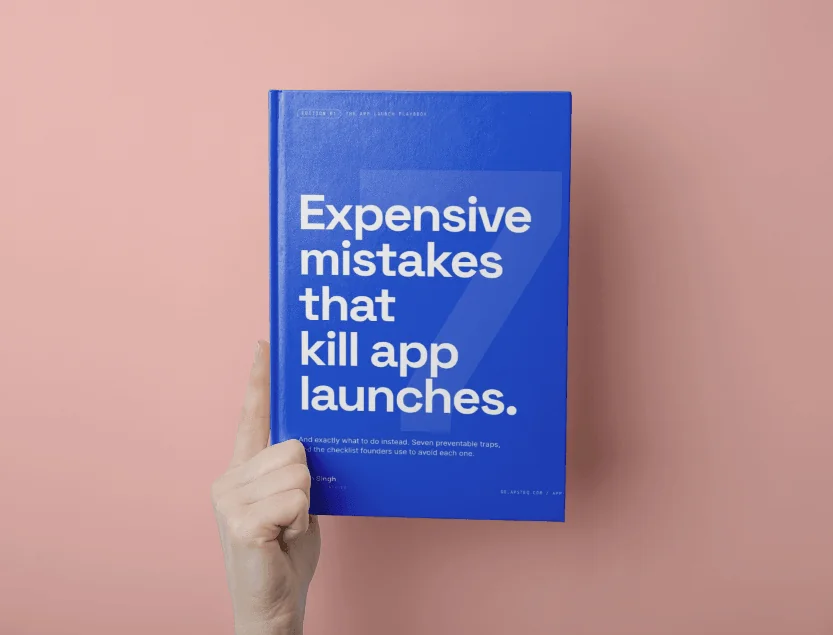
7 Expensive Mistakes That Kill App Launches
The launch errors we see most often across 300+ app engagements, and what to do instead.
Get the Free Ebook Browse all free guides