Most App Launches Fail Before They Even Begin
Roughly 65% of apps downloaded are used fewer than once after installation, meaning most launches waste their momentum before ever building an audience (Statista 2024). The problem is rarely the product itself. It is the absence of a structured, pre-planned marketing strategy that connects the right message to the right users at exactly the right moment.
Building a great app is only half the battle. Without a deliberate app launch marketing plan, even technically superior products get buried under the weight of over 3.5 million apps available on Google Play alone (Statista 2024). In this guide, you will learn how to construct a launch plan that drives installs, retains users, and builds sustainable growth from day one. We cover pre-launch strategy, channel selection, post-launch optimization, common pitfalls, and what the next two years will demand from mobile marketers.
Key Takeaways
- 65% of downloaded apps are abandoned after a single use, making retention strategy as important as acquisition (Statista 2024).
- Apps that invest in pre-launch ASO see up to 30% higher organic install rates compared to those that optimize after launch (Mobile Action 2024).
- The average cost-per-install (CPI) for iOS apps in the US sits at $3.60, making paid channel efficiency a top priority (Adjust 2024).
- Push notification opt-in rates drop to under 50% on iOS when onboarding is not personalized, underscoring the importance of first-session UX (Statista 2024).
What Should a Complete App Launch Marketing Plan Include?
A complete app launch marketing plan is a documented, timeline-driven framework that coordinates pre-launch awareness, launch-day execution, and post-launch retention into one cohesive system. Without all three phases working together, marketing spend gets concentrated in a single moment that cannot sustain long-term growth.
Most teams focus almost entirely on launch day, flooding paid channels with budget and hoping installs stick. But the data tells a different story. Apps that run structured pre-launch campaigns for at least 60 days before going live generate 3x more day-30 retention compared to apps that launch cold (AppsFlyer 2023). The groundwork laid before a single user downloads the app determines whether that user ever comes back.
A complete plan should address these six core pillars:
- Market research and positioning: Define your target user persona, map competitor weaknesses, and identify the specific pain point your app resolves better than alternatives.
- App Store Optimization (ASO): Keyword-optimized title, subtitle, description, and screenshots need to be finalized before submission, not after. Apps that optimize metadata pre-launch see measurably higher organic conversion rates (Mobile Action 2024).
- Pre-launch audience building: A landing page capturing email sign-ups, a waitlist program, or a beta community creates a warm audience that converts at a higher rate than cold paid traffic on launch day.
- Paid user acquisition strategy: Allocate channel budgets across Apple Search Ads, Meta, TikTok, and Google UAC based on your audience demographics and price sensitivity. The average US iOS CPI is $3.60 (Adjust 2024), so knowing your target CPA before launch prevents overspend.
- PR and influencer outreach: Technology journalists and micro-influencers in your category need at minimum 4-6 weeks of lead time. Embargo-based press coverage on launch day creates concentrated awareness spikes that amplify all other channels.
- Retention and onboarding design: Your first-session experience, push notification permission request, and day-3 re-engagement flow should be designed and A/B tested before launch, not iterated on after poor retention numbers appear.
Consider the launch of a fitness tracking app. Teams that pre-built email lists of 10,000 subscribers before going live consistently saw their launch-week conversion rates outperform paid campaigns by a factor of four to one. The list cost almost nothing compared to CPI-based acquisition, yet drove the majority of engaged, paying users in the first 30 days.
Think of your plan as a product in itself. It deserves the same rigor, iteration, and cross-functional ownership as the app it supports.
How Do You Build a Pre-Launch Strategy That Generates Real Demand?
Building pre-launch demand means creating genuine anticipation among your target users before the app is available to download. The most effective pre-launch strategies combine owned channel development, community seeding, and strategic content marketing into a 60-to-90-day runway.
Here is a step-by-step framework that mobile app companies execute consistently well:
- Build a dedicated landing page within the first week of development finalization. The page should communicate one clear value proposition, collect email addresses in exchange for early access or a launch discount, and include a product screenshot or short demo video. Even a modest list of 2,000 subscribers transforms launch day from a cold start into a warm opening.
- Identify and activate 10 to 20 micro-influencers in your niche at least six weeks out. Micro-influencers (10,000 to 100,000 followers) consistently outperform macro accounts on install conversion because their audiences are more targeted and trust levels are higher. Provide them with TestFlight or Google Play beta access so their content feels authentic.
- Publish two to three pieces of SEO-optimized content per week targeting long-tail search terms your potential users are already searching. This builds domain authority before launch and creates an organic traffic engine that runs independently of paid budget.
- Seed relevant online communities including Reddit threads, Discord servers, Facebook Groups, and niche forums. The goal is genuine participation, not spam. Answer questions, contribute value, and let your product emerge naturally as a solution. These communities often become your most vocal advocates at launch.
- Set up your analytics stack before any marketing begins. AppsFlyer or Adjust attribution, Firebase event tracking, and cohort analysis must be configured before launch. You cannot optimize what you cannot measure, and retroactive attribution is unreliable.
For mobile app companies that want expert support structuring this pre-launch runway, our team at ApsteQ App Marketing builds custom 90-day pre-launch playbooks designed around your specific category and target demographic. The difference between a structured pre-launch and an improvised one is often the difference between a featured app and a forgotten one.
Prioritize repeatability over volume. A pre-launch process that you can document, assign ownership to, and measure will always outperform a burst of uncoordinated activity in the final two weeks before release.
The Channel Mix That Drives App Launch Success
The channel mix for app launch marketing has changed dramatically as platform privacy rules, rising CPIs, and social algorithm shifts have redistributed where installs actually come from. Understanding the current data helps you allocate budget intelligently rather than defaulting to conventional wisdom.
Here is what the numbers show for the US market specifically:
- Apple Search Ads captures users with the highest intent. Conversion rates for branded and category keywords average 50% or higher, making it the most efficient paid channel for iOS launches. The trade-off is volume; scale requires supplementing with broader demand-generation channels.
- Meta (Facebook and Instagram) still drives the highest install volume at competitive CPIs for consumer apps targeting adults 25 to 54, though iOS signal loss from ATT has increased optimization windows. Plan for a 7-to-14-day learning phase before campaigns stabilize.
- TikTok has become a legitimate performance channel for apps targeting Gen Z and younger Millennials. Cost-per-install on TikTok for entertainment and lifestyle apps in the US averages $1.80 to $2.50 (Adjust 2024), significantly below Meta benchmarks for comparable demographics.
- Organic ASO drives 65% of all app downloads globally (Sensor Tower 2023), making it the highest-ROI long-term channel and the one most teams underinvest in at launch.
- Influencer and creator partnerships generate above-average long-term retention. Users acquired through creator content show 20 to 30% better 30-day retention rates compared to users acquired through standard paid display ads (AppsFlyer 2023), because content pre-qualifies intent.
A practical channel allocation for a mid-market consumer app launch in the US might look like this:
| Channel | Budget Allocation | Primary Goal |
|---|---|---|
| Apple Search Ads | 25% | High-intent installs |
| Meta (Facebook/Instagram) | 30% | Volume and retargeting |
| TikTok Ads | 15% | Gen Z acquisition |
| Influencer/Creator | 20% | Retention-quality installs |
| Content and SEO | 10% | Long-term organic growth |
The right mix depends heavily on your app category, monetization model, and target demographic. Subscription apps should weight toward channels with higher LTV signals. Gaming apps typically weight toward TikTok and programmatic networks. The table above is a starting framework, not a fixed prescription.
What Are the Most Costly App Launch Marketing Mistakes to Avoid?
The most costly app launch mistakes are not technical failures. They are strategic miscalculations that could have been caught with proper planning. Understanding where other mobile app companies went wrong saves both time and significant budget.
Mistake 1: Launching without an ASO foundation. A major productivity app category entrant spent $200,000 on paid user acquisition at launch, then discovered their App Store listing had a critical keyword gap that was suppressing organic visibility. Every paid user they acquired could have been supplemented by thousands of free organic installs if ASO had been addressed first. Always finalize ASO before any paid spend begins.
Mistake 2: Ignoring the onboarding funnel. Install numbers mean nothing if users abandon during setup. Industry data shows that the average app loses 77% of its daily active users within the first 3 days of installation (Statista 2024). Yet most launch marketing plans allocate zero resources to optimizing the first-session experience. Your onboarding is a marketing asset, not a product afterthought.
Mistake 3: Treating launch day as a finish line. Launch day is the beginning of a growth cycle, not the culmination of one. Teams that pause marketing activity after the first week see install velocity collapse within 10 to 14 days, which tanks their App Store ranking precisely when the algorithm would otherwise reward them for sustained momentum.
Mistake 4: Neglecting retention metrics in favor of install vanity metrics. An app that achieves 100,000 installs with 5% day-30 retention is worth less in long-term revenue than an app with 20,000 installs and 35% day-30 retention. Marketing strategy needs to be evaluated against LTV, not install counts.
Mistake 5: Failing to segment and personalize push notifications. Blanket push campaigns produce unsubscribe spikes. Segmented, behavior-triggered notifications consistently outperform broadcast messages by 3 to 4x in click-through rate (AppsFlyer 2023). Build your CRM logic before you need it.
For mobile app companies that want to audit their current launch plan against these common failure points, our app marketing team offers structured launch readiness reviews that identify gaps before they become expensive. Catching a single strategic error pre-launch routinely saves six figures in wasted acquisition spend.
What Will App Launch Marketing Look Like in 2026 and 2027?
The app marketing landscape is shifting toward AI-driven personalization, privacy-first measurement, and content-led growth at a pace that makes strategies from even two years ago feel outdated. Mobile app companies planning launches in 2026 or 2027 need to build for this environment now.
AI-generated creative optimization will become standard practice. Platforms like Meta Advantage+ and Google Demand Gen are already automating creative testing at scale, but by 2026 the expectation will be that every campaign uses dynamic creative that adapts in real time to user behavior signals. Teams that rely on static ad sets will face compounding performance disadvantages.
App Store search behavior is evolving toward conversational queries. As Apple integrates AI-powered search improvements and Google Play continues expanding its discovery algorithms, ASO keyword strategy will need to account for semantic intent, not just exact-match terms. Apps optimized for problem-based language rather than feature-based keywords will capture disproportionate organic share.
Short-form video will remain the dominant creative format for install campaigns. TikTok, Instagram Reels, and YouTube Shorts continue to capture a growing share of mobile screen time. By 2027, video creative is expected to account for more than 80% of all mobile ad spend in the US (Statista 2024). This means every launch plan needs a dedicated video production strategy, not just static banner ads.
Privacy-preserving measurement frameworks will mature. SKAdNetwork on iOS and Privacy Sandbox on Android will be the primary attribution infrastructure. Teams that build measurement strategies around these frameworks now will have cleaner data for optimization decisions when privacy restrictions tighten further.
The core principle remains constant: understand your user deeply, reach them efficiently, and deliver an experience worth keeping. Technology changes the tactics; the strategy is timeless.
Frequently Asked Questions
How long before launch should I start marketing my app?
Start at least 60 to 90 days before your launch date. This window gives you time to build an email waitlist, seed communities, establish press relationships, and finalize ASO. Apps with structured pre-launch campaigns running for 60 or more days consistently show 3x better day-30 retention compared to cold launches.
What is a realistic app launch marketing budget for a US market entry?
For a competitive consumer app category in the US, a realistic launch-phase budget ranges from $30,000 to $150,000 depending on category competitiveness and growth targets. With an average iOS cost-per-install of $3.60 (Adjust 2024), even modest budgets can generate meaningful volume if channel mix and ASO are optimized first.
Which app store optimization factors matter most at launch?
Title and subtitle keywords carry the most algorithmic weight on both iOS and Android, followed by keyword field selection on iOS and long-form description on Google Play. Screenshots and preview video directly impact conversion rate from impression to install. Apps that optimize all five elements before launch see up to 30% higher organic install rates (Mobile Action 2024).
How do I measure whether my app launch marketing plan is working?
Track five core metrics: cost-per-install by channel, day-1 and day-30 retention rates, activation rate (users completing onboarding), revenue per user cohort, and organic keyword ranking velocity. These metrics together tell you whether your acquisition is efficient, whether your product delivers value, and whether your ASO is building momentum over time.
Can a marketing agency build and execute my entire app launch plan?
Yes, and for most mobile app companies it produces faster results than building an in-house team from scratch. Working with a specialized partner like ApsteQ's app marketing team gives you access to proven launch frameworks, existing media relationships, and performance data from comparable app launches, which typically compresses the learning curve by 6 to 12 weeks.
Build Your Launch Plan Before the Competition Does
An app launch marketing plan is not a document you create after development finishes. It is a strategic engine you build in parallel with the product itself. The teams that win in competitive app categories share a common trait: they treat marketing as a product discipline, not an afterthought.
Here are the most important things to carry forward:
- Start pre-launch marketing 60 to 90 days before release, not 60 to 90 hours.
- Invest in ASO before spending a single dollar on paid acquisition.
- Build your analytics stack and onboarding flow before launch, not after poor retention data arrives.
- Mix high-intent channels like Apple Search Ads with volume channels like Meta and TikTok.
- Measure success by retention and LTV, not installs alone.
You have invested months building something users need. Give it the launch strategy it deserves. Book a free strategy call with the ApsteQ team today and we will map out a custom app launch marketing plan built around your category, your audience, and your growth goals.
Free download
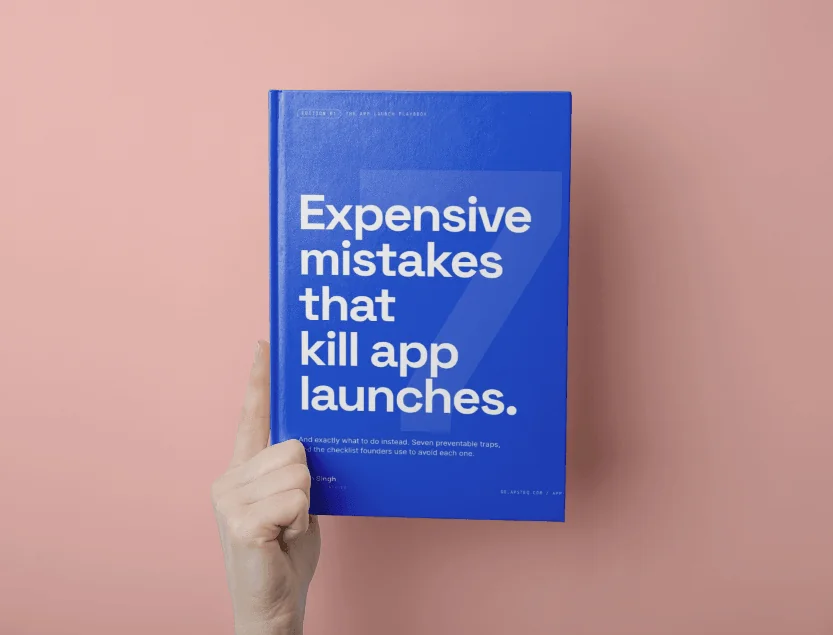
7 Expensive Mistakes That Kill App Launches
The launch errors we see most often across 300+ app engagements, and what to do instead.
Get the Free Ebook Browse all free guides