
The App Monetization Landscape Is Shifting Faster Than Most Companies Realize
Mobile apps generated over $935 billion in consumer spending across app stores in 2023, yet the majority of apps still fail to convert more than 5% of their users into paying customers (data.ai, 2024). That gap between total market potential and individual app performance represents one of the biggest unsolved problems in mobile product development today. The strategies that worked in 2022 are already losing effectiveness as user expectations, platform policies, and AI-driven personalization reshape what monetization actually looks like.
If you run or market a mobile app, this guide will show you exactly which monetization models are gaining ground in 2026, how to stack revenue streams intelligently, where most companies leak money without knowing it, and what the next 18 months will demand from your monetization playbook.
Key Takeaways
- Global mobile app revenue is projected to surpass $1.3 trillion by 2026, driven primarily by subscription and in-app purchase growth (Statista, 2024).
- Apps using hybrid monetization models (subscriptions plus in-app purchases) show up to 2.3x higher lifetime value compared to single-model apps (AppsFlyer, 2024).
- The average iOS user spends $138 per year on in-app purchases and subscriptions, versus $61 for Android users (data.ai, 2024).
- Rewarded video ads generate completion rates above 85%, making them the highest-performing ad format for non-subscription apps (Adjust, 2023).
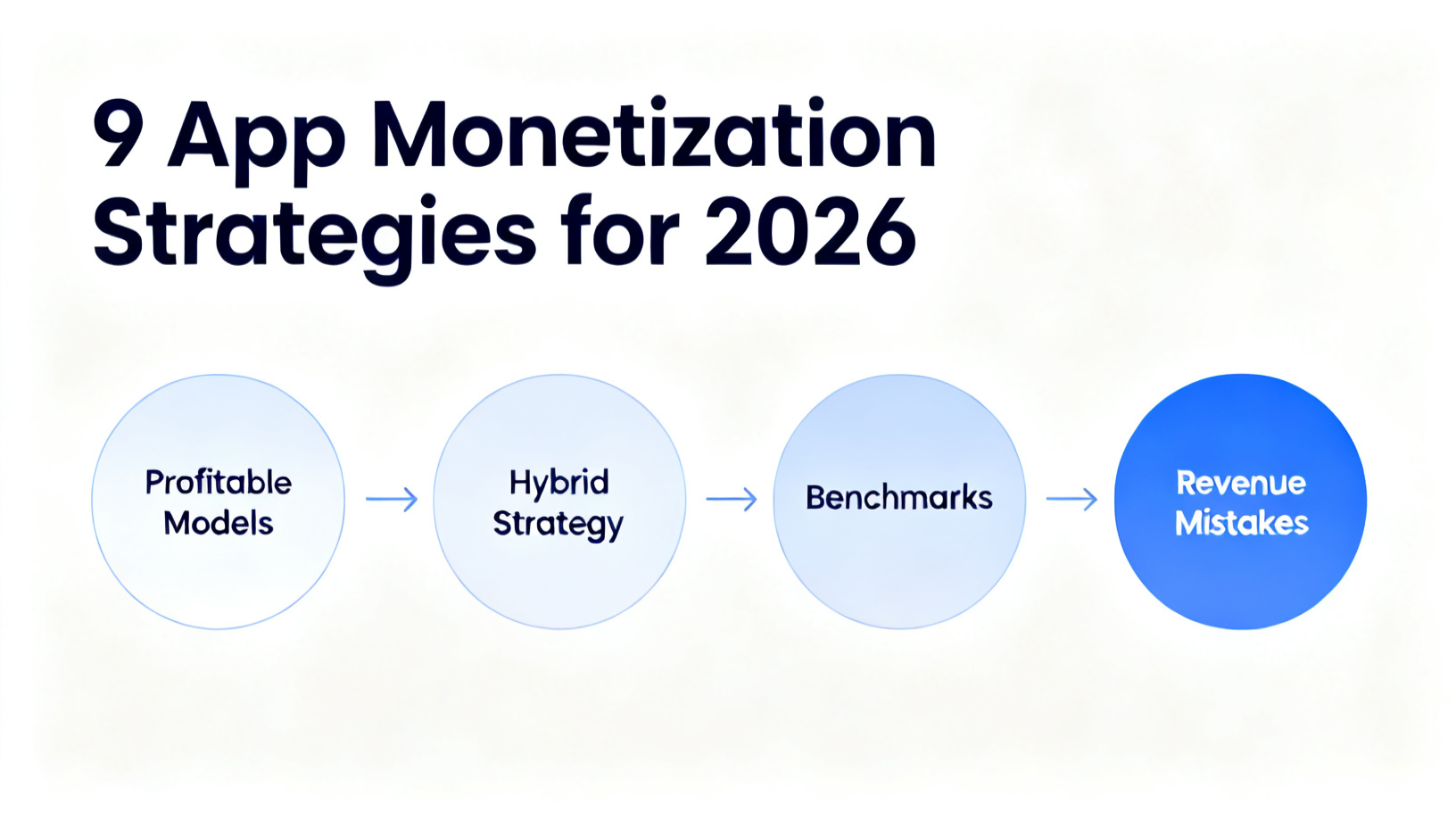
What Are the Most Profitable App Monetization Models in 2026?
Subscription models now dominate top-grossing charts across both iOS and Android, but the real answer is more nuanced: the most profitable apps in 2026 combine multiple revenue streams rather than committing to a single approach. Understanding each model's mechanics gives you the foundation to build a strategy that fits your user base and category.
The six core monetization models active in the market right now are: subscriptions, in-app purchases (consumable and non-consumable), advertising, freemium upgrades, paid downloads, and affiliate or referral commissions. Each has a distinct risk-reward profile depending on your app category, user retention curve, and average session length.
Subscriptions have become the default for productivity, health, and entertainment apps. Subscription-based apps account for 97% of the top-grossing non-game apps on the App Store (Sensor Tower, 2024). The recurring revenue model aligns developer incentives with genuine product value, which is why investors reward subscription apps with higher multiples. However, subscription fatigue is real. Users are canceling faster than they used to, which raises the pressure on onboarding and early activation experiences.
In-app purchases, particularly consumables like currency, lives, or credits, remain the dominant model for mobile gaming. Non-gaming apps are increasingly borrowing this mechanic through "credits" for AI features, premium filters, or additional storage. Mobile gaming alone accounted for 60% of all in-app purchase revenue in 2023 (data.ai, 2024), but non-gaming categories are closing the gap as AI-powered features justify per-use pricing.
A useful real example: Duolingo built a dominant position by combining a freemium tier, a premium subscription called Super Duolingo, and a family plan tier. Their 2023 earnings call confirmed that subscribers grew 57% year over year, yet they simultaneously expanded their free tier's reach. That balance, giving away enough to hook users while creating clear premium value, is the template that most 2026 monetization strategies are being designed around.
Advertising models work best when your free tier generates massive daily active user counts and when session length is long enough to show ads without damaging retention. Rewarded video remains the format least likely to drive uninstalls, especially when the reward is genuinely meaningful to the user's experience.
How Should Mobile App Companies Build a Hybrid Monetization Strategy?
Building a hybrid monetization strategy means deliberately layering revenue streams so each one captures value from a different segment of your user base without cannibalizing the others. The process is not complicated, but it requires clear segmentation data before you start adding revenue levers.
Start with your user data and identify three audiences: users who will never pay, users who will pay occasionally for high-value moments, and users who derive enough consistent value to justify a monthly fee. Most apps have all three segments, and most apps currently serve only one or two of them intentionally.
Step 1: Anchor on one primary model. Choose the model that best fits your retention curve. If daily active usage is high and sessions are long, subscriptions work. If usage is episodic, in-app purchases or credits make more sense.
Step 2: Add a non-intrusive advertising layer for your non-payer segment. Rewarded video and native ads cause the least friction. Banner ads and interstitials continue to drive meaningful churn in 2026, particularly among iOS users who have low tolerance for intrusive ad formats.
Step 3: Introduce a mid-tier option between your free and premium levels. Research consistently shows that presenting three pricing tiers increases conversion to the middle tier by making it feel like a reasonable compromise. This "decoy pricing" effect is well-documented in behavioral economics and directly applicable to app paywall design.
Step 4: Experiment with lifetime purchase options. A significant segment of users resists subscription billing on principle. A lifetime access option priced at roughly 18 to 24 months of subscription value captures these users and provides a cash flow boost that funds product development cycles.
Step 5: Track LTV per monetization segment, not just overall ARPU. Average revenue per user obscures which segments are actually profitable after factoring in ad spend and support costs. Segment-level LTV analysis reveals where to focus acquisition budgets.
If you are building a content or service app in a competitive vertical, the same principles that drive app marketing strategy also determine how your monetization model gets positioned to users. Monetization and marketing are not separate disciplines in 2026; the paywall is a marketing moment, and it should be designed with the same rigor as an ad creative.
App Monetization Benchmarks Every Company Should Know in 2026
Benchmarks give your internal data context. Without industry comparison points, it is impossible to know whether your conversion rate is a problem to fix or a competitive advantage to press. The numbers below reflect 2024 published data, which is the most current available for 2026 planning cycles.
Free-to-paid conversion rates vary dramatically by category. The median free-to-paid conversion rate across all app categories is 2-5% (Sensor Tower, 2024). Top-quartile apps achieve 8-12%, often by investing heavily in paywall personalization and trial mechanics. The gap between median and top quartile is almost always explained by onboarding quality and the clarity of value delivery before the paywall appears.
Subscription retention is the number that most companies track too late. 30-day subscription retention averages 50-60% across most non-gaming categories (AppsFlyer, 2024), meaning nearly half of new subscribers cancel within their first billing cycle. Apps that implement proactive cancellation flows, downgrade offers, or pause options retain 15-20% more subscribers than those that let users churn without intervention.
Key benchmarks to track in your category:
- Day-1 retention directly predicts paywall conversion rates; below 30% Day-1 retention makes any paywall strategy ineffective.
- ARPU (Average Revenue Per User) should be tracked separately for iOS and Android cohorts because spending behavior differs significantly by platform.
- Trial-to-paid conversion is the single most important metric for subscription apps; industry average sits at 30-40% for 7-day trials.
- Ad eCPM by format should be benchmarked quarterly because programmatic rates shift with advertiser demand cycles.
| Monetization Model | Avg. Free-to-Paid Conversion (%) | Avg. 30-Day Retention (%) | Typical ARPU ($/year) |
|---|---|---|---|
| Subscription (non-gaming) | 3-8% | 50-60% | $45-$120 |
| In-App Purchases (gaming) | 2-5% | 35-50% | $20-$60 |
| Freemium + Ads | 1-3% | 40-55% | $8-$25 |
| Hybrid (Sub + IAP) | 5-12% | 55-70% | $80-$200 |
| Paid Download | N/A (upfront) | 60-75% | $3-$15 one-time |
Sources for benchmark ranges: Sensor Tower 2024, AppsFlyer 2024, data.ai 2024.
What Monetization Mistakes Are Killing App Revenue in 2026?
The most damaging monetization mistakes are not technical failures. They are strategic misalignments between how users experience value and where the paywall or purchase prompt appears. Getting this wrong does not just suppress revenue; it accelerates churn and raises your cost per acquisition for every subsequent user.
Mistake 1: Showing the paywall before delivering value. This is the single most common and most expensive error in subscription app design. Users who hit a paywall before experiencing the core benefit of the app convert at roughly one-third the rate of users who reach the paywall after a meaningful activation moment. Map your paywall trigger to a specific user behavior, not a time-based delay, and conversion rates will improve measurably within weeks.
Mistake 2: Ignoring platform-specific subscription mechanics. Apple and Google both offer introductory pricing, promotional offers, and win-back offer eligibility for lapsed subscribers. Many app companies leave significant revenue on the table by not using these tools. Apple's StoreKit 2 API, documented fully in Apple Developer documentation, enables offer codes, promotional pricing, and subscription group management that most teams still have not implemented.
Mistake 3: Treating all free users as a single segment. Some free users are two weeks away from subscribing. Others will never pay. Running the same re-engagement or upsell campaigns to both groups wastes budget and generates unsubscribe noise. Behavioral segmentation using in-app event data is now accessible through most mobile measurement partners without requiring data science resources.
Mistake 4: Underinvesting in subscription cancellation flows. Most apps display a simple cancel confirmation. Best-in-class apps present a dynamic cancellation screen that offers a pause option, a downgrade tier, or a limited-time discount. Companies that implement this intervention recover 15-25% of churning subscribers without any additional acquisition spend.
Mistake 5: Optimizing for installs instead of paying users. This remains widespread. App store optimization, paid user acquisition, and creative testing should all be evaluated against downstream monetization metrics, not just install volume. If your app marketing campaigns are being measured on CPI rather than LTV, you are almost certainly acquiring a disproportionate share of users who will never pay.
A concrete example: a productivity app that was spending $2.4 million annually on user acquisition discovered that 68% of its paid installs came from campaign segments with zero subscription conversion. Reallocating that budget toward segments with demonstrated purchase intent cut their blended CPI by 40% and tripled subscription revenue within two quarters.
Where Is App Monetization Headed in 2027 and Beyond?
The next 18 months will be defined by three forces: AI-driven personalization of monetization moments, platform policy changes that redistribute revenue, and the maturation of alternative app distribution channels following regulatory pressure on Apple and Google.
AI personalization is already changing how paywalls behave. Dynamic paywalls that adapt pricing, offer timing, and feature emphasis based on individual user behavior are moving from experimental to standard. Early adopters using AI-optimized paywall tools are reporting 20-35% lifts in trial conversion compared to static paywall controls. This is not a distant development; the infrastructure is available today through platforms like RevenueCat and Adapty.
Alternative app stores and web-based purchase flows are becoming material revenue channels for the first time. Following EU Digital Markets Act enforcement and evolving US court orders, Apple has opened pathways for iOS developers to direct users to web checkouts. Developers who move purchases off-platform avoid the 15-30% Apple commission, which can represent a dramatic improvement in unit economics. Early adopters of off-platform purchase flows have reported effective margin improvements of 20-25 percentage points on those transactions (Apple Developer documentation, 2024).
Subscription personalization will extend beyond pricing to include feature gating. Rather than offering one or two subscription tiers with fixed feature sets, apps will increasingly offer modular subscriptions where users select the feature bundles they want. This mirrors how SaaS companies have operated for years and reduces the "I only use 10% of the features" objection that drives cancellations.
Finally, the consolidation of attribution and privacy frameworks will force monetization and marketing teams to collaborate more tightly than ever. Privacy-preserving measurement tools will become the standard operating environment, and companies that build clean first-party data infrastructure now will have a significant advantage in optimizing monetization across all channels in 2027.
Frequently Asked Questions
What is the best app monetization model for a new app in 2026?
For most new apps, a freemium model with a subscription option delivers the best balance of user acquisition and revenue growth. Subscriptions now account for 97% of top-grossing non-game App Store apps (Sensor Tower, 2024). Start with a 7-day free trial, focus on delivering a clear activation moment before the paywall, and add advertising only after you have validated your subscription conversion rate.
How do I increase my app's free-to-paid conversion rate?
Improve onboarding so users experience core value within their first session, then trigger the paywall immediately after that activation moment. A/B test your paywall copy, pricing tiers, and trial length. Industry data shows 7-day trials consistently outperform 14-day trials in net conversion because urgency is higher. Introducing a mid-tier pricing option typically lifts conversion to paid plans by 15-25%.
Should my app use advertising alongside subscriptions?
Yes, but only if you structure it carefully. Rewarded video ads generate completion rates above 85% (Adjust, 2023) and cause minimal churn when positioned as user-chosen rewards rather than interruptions. Run ads exclusively for your free tier users, ensure ads never appear for paying subscribers, and cap daily ad frequency to protect retention. Done correctly, this hybrid approach adds meaningful revenue without damaging your subscription business.
How much does it cost to acquire a paying app subscriber in the US?
Cost per paying subscriber varies widely by category, ranging from $15 to $80 in competitive verticals like health and fitness or productivity. The key metric is not acquisition cost alone but the ratio of LTV to CPA. A sustainable app business typically targets an LTV-to-CPA ratio of at least 3:1. To learn how acquisition strategy connects to monetization, explore our app marketing resources for deeper guidance.
What role does AI play in app monetization in 2026?
AI is transforming monetization through dynamic paywall personalization, predictive churn scoring, and real-time pricing optimization. Apps using AI-optimized paywall tools are reporting 20-35% lifts in trial conversion compared to static paywalls. AI also enables behavioral segmentation that identifies high-intent users before they self-identify as ready to pay, allowing precise offer timing that dramatically improves conversion efficiency.
What You Should Do Next
App monetization in 2026 is not a single decision. It is a system of interconnected choices that span product design, pricing architecture, marketing strategy, and data infrastructure. The companies gaining ground are those that treat monetization as a continuous optimization process rather than a feature shipped once and forgotten.
Here is what the evidence points to:
- Hybrid monetization models outperform single-model approaches by a significant margin across every major category.
- Subscription conversion depends almost entirely on the quality of the activation moment that precedes the paywall.
- Cancellation flow optimization and off-platform purchase capabilities are the two highest-ROI improvements most apps have not yet made.
- AI-driven paywall personalization is moving from competitive advantage to table stakes over the next 18 months.
- Measuring LTV by segment, not blended ARPU, is the single most important analytical shift you can make today.
If you want an expert review of your current monetization architecture and a prioritized roadmap for 2026 improvements, our team at ApsteQ has helped mobile app companies identify and close revenue gaps across all major categories. Book a free strategy call and walk away with specific, actionable recommendations tailored to your app, your category, and your growth stage.
Free download
The App Monetization Playbook
Pricing models, paywall placement, and the revenue math behind apps that actually make money.
Get the Free Ebook Browse all free guides