
What is the average Day 7 retention rate for mobile apps?
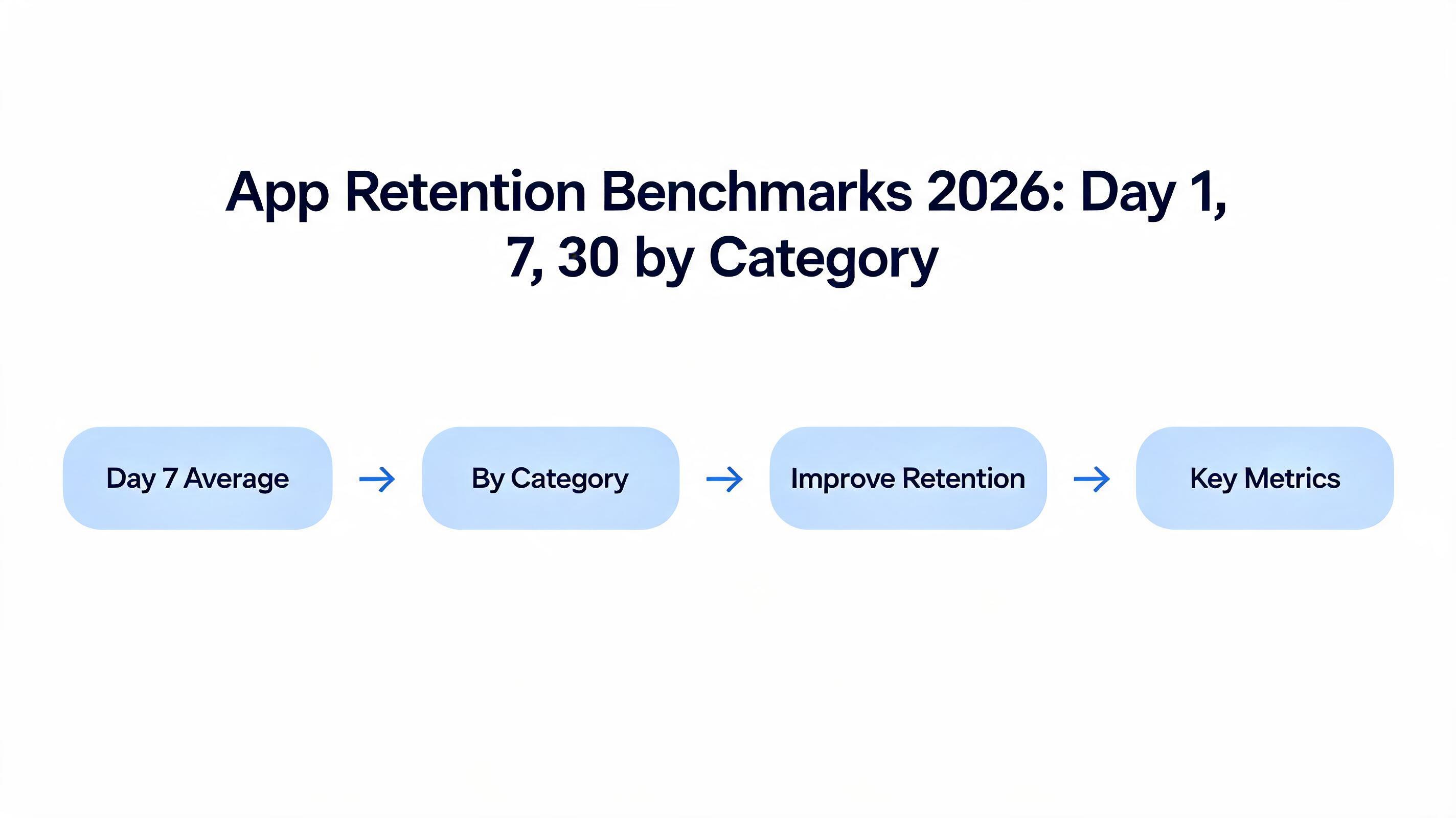
Median day-7 retention sits at roughly 10% to 12% across app categories, based on 2023 industry data (Sensor Tower), with median day-1 retention at approximately 25% to 27% (Adjust, 2023). In other words, about 9 in 10 users who install a typical app are gone within a week. Category matters enormously: the tables below break Day 1, Day 7, and Day 30 benchmarks down by vertical so you can compare against the right baseline.
Most Apps Lose Nearly All Their Users Within 30 Days. Here Is What the Data Actually Says.
On average, apps retain only 25% of users after day one and fewer than 5% after 30 days (Adjust, 2023). That statistic stops most growth teams cold the first time they see it. You spend months building a product, thousands of dollars on user acquisition, and then watch the overwhelming majority of those users vanish before the month is out. The brutal truth is that retention is not a feature problem or a marketing problem in isolation. It is a systems problem, and most companies are measuring the wrong things to fix it.
This post breaks down exactly what app retention benchmarks look like across categories, how top-performing apps achieve 2x to 3x the industry average, where most teams make avoidable mistakes, and what trends will define retention strategy through 2027. If you manage growth, product, or marketing for a mobile app, this is the guide you need.
Key Takeaways
- Average day-30 retention across all app categories sits below 5%, but top-quartile apps regularly achieve 15% or higher (Adjust, 2023).
- Push notification opt-in users retain at nearly 2x the rate of users who decline notifications (AppsFlyer, 2023).
- Gaming apps see the steepest early drop-off, losing roughly 70% of users within the first 72 hours (Sensor Tower, 2024).
- Personalization at onboarding can increase day-7 retention by up to 20 percentage points compared to generic flows (Adjust, 2023).
Check your app against these benchmarks
Paste your day-1, day-7, and day-30 retention numbers into this free checker to see how your app compares to category benchmarks:
What Is the Average Day-7 Retention Rate? (AppsFlyer Benchmarks)
Across all app categories, average day-7 retention sits in the 6% to 12% band, with a cross-category median near 8%. Day-1 retention averages roughly 25% to 30%, and day-30 retention falls to about 3% to 6% for most consumer apps. Finance, productivity, and subscription utilities run well above those averages; casual gaming and one-off utility apps run below them.
Those ranges are the ones worth memorising, because a single number is misleading. A 9% day-7 retention rate is mediocre for a fintech app and excellent for a hyper-casual game. Always compare against your own category, your own platform, and ideally your own acquisition channel, since paid installs almost always retain worse than organic ones.
Two practical cautions when you benchmark against published AppsFlyer, Adjust, or Sensor Tower figures:
- Definitions differ. "Day 7" can mean the seventh calendar day after install, or any session within a rolling seven-day window. The second definition produces materially higher numbers.
- Reporting years lag. Benchmark reports published in a given year usually describe data collected the year before, so a 2024 report largely reflects 2023 behaviour. Check the methodology page before treating a number as current.
The table below gives the working ranges we use with clients, blended from public benchmark reporting and the campaigns we run.
How does your app compare?
Benchmarks only matter once you know which cohort is leaking. Send us your day-1, day-7, and day-30 numbers and we will tell you on a free 30-minute call whether the problem is acquisition quality, onboarding, or the product itself, plus the two fixes we would run first. Book a free strategy call.
What Are the Standard App Retention Benchmarks by Category?
App retention benchmarks vary dramatically by category, and comparing your numbers against the wrong baseline will lead to bad decisions. The industry standard is to measure retention at day 1, day 7, day 14, and day 30, with some teams extending that to day 90 for subscription products.
Here is how the numbers break down across major verticals. Gaming apps experience the steepest drop-off of any category. Day-1 retention for mobile games averages around 30%, which sounds respectable until you realize day-7 retention falls to roughly 10% and day-30 retention collapses to 3% to 5% (Sensor Tower, 2024). Casual games sit at the lower end of those ranges; mid-core and strategy titles tend to perform better because their mechanics create natural habit loops.
Finance and fintech apps tell a very different story. Because users have a tangible financial incentive to stay engaged, day-30 retention in fintech regularly reaches 15% to 25%, making it one of the strongest-performing categories by that metric (AppsFlyer, 2023). Banking apps anchored to direct deposit or bill payment functions see even higher long-term retention because they become infrastructure in users' daily lives rather than discretionary tools.
Health and fitness apps sit somewhere in the middle. They benefit from habitual use patterns, especially when tied to wearable devices, but they also suffer heavily from the "new year effect," where January acquisition spikes give way to dramatic February drop-offs. Day-30 retention for health apps averages around 6% to 8% across the full calendar year (Adjust, 2023).
A real-world example makes this concrete. Duolingo, widely studied for its retention engineering, achieves day-30 retention well above category average for education apps through streak mechanics, loss aversion notifications, and social accountability features. Their approach demonstrates that benchmark-beating retention is not accidental. It is the result of deliberate design decisions made early in the product lifecycle.
The practical implication is this: before benchmarking your app, identify the correct peer group. A meditation app should not compare its retention to a mobile game, and a B2B SaaS tool with daily workflow integration should not benchmark against a consumer lifestyle app. Segment matters as much as the metric itself.
How Do Top-Performing Apps Actually Improve Retention Rates?
Top-performing apps improve retention by engineering habit formation from the very first session, not by reacting to churn after it happens. The highest-retention products treat onboarding not as a tutorial but as a conversion funnel with measurable drop-off points at every step.
Here is a practical framework for building a retention improvement system:
- Map your activation event. Every app has a specific action that, once completed, dramatically increases the probability a user will return. For a photo editing app it might be exporting a finished image. For a fitness app it might be completing a first workout. Identify yours with cohort analysis, then restructure onboarding to drive every new user toward that moment as fast as possible.
- Segment your push notification strategy. Blanket notifications are one of the fastest ways to drive users to disable permissions or delete the app entirely. Behavioral triggers, such as sending a re-engagement message when a user has not opened the app in 48 hours rather than on a fixed schedule, consistently outperform static campaigns. Push notification opt-in users retain at nearly 2x the rate of non-opt-in users, so getting that permission is itself a retention intervention (AppsFlyer, 2023).
- Personalize onboarding based on stated intent. Asking users why they downloaded the app and then immediately surfacing content relevant to that answer is one of the highest-leverage moves available to product teams. This single change can increase day-7 retention by up to 20 percentage points (Adjust, 2023).
- Build in-app feedback loops at the right moments. Asking for a review or rating immediately after a user completes a positive action captures sentiment data and reinforces the habit loop simultaneously. Timing this prompt correctly, not on the first session and not after a frustrating interaction, requires A/B testing but pays dividends in both ratings and retention.
- Establish a re-engagement window and stick to it. Most teams wait too long to pursue lapsed users. A user who has not opened an app in seven days is far easier to re-engage than one who has been dormant for 30 days. Define your re-engagement window based on your cohort data and build automated flows that activate within that window.
If you want to see how these retention principles apply specifically within a growth marketing context, our team at ApsteQ goes deep on this through our app marketing services, where we help mobile companies architect retention systems from acquisition through long-term engagement.
App Retention Benchmarks Across Key Metrics: A Data-Driven Breakdown
Understanding the full landscape of retention data requires looking beyond simple day-30 numbers. The best-performing growth teams track retention across multiple time horizons and cross-reference that data against acquisition channel, device type, and user segment.
Key data points that define the current retention landscape:
- Median day-1 retention across all app categories is approximately 25% to 27% (Adjust, 2023).
- By day 7, the median drops to roughly 10% to 12% across categories (Sensor Tower, 2024).
- By day 30, only the top quartile of apps maintain double-digit retention rates (AppsFlyer, 2023).
- Apps with in-app purchase flows see meaningfully higher long-term retention because purchasing behavior signals commitment and investment in the product.
- Social features, including friend lists, leaderboards, and community feeds, are consistently associated with retention rates 30% to 50% above category average for apps that implement them effectively.
| App Category | Day-1 Retention (%) | Day-7 Retention (%) | Day-30 Retention (%) |
|---|---|---|---|
| Mobile Gaming | 28-32% | 8-12% | 3-5% |
| Finance / Fintech | 35-40% | 20-25% | 15-25% |
| Health and Fitness | 30-35% | 12-16% | 6-8% |
| E-Commerce | 32-38% | 14-18% | 7-11% |
| Productivity / Utilities | 40-45% | 22-28% | 13-18% |
Sources: Adjust (2023), Sensor Tower (2024), AppsFlyer (2023). Ranges represent median to top-quartile performance across US market data.
The table above reveals something important: productivity and utility apps punch significantly above their weight class in retention. This is because they integrate into daily workflows rather than competing for discretionary attention. If your app can become a tool rather than an entertainment option, your retention trajectory shifts dramatically.
What Retention Mistakes Are Silently Killing Your App Growth?
The most damaging retention mistakes are not obvious bugs or crashes. They are strategic blind spots that compound over months and make churn look like an unsolvable mystery rather than a predictable, fixable pattern.
Mistake 1: Optimizing acquisition without measuring downstream retention by channel. This is the most expensive mistake in mobile growth. A paid social campaign might generate 10,000 installs at a low CPI, but if those users retain at half the rate of organic users, the real cost per retained user could be 3x to 4x higher than it appears. Always segment your retention cohorts by acquisition source. The best acquisition channel is not the one with the lowest CPI; it is the one with the best combination of CPI and downstream retention.
Mistake 2: Treating all churned users as equally lost. There is a meaningful difference between a user who opened your app once and never returned, a user who was active for two weeks and then lapsed, and a user who actively deleted the app. Each of those segments requires a different response. Many teams lump all three into a single "churned" cohort and apply generic win-back campaigns that are not relevant to any of the three groups.
Mistake 3: Ignoring the permission moment. The sequence and timing of requests for push notification permissions, location access, and other sensitive permissions have an outsized impact on long-term retention. Apps that request critical permissions before demonstrating value see dramatically lower opt-in rates. Lower opt-in rates mean fewer behavioral triggers available, which means weaker re-engagement capability across the board. This is a compounding problem.
Mistake 4: Building retention features without measuring the activation baseline first. Many teams invest in loyalty programs, streak mechanics, and social features before they have identified what percentage of new users are actually reaching the core value moment of the app. If 60% of new users are churning before they ever experience the main product feature, retention mechanics built for engaged users will have minimal impact.
Real example: A mid-size fitness app in the US invested heavily in a social leaderboard feature to improve retention. It moved the needle for users who were already in the habit loop. But day-7 retention barely changed because the majority of new users were churning before they ever reached the social features. The fix required restructuring onboarding, not adding more retention mechanics.
For a full audit of where your acquisition and retention strategy might have gaps, explore how ApsteQ approaches mobile growth through our app marketing framework.
App Retention in 2026 and 2027: Trends Every Growth Team Should Prepare For
The retention landscape is shifting, and the strategies that worked in 2023 are already becoming table stakes. Two macro forces will define how top apps approach retention over the next two years.
AI-driven personalization will become the baseline expectation, not a differentiator. Users are increasingly accustomed to products that anticipate their behavior. Apps that still serve generic content feeds or one-size-fits-all onboarding flows will feel outdated by 2026. The competitive gap between apps with machine learning-driven personalization and those without will continue to widen. Tools for implementing this kind of personalization at scale are becoming more accessible, which means smaller teams will have fewer excuses for not deploying them.
Privacy changes will continue to reshape the re-engagement toolkit. Apple's App Tracking Transparency framework and ongoing signal loss across platforms mean that traditional retargeting, which was a major retention lever for many app teams, is less reliable than it was three years ago. Teams that have built strong first-party data assets, including in-app behavioral data, email lists, and push notification audiences, will have a structural advantage in re-engagement over teams that relied heavily on third-party data (AppsFlyer, 2023).
Cross-platform retention will become a core metric. As users increasingly move between web, mobile web, and native app experiences, retention strategies that treat the app in isolation will miss a significant portion of the engagement picture. Apps with companion web experiences or progressive web app components are already tracking cross-platform retention as a distinct metric, and that approach will become standard practice by 2027.
The teams that win the retention battle over the next three years will be those that invest in owned channels, first-party data infrastructure, and behavioral personalization now, before those capabilities become industry requirements rather than competitive advantages.
Frequently Asked Questions
What is a good day-30 retention rate for a mobile app?
A good day-30 retention rate depends heavily on category, but as a general benchmark, anything above 10% is considered strong across most verticals. Top-quartile apps in fintech regularly achieve 15% to 25% at day 30, while gaming apps consider 5% exceptional. Compare your numbers against category-specific benchmarks rather than the all-app average, which sits below 5% (Adjust, 2023).
How do you calculate app user retention rate?
Retention rate is calculated by dividing the number of users who return on a specific day by the number of users who installed the app on day zero, then multiplying by 100. For example, if 1,000 users install your app and 100 return on day 7, your day-7 retention rate is 10%. Most mobile measurement platforms including AppsFlyer and Adjust calculate this automatically within their cohort reporting dashboards.
What is the biggest factor that causes app churn?
The single biggest driver of early churn is failure to reach the activation event, the specific in-app action that demonstrates core product value. Research consistently shows that users who reach the activation moment within their first session retain at dramatically higher rates. Poorly designed onboarding that delays or obscures that moment is responsible for the majority of day-1 and day-3 churn across most app categories (Adjust, 2023).
How can I improve my app retention rate quickly?
The fastest wins in retention typically come from three changes: restructuring onboarding to reach the activation event faster, enabling behavioral push notifications for users who opted in, and adding a re-engagement email or push sequence triggered at the 48-hour inactivity mark. These three levers can improve day-7 retention measurably within a single sprint cycle. For a deeper strategy, our app marketing services team can audit your current retention funnel and identify your highest-leverage opportunities.
Do push notifications actually improve app retention?
Yes, and the data is consistent on this point. Users who opt in to push notifications retain at nearly 2x the rate of users who decline permissions (AppsFlyer, 2023). The key variable is relevance: behavioral and triggered notifications significantly outperform static scheduled blasts. Apps that send more than 3 to 5 non-personalized push notifications per week see accelerated permission revocation, which eliminates the channel advantage entirely.
Conclusion: Turn Retention Data Into a Competitive Advantage
App retention benchmarks are not just diagnostic tools. They are a strategic roadmap. The gap between median retention and top-quartile retention is not luck or budget. It is the result of deliberate, data-informed decisions made at every stage of the product and marketing lifecycle.
Here is what the data tells us to do:
- Benchmark against your specific app category, not industry averages.
- Find your activation event and rebuild onboarding around it.
- Segment retention by acquisition channel and cut underperforming sources.
- Treat push notification opt-in as a retention intervention, not an afterthought.
- Invest in first-party data and behavioral personalization before privacy changes force the issue.
- Build re-engagement workflows triggered by inactivity windows, not calendar schedules.
The difference between an app that retains 5% of users at day 30 and one that retains 20% is not a product miracle. It is a system. If you want help building that system for your app, book a free strategy call with the ApsteQ team and we will show you exactly where your retention funnel has gaps and how to close them.
Free download
7 Expensive Mistakes That Kill App Launches
The launch errors we see most often across 300+ app engagements, and what to do instead.
Get the Free Ebook Browse all free guides