Here is a surprising reality check: 65% of all app downloads begin with a search in the app store (Apple Developer documentation, 2024). Yet most mobile app companies still treat App Store Optimization as an afterthought, bolting it on after launch instead of building it into their growth strategy from day one. The result? Millions of dollars in paid user acquisition spent compensating for organic visibility that should have been earned for free. In this guide, you will learn the ASO best practices for 2026 that top-performing mobile teams are using to dominate search rankings, improve conversion rates, and reduce dependence on costly paid channels. We cover metadata strategy, creative optimization, algorithm updates, common mistakes, and the emerging trends reshaping the discipline heading into 2027.
Key Takeaways
- 65% of app downloads originate from app store search, making organic visibility critical for sustainable growth (Apple Developer documentation, 2024).
- Apps that A/B test their store listing creatives see conversion rate lifts of up to 30% (Google Play Console documentation, 2024).
- The average top-ranked app targets between 3 and 5 high-intent keywords in its title and subtitle fields (Mobile Action, 2025).
- Localized store listings generate up to 26% more downloads in targeted regional markets compared to English-only listings (Adjust blog, 2024).
What Exactly Is ASO and Why Does It Matter More Than Ever in 2026?
App Store Optimization is the discipline of improving an app's visibility and conversion rate within app store search results and browse surfaces. In 2026, ASO matters more than ever because user acquisition costs have risen sharply, making organic discovery the most cost-efficient growth lever available to mobile teams.
Paid install costs across iOS and Android have climbed steadily since Apple's App Tracking Transparency framework disrupted mobile attribution. The global average cost per install on iOS reached $3.37 in 2024 (AppsFlyer research, 2024), and competitive verticals like finance and gaming frequently see CPIs five to ten times higher. Against that backdrop, an app that earns strong organic rankings can acquire users at near-zero marginal cost per install, fundamentally changing its unit economics.
The mechanics of ASO split into two distinct pillars. The first is keyword optimization, which governs how often and how prominently your app appears when users search. The second is conversion rate optimization (CRO), which determines what percentage of users who view your store listing actually tap "Get" or "Install." Both matter equally. An app ranking number one for a high-volume keyword but converting at 2% will underperform an app ranking number three that converts at 8%.
Consider the case of a productivity app that dominated "task manager" searches but had a generic icon and a first screenshot showing a blank interface. After a focused ASO audit, the team updated the icon color contrast, replaced the opening screenshot with a value-proposition overlay, and rewrote the subtitle to include the phrase "to-do list and planner." Within 60 days, conversion rate climbed from 3.1% to 7.4% with no change to paid spend. That kind of compounding organic improvement is what makes ASO a genuinely high-return investment in 2026's environment.
App store algorithms in 2026 also weigh behavioral signals more heavily than pure metadata matching. Ratings, reviews, user engagement, crash rate, and session length all feed into ranking calculations on both the App Store and Google Play. This means ASO is no longer a set-it-and-forget-it metadata exercise. It requires ongoing performance management across the full user lifecycle.
How Do You Build an Effective ASO Keyword Strategy for 2026?
A strong keyword strategy starts with understanding search intent, not just search volume. The goal is to identify terms your ideal users type when they are ready to download, not just browsing. Here is a step-by-step framework that top-performing mobile teams are following in 2026.
Step 1: Seed keyword research. Begin with your core value proposition. If your app helps freelancers invoice clients, your seeds are "invoice app," "freelance billing," and "expense tracker." Use tools like Mobile Action or Sensor Tower to pull search volume scores, difficulty ratings, and trend data for each seed term.
Step 2: Expand with competitor keyword mining. Identify your three to five closest competitors and analyze which keywords they rank for that you do not. These gaps represent immediate opportunities. Sensor Tower's keyword gap analysis and Mobile Action's competitor intelligence features make this process systematic rather than guesswork.
Step 3: Prioritize by relevance times opportunity. A keyword with a volume score of 60 and low competition will often outperform a keyword with a volume score of 90 and fierce competition from apps with ten times your rating count. Score each candidate by multiplying relevance (1-10) by achievability (1-10) and rank accordingly.
Step 4: Allocate keywords across metadata fields strategically. On the App Store, your title carries the highest ranking weight, followed by the subtitle, then the keyword field. On Google Play, the title and short description are indexed most heavily. The average top-ranked app places 3 to 5 high-intent keywords in its title and subtitle (Mobile Action, 2025). Never repeat a keyword across fields as the algorithm ignores duplicates and you waste valuable character real estate.
Step 5: Build a refresh cadence. Keyword relevance shifts with seasons, competitor actions, and product updates. Schedule a metadata audit every 60 to 90 days. When you release a major new feature, treat it as a keyword expansion event, adding terms tied to the new use case.
For mobile app companies that also serve regulated industries, keyword strategy intersects with compliance requirements in ways that demand specialist knowledge. Our team at ApsteQ handles this complexity daily across client portfolios. You can see how we approach integrated growth strategies on our app marketing services page, which covers organic and paid channel orchestration for scaling mobile products.
Finally, localization deserves its own sub-strategy. Translated metadata is not enough. Localized keyword research in the target language, using native speakers and in-country search data, consistently outperforms direct translation. This is where many US-based teams leave significant download volume on the table when expanding internationally.
ASO Benchmarks Every Mobile App Company Should Know in 2026
Data-driven ASO requires knowing what "good" looks like. The benchmarks below give you objective targets across the metrics that matter most, so you can assess your current performance and prioritize improvement areas.
Conversion rate is the percentage of store listing page views that convert to installs. Industry averages vary significantly by category. Games tend to convert lower because discovery often happens through social referral rather than direct search. Productivity and utility apps typically see stronger search-driven conversion because user intent is high.
Rating and review velocity is increasingly important. Google Play's algorithm openly weights recent ratings more heavily than historical averages, meaning a fresh wave of four and five-star reviews can reverse a ranking decline faster than any metadata change. Apps that actively prompt for ratings at high-satisfaction moments see review volumes three to five times higher than passive apps (Google Play Console documentation, 2024).
Key benchmarks to track in 2026:
- Store listing conversion rate: 25-35% is strong for utility apps; below 15% signals urgent creative optimization needed.
- Keyword ranking position: Top 3 positions capture the majority of clicks; position 10 and beyond generates minimal volume.
- Rating threshold: Apps below 4.0 stars see measurable conversion rate penalties on both platforms.
- Review response rate: Responding to reviews, especially negative ones, correlates with higher ratings over time and signals active developer engagement to algorithm signals.
- Update frequency: Apps updated at least every 30 days maintain stronger ranking signals than apps updated quarterly or less (Sensor Tower, 2024).
| ASO Metric | Benchmark (Good) | Benchmark (Excellent) | Primary Platform Driver |
|---|---|---|---|
| Store Listing Conversion Rate (%) | 20-30% | 35%+ | Both iOS and Android |
| Average Star Rating | 4.2 - 4.5 | 4.6+ | Both iOS and Android |
| Keyword Ranking Position (target) | Top 5 | Top 3 | App Store (iOS weighted) |
| App Update Frequency (days) | Every 30 days | Every 14-21 days | Google Play weighted |
| Review Response Rate (%) | 50-70% | 90%+ | Google Play weighted |
What Are the Most Costly ASO Mistakes Mobile App Companies Make?
Even experienced mobile teams repeat the same ASO errors year after year. Identifying and eliminating these mistakes is often faster than building new optimization tactics from scratch. Here are the most damaging mistakes we see in 2026, with real examples of how they play out.
Mistake 1: Stuffing keywords unnaturally into the title. A finance app called "Budget App, Money Tracker, Expense Manager, Bill Planner, Finance Tool" might seem keyword-rich, but it reads as spam to both the algorithm and the user. Apple has become more aggressive about rejecting or demoting apps with keyword-stuffed titles that sacrifice brand clarity. The title should communicate what the app is, with one or two naturally integrated keywords, not a comma-separated keyword dump.
Mistake 2: Ignoring the first three seconds of the screenshot carousel. Research consistently shows that the vast majority of users who do not immediately tap "Install" will glance at the first two screenshots before making their decision. Yet many development teams ship screenshots that are literal screen captures with no context, no caption overlay, and no visual hierarchy. This is a direct conversion rate killer. Your first screenshot should function like a billboard, communicating the primary value proposition in under three seconds with minimal cognitive load.
Mistake 3: Treating ASO as a one-time launch task. Many companies execute a solid ASO setup at launch and then let it stagnate for 12 months. Competitor apps update their metadata, new high-volume keywords emerge, and algorithm weights shift. An app that ranked well at launch can slide 20 positions in six months through pure inaction. ASO requires a quarterly optimization rhythm at minimum, and a monthly cadence for competitive categories.
Mistake 4: Running creatives tests without statistical significance. Google Play's store listing experiments are a powerful tool, but teams frequently call a winner after only a few hundred impressions. A/B tests need thousands of impressions and a clear primary metric (usually install rate) before results are actionable. Premature test conclusions lead to false confidence and can actually degrade conversion rates.
Mistake 5: Neglecting in-app rating prompts. Low review volume is one of the fastest ways to lose ranking ground. Many apps surface the rating prompt at the worst possible moment, immediately after installation or during a frustrating onboarding step. The prompt should appear after a user completes a core action that reflects genuine satisfaction, such as finishing a workout, saving a document, or completing a purchase. Properly timed prompts dramatically increase both volume and star rating.
For companies running parallel growth strategies across organic and paid, avoiding these errors becomes even more important. Our app marketing team at ApsteQ conducts full ASO audits that surface these exact issues, prioritize fixes by revenue impact, and implement changes with development-friendly briefs that reduce time to deployment.
Where Is ASO Heading in 2026 and 2027?
The ASO landscape is shifting faster than at any previous point in the discipline's history. Three forces are reshaping what "optimization" means heading into 2027: AI-generated metadata assistance, deeper integration of behavioral ranking signals, and the rise of alternative app distribution channels.
AI-assisted metadata generation is now embedded in tools like Mobile Action and AppFollow, allowing teams to generate keyword-rich descriptions, subtitle variants, and even screenshot copy at scale. However, the apps winning in 2026 are using AI as a starting point, not a final output. Human editorial judgment, brand voice alignment, and competitive differentiation still separate great store listings from generic ones.
Behavioral signals are becoming more deterministic in rankings. Both Apple and Google are placing greater weight on post-install engagement quality. An app with high installs but low Day 1 retention will see its organic rankings suppressed over time, even if its metadata is perfectly optimized. This means ASO and product teams must collaborate more closely than ever. Onboarding flow quality, feature adoption speed, and session depth all feed back into store ranking signals.
Alternative distribution is emerging as a parallel ASO frontier. The EU's Digital Markets Act has forced Apple to allow third-party app marketplaces in Europe, and this model may expand to other regions. Third-party Android stores already account for a significant share of installs in Asia and Latin America (data.ai, 2025), and optimizing for those surfaces requires adapted ASO approaches. US-focused companies will increasingly need to develop multi-marketplace strategies rather than treating the App Store and Google Play as the only venues that matter.
Voice search and AI assistant-driven discovery represent another emerging vector. As Siri, Google Assistant, and third-party AI tools become more capable at recommending apps contextually, the metadata signals that influence those recommendations will expand beyond traditional keyword fields into semantic content territories that teams should begin exploring now.
Frequently Asked Questions
How long does it take to see results from ASO changes?
Most metadata changes on the App Store take 3 to 7 days to be indexed and reflected in keyword rankings. Google Play typically indexes updates within 24 to 48 hours. Meaningful conversion rate improvements from creative tests generally require 2 to 4 weeks to accumulate enough data for statistical confidence. Plan for a 30 to 60 day window to see measurable organic download impact from a full ASO refresh.
How many keywords should I target in my App Store metadata?
Apple's keyword field allows 100 characters, and you should use all of them with comma-separated terms and no spaces after commas. Your title and subtitle collectively add roughly 45 more indexable characters. Prioritize 8 to 12 high-intent keywords across these fields. Avoid repeating any keyword across multiple fields, as Apple's algorithm ignores duplicates and you lose indexation coverage.
Does having more ratings always improve ASO rankings?
Volume matters, but recency and quality matter more in 2026. An app with 500 ratings averaging 4.7 stars in the past 90 days will typically outrank an app with 10,000 historical ratings averaging 3.9 stars. Both Apple and Google weight recent rating velocity heavily. Actively prompt satisfied users for reviews using native in-app request APIs to maintain a healthy and current ratings profile.
What is the difference between ASO and paid app install campaigns?
ASO drives organic (unpaid) installs through improved search visibility and store listing conversion, while paid campaigns like Apple Search Ads or Google UAC generate installs through direct ad spend. The two channels are complementary: strong ASO improves Quality Score in paid search campaigns, lowering cost per tap. Our app marketing services integrate both channels for compounding growth efficiency.
How important is the app preview video for conversion rates?
App preview videos can lift conversion rates by 15 to 25% when executed well, but they can also hurt performance if they are slow to start or fail to demonstrate core value within the first 3 seconds. Auto-play behavior on the App Store means the video's opening frame is the new "thumbnail." Test video versus no video as a controlled experiment before making it the permanent default for your store listing.
Conclusion
ASO in 2026 is a multidisciplinary growth function that demands keyword precision, creative excellence, behavioral performance management, and a consistent optimization cadence. Here are the actions that will move the needle most:
- Build a structured keyword strategy using competitor gap analysis and intent-based prioritization, refreshed every 60 to 90 days.
- Treat your screenshot carousel as a conversion asset, not a screen capture exercise, with clear value-proposition overlays.
- Monitor behavioral signals including Day 1 retention and session depth, because they feed directly into ranking algorithms.
- Run statistically significant A/B tests on creatives before declaring winners and making permanent changes.
- Prepare for multi-marketplace optimization as alternative distribution channels grow in the US and globally.
The mobile teams that treat ASO as a core growth discipline rather than a one-time setup task will compound their organic advantage quarter over quarter, dramatically reducing their cost per install and building defensible ranking positions that paid-only competitors cannot easily replicate. Ready to build a 2026 ASO strategy that delivers measurable results? Book a free strategy call with the ApsteQ team and let us audit your current store presence, identify your highest-impact opportunities, and build a roadmap to sustainable organic growth.
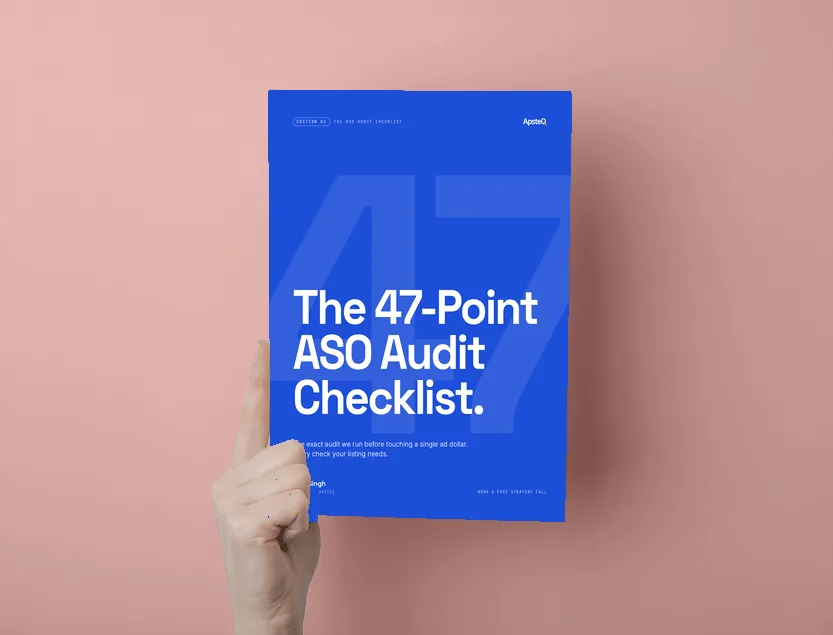
Free download
The 47-Point ASO Audit Checklist
The exact checklist we run before touching any app store listing. Find the gaps costing you organic installs.
Get the Free Ebook Browse all free guides