Facebook Ads for Apps: The Complete 2026 Growth Guide for Mobile App Companies
Mobile app advertisers spent over $362 billion on in-app advertising globally in 2023, yet the majority of app companies running Facebook campaigns still struggle to break even on user acquisition costs (Statista 2024). The problem is rarely budget. It is strategy. Most mobile app companies treat Facebook like a billboard when it functions best as a precision targeting engine, capable of reaching users who are statistically likely to install, engage, and pay.
This guide cuts through the noise. You will learn exactly how Facebook app install campaigns work in 2025, which bidding strategies actually lower your cost per install, why creative fatigue kills ROI faster than any algorithm change, and what the sharpest app marketing teams are doing differently to scale profitable user acquisition on Meta's platform.
Key Takeaways Before You Dive In
- Facebook and Instagram together reach 3.27 billion daily active users, making Meta the single largest paid acquisition channel available to app marketers (Statista 2024).
- The average cost per install (CPI) for iOS apps in the US sits between $2.37 and $4.10 depending on category, with gaming apps trending lower and finance apps pushing well above $6 (AppsFlyer Research 2024).
- App campaigns using Advantage+ App Campaigns see 32% lower cost per acquisition on average compared to manually configured app install campaigns (Meta internal data cited in AppsFlyer Research 2024).
- Only 24% of apps that get installed are used more than once, which means your Facebook campaign strategy must optimize for quality installs, not raw volume (Statista 2024).

How Do Facebook App Install Campaigns Actually Work in 2026?
Facebook app install campaigns operate through Meta's Advantage+ App Campaigns framework, which uses machine learning to match your ad creative to users most likely to install and engage with your specific app. The core mechanic is straightforward: you connect your app via the Meta SDK or a mobile measurement partner (MMP) like AppsFlyer or Adjust, define an optimization event, and Meta's algorithm does the targeting heavy lifting.
Here is what makes this different from standard Meta campaigns. When you run app install campaigns, you are not simply bidding for clicks. You are bidding for a specific downstream action, whether that is a simple install, a registration, or a first purchase. Meta's system then works backward from that event to find users who mirror those who already completed the action. This is called event optimization, and it is the single most important lever you have.
The setup process involves three foundational steps. First, integrate the Meta SDK into your app or connect an MMP. AppsFlyer and Adjust both offer direct Meta integrations that pass postback events in real time. Second, configure your App Events and verify they are firing correctly using the Events Manager. Third, select your campaign objective. For most app companies, App Installs works for volume, but switching to App Events optimization targeting "purchase" or "subscription" unlocks dramatically better downstream value.
Cost per install in the US averaged $3.60 for Android and $4.10 for iOS in 2024, but those numbers mask enormous variance by vertical (AppsFlyer Research 2024). A fitness app in the US might pay $5.20 per install while a casual gaming app pays $1.80 because the audiences, competition levels, and creative environments are completely different.
Consider how a mid-sized productivity app approached this. Rather than optimizing for installs, they switched their campaign objective to optimize for "trial started" events after 500 trials had been recorded. Within three weeks, cost per trial dropped 41% because Meta stopped delivering to install-and-forget users and started finding people who actually engaged with the product. This is not a trick. It is using the system the way it was designed to work.
One critical detail that most teams overlook: Meta requires at least 50 optimization events per ad set per week to exit the learning phase. If your ad set cannot generate that volume, the algorithm never stabilizes, and you are essentially paying for a perpetually confused campaign. This is why consolidating ad sets is almost always the right move for smaller budgets.
What Is the Best Facebook Ad Strategy for Growing an App's User Base?
The most effective Facebook ad strategy for app growth in 2025 combines funnel-stage segmentation, creative velocity, and retention-weighted bidding. This is not about picking one clever tactic. It is about building a system where each component reinforces the others.
Step 1: Define your true north metric before touching the campaign dashboard. Is it cost per install? Cost per registration? Cost per paying user? Your optimization event inside Meta must match the metric that actually determines business health. Companies that optimize for installs while measuring success by revenue always end up confused about why their ROAS looks broken.
Step 2: Build three distinct audience strategies running simultaneously. Your cold prospecting audience should use broad targeting with Advantage+ audience expansion enabled. Meta's algorithm has improved to the point where interest and demographic stacking often hurts performance by restricting the system's reach. Your warm retargeting audience should hit users who viewed your store listing or engaged with your ads but did not install. Your retention audience should target existing users segmented by behavior, pushing them toward in-app purchases or premium upgrades.
Step 3: Establish a creative testing cadence, not a creative testing event. The biggest mistake app marketers make is running a creative test once, picking a winner, and then leaving that creative to die slowly over three months. Creative fatigue on Meta typically sets in within three to six weeks for high-volume campaigns. You need a pipeline: introduce at least two to three new creative concepts every month, test them rapidly at low budget, and scale winners before they plateau.
Step 4: Use App Store product pages and Google Play custom store listings as landing page tests. Your Facebook ad is only half the equation. The app store page completes the conversion. Split testing your store listing visuals in parallel with your ad creative reveals which combination drives actual installs, not just clicks.
Step 5: Connect your MMP data back to Meta through the Conversions API for Apps. iOS 14.5 and subsequent privacy updates reduced the signal Meta receives through the standard SDK. Routing events through CAPI restores a significant portion of that signal, improving algorithm performance. Teams that implemented CAPI for apps reported an average 15% improvement in campaign efficiency according to AppsFlyer's 2024 research.
For a deeper look at how performance marketing principles translate across verticals, the ApsteQ app marketing resource hub covers mobile-specific acquisition frameworks in detail. Getting the strategy architecture right before scaling budget is the difference between efficient growth and expensive chaos.
Facebook Ad Performance Benchmarks Every App Company Should Know
Understanding where your campaigns stand relative to industry benchmarks is not optional. It is the only way to know whether you have an optimization problem or a product-market fit problem. The data here is specific to US markets and 2024 performance windows.
Cost per install benchmarks by category (US, 2024):
- Gaming apps: $1.20 to $2.50 average CPI (AppsFlyer Research 2024)
- Shopping and ecommerce apps: $3.10 to $4.80 average CPI (AppsFlyer Research 2024)
- Finance and fintech apps: $6.20 to $9.40 average CPI, the most expensive category consistently (AppsFlyer Research 2024)
- Health and fitness apps: $4.00 to $6.50 average CPI, with significant spikes in January and September (Adjust Blog 2024)
- Productivity apps: $3.50 to $5.20 average CPI, with strong correlation between ad creative quality and install rate (Adjust Blog 2024)
Click-through rate benchmarks for app install ads on Facebook average 1.5% to 2.5% for well-optimized creative, with video ads consistently outperforming static image ads by 20 to 30% in most app categories (Adjust Blog 2024).
Day-7 retention rate, meaning the percentage of users still active seven days after install, averages just 25% across all app categories globally (Statista 2024). This statistic matters enormously for Facebook campaign strategy because it means roughly three quarters of every install you pay for is gone within a week. Campaigns that do not account for post-install quality are essentially measuring the wrong thing.
Return on ad spend benchmarks are harder to generalize, but app companies running Meta campaigns with event optimization targeting purchases typically see 1.5x to 3.0x ROAS on a 30-day window in competitive US markets. Subscription apps with strong retention curves often see ROAS improve significantly at the 60 and 90-day windows as recurring revenue compounds.
Three additional performance patterns worth internalizing:
- Reels placements on Meta now drive lower CPMs than Feed placements by approximately 18 to 25% in app install campaigns, making them underpriced inventory for most app verticals (Mobile Action 2024).
- Campaigns using lookalike audiences built from high-value users (top 5% by lifetime value) consistently outperform broad interest targeting, but require a clean first-party data set of at least 1,000 users to generate a stable seed audience.
- Ad frequency above 3.5 impressions per user per week correlates strongly with CPM increases and install rate decline, a clear signal that creative refresh is overdue.
What Are the Most Costly Facebook Ads Mistakes App Companies Make?
The fastest way to drain a Facebook ads budget without results is to make one of these structural mistakes. These are not beginner errors. Many of them are made by experienced teams operating with outdated mental models of how Meta's system works in 2025.
Mistake 1: Optimizing for installs when you should optimize for events. This is the single most common and expensive error in app campaign management. When you optimize for installs, you get installs. Meta finds the cheapest installs possible, which are often users who download and immediately churn. As soon as you have 50 or more downstream conversion events recorded (purchases, subscriptions, registrations), switch your optimization event to reflect the action that actually generates revenue. The short-term CPI will appear to rise, but cost per paying user almost always drops significantly.
Mistake 2: Running too many ad sets with too little budget. When a $5,000 monthly budget is spread across eight ad sets, no individual ad set has enough spend to exit Meta's learning phase and generate statistically meaningful data. Consolidate. Run three to four ad sets maximum on that budget, let each one breathe, and resist the urge to pause and relaunch constantly. Every significant change resets the learning phase.
Mistake 3: Ignoring creative wear-out signals. App teams often set up campaigns, see initial results, and walk away. Frequency climbs, CPM increases, install rate drops, and the instinct is to blame the algorithm or the audience. Usually, the creative is simply exhausted. Build a dashboard that tracks frequency alongside CPI weekly. When frequency crosses 3.0 and CPI rises more than 20% week-over-week, the creative needs rotation, not the targeting.
Mistake 4: Skipping the mobile measurement partner integration. Running Facebook app campaigns without Adjust, AppsFlyer, or a comparable MMP is essentially flying blind. You cannot attribute across channels, you cannot measure post-install behavior accurately, and you cannot feed quality signals back to Meta's algorithm. The setup takes a few days and pays for itself in campaign efficiency within the first month.
Mistake 5: Treating all installs as equal in reporting. An install from a 35-year-old professional in San Francisco who uses the app three times a week is not the same as an install from a user who opens the app once and deletes it. Segment your install cohorts by behavior within your MMP and feed those quality signals back into Meta's system. This approach is detailed more extensively in the ApsteQ app marketing services section, where cohort-based optimization frameworks are covered for different app business models.
One real-world example: a SaaS-adjacent mobile app company was spending $45,000 per month on Meta with a reported CPI of $2.10, which looked impressive. When they connected their MMP and segmented by 30-day active users, their effective cost per engaged install was $18.40. They had been celebrating a metric that bore almost no relationship to actual business outcomes.
The Future of Facebook App Ads: What to Expect in 2026 and 2027
The Facebook ads ecosystem for apps is entering a period of significant structural change, driven by three converging forces: AI-generated creative automation, privacy-first measurement infrastructure, and the expanding role of Reels and short-form video in driving installs.
Meta's Advantage+ Creative suite is expanding rapidly. By 2026, most campaign creative will be dynamically assembled from component assets, with Meta's AI selecting background colors, copy variations, video clip sequences, and call-to-action text in real time based on individual user signals. App companies that build creative asset libraries with modular components will have a structural advantage over those who rely on finished, static ad units.
Privacy infrastructure will continue reshaping attribution. Apple's SKAdNetwork and Android's Privacy Sandbox are pushing the industry toward aggregated, modeled measurement rather than deterministic user-level tracking. AppsFlyer projects that over 70% of iOS attribution will rely on probabilistic or modeled methods by 2026 (AppsFlyer Research 2024). This means investing in first-party data collection inside your app, particularly email capture, account creation, and behavioral event logging, becomes a critical competitive advantage.
Short-form video's dominance will intensify. Reels already accounts for a growing share of time spent on Meta properties, and ad inventory within Reels is currently underpriced relative to engagement quality. App companies that build creative teams capable of producing native-feeling, vertically oriented video content at scale will capture disproportionate value in the 2026-2027 window before that inventory becomes as competitive as Feed placements.
Generative AI tools are also shortening the gap between creative ideation and production. Teams that once needed two weeks and a creative agency to produce five ad variants can now produce thirty variants in a week using AI-assisted video and image generation. Volume of creative testing will increasingly separate winning campaigns from stagnant ones.
Frequently Asked Questions
How much should a mobile app company budget for Facebook ads to see meaningful results?
Most app companies need a minimum of $5,000 per month to generate enough data for Meta's algorithm to exit the learning phase and optimize effectively. At that budget, you can fund 3 to 4 ad sets with enough daily spend to hit the 50-event-per-week threshold required for stable performance. Budgets below $2,000 per month rarely produce reliable optimization signals.
What is the difference between App Installs and App Events campaign objectives on Facebook?
App Installs optimization tells Meta to find users most likely to install your app, prioritizing volume and low CPI. App Events optimization tells Meta to find users likely to complete a specific downstream action, such as a purchase or subscription. Once you have 50 or more recorded events per ad set weekly, App Events optimization almost always produces better quality users and higher ROAS despite a higher apparent CPI.
Do I need a mobile measurement partner to run Facebook app install campaigns?
You do not technically need one, but running without a partner like AppsFlyer or Adjust means you cannot accurately measure cross-channel attribution, cannot segment install quality by post-install behavior, and cannot feed granular quality signals back to Meta's algorithm. Teams using an MMP consistently report 15 to 25% better campaign efficiency compared to SDK-only setups, making the integration cost highly worthwhile.
How can I reduce creative fatigue in my Facebook app campaigns?
Monitor your ad frequency weekly. When any ad set crosses 3.0 frequency and CPI rises more than 20% week-over-week, introduce new creative immediately. Build a pipeline of at least 2 to 3 new creative concepts monthly, test each at a small daily budget of $30 to $50, and promote winners to your primary ad sets before the existing creatives plateau. Video and Reels formats typically last longer than static images before wearing out.
What app marketing strategies work best alongside Facebook ads to maximize growth?
Facebook ads perform best when combined with App Store Optimization, which improves conversion from ad click to install, and with a strong onboarding experience that reduces early churn. Retargeting campaigns re-engaging lapsed users often produce the highest ROAS of any campaign type. For a complete multi-channel approach tailored to your app's category and growth stage, explore the frameworks outlined in ApsteQ's app marketing services, where paid and organic strategies are integrated.
Conclusion: Build a Facebook App Ads System, Not Just Campaigns
Facebook advertising for apps is one of the highest-leverage growth channels available to mobile companies in 2025, but only when approached as a system rather than a collection of individual campaigns. The core principles that separate profitable app advertisers from those burning budget are consistent across every category and budget level.
- Optimize for the event that reflects real business value, not the cheapest measurable action.
- Consolidate ad sets to give Meta's algorithm enough signal to learn effectively.
- Treat creative as a perishable asset and build a production pipeline, not a one-time test.
- Integrate a mobile measurement partner to connect ad spend to post-install revenue.
- Use benchmark data to distinguish optimization problems from product problems.
If your app's Facebook campaigns are generating installs without generating revenue, the strategy architecture needs a rebuild before the budget increases. ApsteQ works with mobile app companies at every growth stage to design acquisition systems that connect paid social spend directly to lifetime value outcomes.
Ready to stop guessing and start scaling? Book a free strategy call with the ApsteQ app marketing team and get a specific, actionable audit of your current Facebook campaigns within 48 hours.
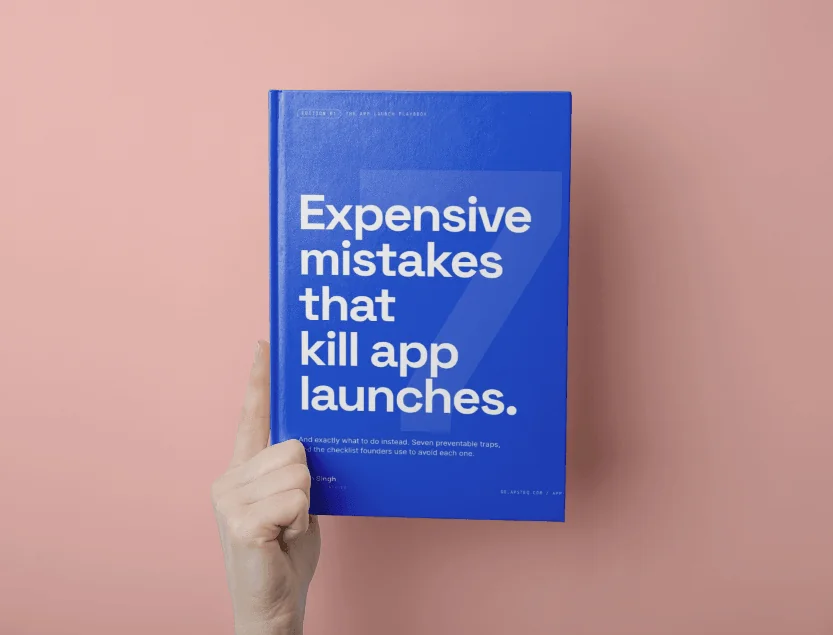
Free download
7 Expensive Mistakes That Kill App Launches
The launch errors we see most often across 300+ app engagements, and what to do instead.
Get the Free Ebook Browse all free guides