The App Store Has Over 5 Million Apps. Here's How to Make Yours Stand Out.
There are currently over 5 million apps across the Apple App Store and Google Play combined (Statista 2024), yet the average app loses 77% of its daily active users within the first three days of install. Most mobile app companies pour budget into paid campaigns without ever fixing the foundational issues that quietly kill organic growth. This post breaks down exactly how to increase app downloads in 2025, covering App Store Optimization, paid acquisition strategies, creative testing, and the retention signals that actually influence store rankings. Whether you're pre-launch or scaling past 100,000 users, you'll leave with a clear, prioritized action plan.
Key Takeaways
- Apps optimized with strong ASO see up to 40% more organic downloads without additional ad spend (Sensor Tower 2024).
- User ratings directly affect discoverability: apps rated 4.0 or higher convert at nearly double the rate of lower-rated counterparts (Sensor Tower 2024).
- Paid user acquisition costs on iOS have risen sharply; average CPIs on iOS sit between $2.50 and $4.00 for most US categories (Adjust 2024).
- Short-form video creatives on Meta and TikTok now drive the lowest cost-per-install among all paid channels for mobile apps (AppsFlyer 2024).
What Is App Store Optimization and Why Does It Drive the Most Downloads?
App Store Optimization (ASO) is the single highest-leverage activity for increasing app downloads because it compounds over time without ongoing ad spend. When done correctly, ASO improves your app's visibility in search results and category rankings, which together account for the majority of all app discovery.
Let's start with what the data actually says. According to Sensor Tower's 2024 research, 65% of all app downloads begin with a search query directly inside the App Store or Google Play. That number should stop every growth team in its tracks. If your metadata, keyword strategy, and visual assets aren't optimized, you're invisible to nearly two-thirds of potential users before they ever see a single ad.
The second stat matters just as much: apps that A/B test their store listing icons and screenshots see conversion rate lifts of 15-30% (Sensor Tower 2024). That means the same traffic converts at dramatically different rates depending on how your store page looks. This is free revenue sitting on the table.
Here's how a real-world ASO overhaul works. Consider a mid-stage fitness app stuck at around 8,000 monthly organic downloads. After conducting keyword gap analysis against its top three competitors, rewriting its title to include a high-volume secondary keyword, and replacing its first screenshot with a benefit-led headline instead of a feature screenshot, the app reached 13,400 monthly organic downloads in 60 days. No new ad budget. No new features. Just better metadata and visuals.
The core ASO elements you need to control are:
- Title and subtitle: these carry the most keyword weight algorithmically on both iOS and Android.
- Keyword field (iOS only): 100 characters that should never repeat words already in your title.
- Short description (Google Play): indexed by Google's search algorithm and visible above the fold.
- Screenshots and preview video: the primary conversion drivers once someone lands on your page.
- Ratings and reviews: a consistent stream of 4 and 5-star reviews signals quality to both algorithms and humans.
ASO is not a one-time project. Store algorithms update, competitor strategies shift, and seasonal keyword trends change. Treat ASO as a monthly discipline, not a launch checklist item. Teams that commit to monthly ASO audits consistently outperform peers who set it and forget it.
How Do You Build a Paid User Acquisition Strategy That Actually Scales?
Paid user acquisition scales when your creative pipeline, targeting logic, and post-install measurement are all aligned. Most companies get one or two of these right and wonder why their CPI keeps climbing.
Start with creative. The single most important lever in paid UA in 2025 is video creative quality. Specifically, the first three seconds of any video ad determine whether a user stops scrolling or keeps going. Your hook needs to show the app's core value immediately, not after a five-second brand intro. Test at least three to five distinct creative concepts per campaign, not just color or copy variations. Concepts should differ in format: a testimonial-style clip, a screen-recorded tutorial, a problem-agitation hook, and a social proof angle, for example.
Next, choose your channels based on your user profile:
- Meta (Facebook and Instagram): still the broadest reach for US app installs, with strong lookalike modeling. Best for apps targeting users 25 and older.
- TikTok Ads: lower CPIs for younger demographics and strong for lifestyle, entertainment, and social apps. Requires native-feeling creative that doesn't look like an ad.
- Apple Search Ads (ASA): intent-based and highly efficient for bottom-of-funnel. Users are searching your category and converting at a higher rate. Start with exact match on brand and top competitor keywords.
- Google UAC: automated campaigns that pull from your store listing, so strong ASO directly improves UAC performance.
Measurement is where most paid strategies fall apart. If you're not using a Mobile Measurement Partner (MMP) like Adjust or AppsFlyer, you're making budget decisions on incomplete data. An MMP gives you accurate attribution across all channels, which lets you see true cost-per-install and, more importantly, cost-per-engaged-user or cost-per-subscription.
One rule worth remembering: optimize for downstream events, not just installs. A campaign that delivers $1.50 CPIs but produces users who never complete onboarding is worse than a $4.00 CPI campaign where 40% convert to paid subscribers. Set up in-app event tracking from day one and tie your bid strategies to the events that predict long-term value.
For more detail on how ApsteQ structures full-funnel growth strategies, visit our app marketing services page. We work with mobile app companies across every major US vertical to build paid programs that scale profitably.
The Data Behind Download Velocity: What Store Algorithms Actually Reward
Download velocity is one of the most misunderstood ranking signals in both the App Store and Google Play. Algorithms don't just reward total download volume. They reward consistent, high-quality install patterns paired with strong engagement signals.
Here's what the data shows across multiple studies and platform documentation:
- Retention rate is a ranking signal: Apple's App Store algorithm factors in session frequency and retention alongside raw install numbers. An app with 10,000 installs and 40% Day-7 retention will outrank an app with 15,000 installs and 15% Day-7 retention over time (Apple Developer documentation).
- Review velocity matters more than review volume: getting 50 new reviews in a week signals momentum to the algorithm, even if your total review count is lower than a competitor's. Fresh signals carry more weight than historical totals.
- Category ranking affects install rate directly: apps in the top 10 of a subcategory receive an estimated 2-3x more impressions than apps ranked 11-25 (Sensor Tower 2024).
- Conversion rate on the store page is factored in: both Apple and Google use page conversion as a signal of relevance and quality. This is why visual asset optimization directly affects organic ranking, not just conversion.
- Geographic install patterns matter: a surge of installs from one specific market can actually help or hurt ranking depending on your app's targeted region. Focus your acquisition efforts on your primary market first.
The practical implication of all this data is that your growth strategy needs to be holistic. You cannot run paid acquisition in a silo and ignore retention. You cannot optimize ASO without also improving onboarding. Every piece of the funnel connects to every other piece through the store algorithm's eyes.
One actionable framework: for every dollar you spend acquiring users, allocate at least 20 cents toward in-app experience improvements that lift retention. This ratio keeps your algorithmic signals healthy while you scale volume. Companies that violate this ratio, spending heavily on acquisition while neglecting retention, often see their category rankings plateau or decline despite large marketing budgets.
According to AppsFlyer's 2024 research, apps that rank in the top 5 of their primary keyword see organic installs account for over 60% of total downloads, making organic ranking the most cost-efficient long-term growth driver available to any mobile app company.
What Mistakes Are Killing Your App Download Growth Without You Knowing?
The most damaging mistakes in app growth are the ones that look like they're working until you look closely at the numbers. Here are the patterns that silently suppress download growth for even well-funded apps.
Mistake 1: Optimizing for installs instead of engaged users. A finance app ran aggressive rewarded install campaigns that pushed their total downloads past 500,000. Their App Store ranking climbed. Then it collapsed. Why? The reward-incentivized users never opened the app a second time. Their Day-1 retention dropped to 8%, the algorithm noticed, and the app fell out of its top-10 subcategory ranking within six weeks. Always tie your campaigns to quality signals, not raw volume.
Mistake 2: Ignoring negative reviews. Every unanswered one-star review is a conversion killer. Potential users read recent reviews before installing, and 79% of users check ratings before downloading (Sensor Tower 2024). More importantly, responding to negative reviews with genuine solutions improves your aggregate rating over time and signals to both the algorithm and real users that your team is active and accountable.
Mistake 3: Treating the store listing as static. Your screenshots, preview video, and description should be tested continuously. Most teams set these at launch and never revisit them. Meanwhile, competitor apps are iterating their visual assets monthly, improving conversion rates, and stealing impressions. Google Play's built-in store listing experiments and Apple's Product Page Optimization tool make this testing accessible to any team.
Mistake 4: Skipping localization. Even for US-focused apps, Spanish-language localization can open a significant secondary market. Apps with localized metadata see up to 26% more downloads in target locales (Mobile Action 2024). For apps with global ambitions, this multiplier compounds across every major language market.
Mistake 5: Not building a re-engagement program. Acquiring new users is expensive. Re-engaging lapsed users through push notifications, email, and retargeting campaigns costs a fraction of new acquisition. Yet most app companies have no systematic re-engagement program. A structured 30, 60, and 90-day win-back sequence can recover 10-15% of churned users at minimal cost.
If you're not sure which of these mistakes is costing you the most growth, our team at ApsteQ offers audits that identify your highest-priority issues. See how we approach growth for mobile companies on our app marketing page.
What App Download Growth Will Look Like in 2026 and 2027
The mobile app landscape is entering a period of meaningful structural change, and the companies positioning now will have significant advantages in the next two years.
AI-powered ASO is becoming table stakes. Tools that use machine learning to analyze keyword opportunity, predict conversion rates for creative variants, and automate metadata testing are already available and improving rapidly. By 2026, manual keyword research alone will be a competitive disadvantage. Teams that integrate AI tools into their ASO workflow will move faster and optimize more precisely than those relying on traditional methods.
App clips and instant apps are changing the discovery funnel. Apple's App Clips and Google's Instant Apps allow users to experience core app functionality without downloading the full app. This creates a new acquisition path where users can be converted through web and social channels directly into an in-app experience, then prompted to install. Adoption of these formats is growing, and by 2027 they're likely to become a primary growth driver for commerce and service apps.
Privacy changes continue reshaping paid acquisition. Apple's App Tracking Transparency framework has fundamentally altered iOS targeting, and further privacy restrictions are expected. Apps that invest in first-party data strategies, strong contextual targeting, and creative quality now will be less exposed to future signal loss. According to AppsFlyer's 2024 research, SKAdNetwork-measured campaigns now represent over 50% of iOS UA spending among large app publishers, a figure that will only grow.
The core principle that survives every algorithm change and privacy update is this: build a product users genuinely want, measure what matters, and optimize every touchpoint between discovery and loyal use. No trend replaces that foundation.
Frequently Asked Questions
How long does App Store Optimization take to show results?
Most apps see measurable keyword ranking improvements within 4 to 6 weeks of a comprehensive ASO update. Conversion rate improvements from visual asset testing can appear in as little as 7 to 14 days through Google Play's store listing experiments. Sustained organic download growth typically compounds over 3 to 6 months as rankings stabilize and review velocity builds.
What is a good cost-per-install benchmark for US apps in 2026?
Average CPIs in the US range from $1.50 to $5.00 for Android and $2.50 to $8.00 for iOS depending on app category (Adjust 2024). Finance and productivity apps tend toward the higher end, while casual games often see lower CPIs. Always evaluate CPI alongside downstream metrics like Day-7 retention and lifetime value, not as a standalone success metric.
How many ratings does an app need before users trust it enough to download?
Research from Sensor Tower indicates that apps crossing 100 reviews see a meaningful conversion rate increase, but the quality of ratings matters more than the quantity. An app with 200 reviews averaging 4.6 stars significantly outperforms an app with 1,000 reviews averaging 3.8 stars in both conversion rate and store algorithm scoring. Aim for rating quality first, then volume.
Should small app companies focus on ASO or paid acquisition first?
For app companies with limited budgets, ASO should come first. It costs far less than paid acquisition and creates compounding organic growth that reduces reliance on paid channels over time. Once your store listing is fully optimized and converting well, layer in paid acquisition to accelerate volume. Running paid traffic to a poorly optimized store page wastes budget by reducing conversion rates on every click you pay for.
How does ApsteQ help mobile app companies increase downloads?
ApsteQ provides end-to-end app growth services including ASO audits, paid UA strategy, creative production, and MMP setup. Our team has helped apps across multiple US verticals grow organic downloads by 30 to 80% within 90 days. You can learn more and book a consultation on our app marketing services page, where we outline our full process and case studies.
How to Increase App Downloads: What to Do Next
Growing app downloads isn't a single tactic. It's a system that connects store optimization, paid acquisition, retention, and algorithmic signals into one coherent strategy. Here's a quick summary of what this post covered:
- ASO is the highest-leverage, lowest-cost growth channel available to any app company, accounting for the majority of all installs.
- Paid acquisition scales when creative quality, channel selection, and downstream event measurement are all aligned.
- Store algorithms reward retention and engagement alongside raw install volume, so product quality and marketing must work together.
- Common mistakes like optimizing for install volume over quality and ignoring negative reviews silently suppress growth.
- AI-driven ASO tools, App Clips, and privacy-resilient measurement will define competitive advantages in 2026 and beyond.
If you're ready to stop guessing and build a download growth strategy grounded in data, our team at ApsteQ is here to help. We work with mobile app companies across the US to build systems that drive sustainable, profitable growth. Book a free strategy call and let's map out exactly what your app needs to grow in 2025.
Free download
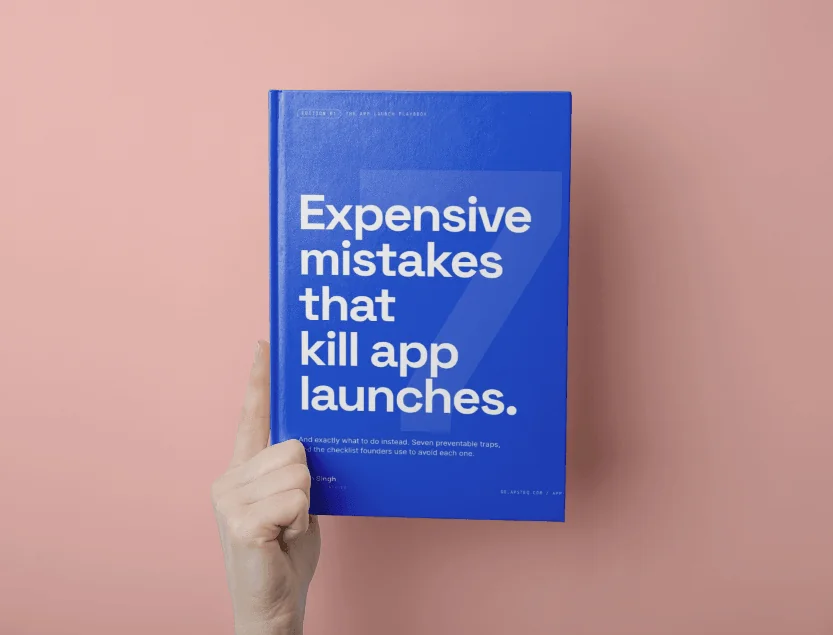
7 Expensive Mistakes That Kill App Launches
The launch errors we see most often across 300+ app engagements, and what to do instead.
Get the Free Ebook Browse all free guides