App Marketing Services in 2026: What Mobile Companies Actually Need to Grow
App marketing services are specialized growth strategies, including app store optimization, paid user acquisition, and lifecycle engagement, designed to help mobile apps acquire, convert, and retain users at scale. If your app is struggling to grow despite a solid product, this guide explains what modern app marketing services cover, how to choose the right approach, and which mistakes cost companies the most money.
Roughly 2.87 million apps are available on Google Play and 1.96 million on the Apple App Store (Statista, 2026). Getting discovered in that environment is not a product problem. It is a marketing problem. Below, you will find a breakdown of every major service category, a benchmark table comparing performance by channel, and a look at where app marketing is heading through 2027.
Key Takeaways
- The average app loses 77% of its daily active users within three days of install (Adjust, 2024), making post-install engagement as important as acquisition.
- Apps in the top 1% of the App Store generate 8x more downloads than average-ranked competitors in the same category (Sensor Tower, 2025).
- Paid user acquisition on mobile now averages $3.52 cost-per-install (CPI) across all verticals in the United States (AppsFlyer, 2025).
- ASO alone can reduce paid acquisition costs by 20-40% by improving organic conversion rates before a single ad dollar is spent (Mobile Action, 2025).
What Do App Marketing Services Actually Include?
App marketing services cover the full funnel from discoverability to retention, and the best providers treat those stages as interconnected, not separate contracts. Understanding each layer helps you spend smarter and avoid hiring specialists who optimize one metric at the expense of another.
The core service categories break down into four areas:
- App Store Optimization (ASO): Keyword research, metadata optimization, screenshot design, and conversion rate testing inside the app stores themselves.
- Paid User Acquisition (UA): Running performance campaigns on Meta, Google UAC, Apple Search Ads, TikTok, and programmatic networks to drive installs at a target cost.
- Lifecycle and Retention Marketing: Push notifications, in-app messaging, email sequences, and segmentation to keep users active after install.
- Creative Strategy: Producing and testing video ads, playable ads, and static creatives tailored to each channel's algorithm.
A real example of how these layers interact: fitness app Noom scaled from roughly 1 million to over 45 million registered users partly by combining aggressive paid acquisition on Facebook with a deeply optimized onboarding flow that lifted 30-day retention. Neither lever alone would have produced that outcome. The paid team needed the retention numbers to justify continued spend; the retention team needed the volume from paid to test meaningfully.
Organic search now drives roughly 65% of all app downloads (Sensor Tower, 2025), meaning ASO is not a nice-to-have supplement to paid campaigns. It is the foundation. When your store listing converts at 35% instead of 20%, every downstream dollar stretches further.
For app companies evaluating outside help, the key question is not "do we need marketing?" but "which layer is the bottleneck right now?" A 0.5% store conversion rate is an ASO problem. A 90-day churn rate above 60% is a lifecycle problem. Paying a UA agency to pour more users into a leaking funnel is a fast way to burn budget.
ApsteQ's app marketing services are structured around diagnosing that bottleneck first, then building the service mix around it, rather than selling a fixed package regardless of your actual metrics.
How Should You Structure an App Marketing Strategy in 2026?
A strong app marketing strategy starts with a pre-launch ASO audit, then layers paid acquisition only after the organic foundation converts reliably. Skipping the sequencing is one of the most common reasons companies waste their first growth budget.
Here is a practical six-step sequence used by growth teams managing apps above 100,000 monthly active users:
- Audit your store listing conversion rate. Pull your product page conversion rate from App Store Connect or Google Play Console. Anything below 25% for a consumer app signals that creative or copy is blocking installs before budget even enters the picture.
- Run keyword gap analysis. Use tools like Mobile Action or Sensor Tower to identify high-volume, low-competition keywords your competitors rank for but you do not. Integrate those into your subtitle, keyword field, and short description without keyword stuffing.
- A/B test screenshots and icons. Google Play's Store Listing Experiments and Apple's Product Page Optimization allow native split testing. Even a 5-percentage-point lift in conversion rate compounds dramatically at scale.
- Set up attribution before spending on paid. Install a mobile measurement partner (MMP) like Adjust or AppsFlyer before launching any paid campaign. Without attribution, you cannot tell which channel or creative is driving quality installs versus cheap installs that churn on day one.
- Start paid acquisition with Apple Search Ads (ASA). ASA reaches users with demonstrated intent (they searched for something in the App Store), and average conversion rates on ASA are 50-65% higher than broad audience networks (Apple Developer documentation, 2025). It is the lowest-risk paid channel to prove unit economics.
- Expand to Meta and UAC once CPI benchmarks are validated. Only after you know your day-30 retention and monetization well enough to calculate a reliable lifetime value (LTV) should you open higher-volume, higher-variance channels.
This sequencing matters because paid UA costs rose 18% year-over-year in Q1 2026 (AppsFlyer, 2026), compressing margins for teams that rely on paid alone. The apps growing profitably right now are combining strong organic search presence with efficient paid campaigns, not replacing one with the other.
If you want a team to build and manage this stack end-to-end, explore ApsteQ's user acquisition services, which cover everything from MMP setup to creative production and bid optimization.
App Marketing Channel Benchmarks: Where the Data Points in 2026
The fastest-growing apps in 2026 are not spending more. They are spending more efficiently, and the difference comes down to knowing which channels deliver the best LTV-to-CPI ratio for their specific category. The table below pulls together current benchmarks across the major channels.
| Channel | Average CPI (US, 2026) | Day-30 Retention Rate | Best App Categories | Source |
|---|---|---|---|---|
| Apple Search Ads | $2.10 - $4.50 | 28-35% | Finance, Health, Productivity | AppsFlyer, 2025 |
| Meta (Facebook/Instagram) | $1.50 - $5.80 | 18-24% | Gaming, eCommerce, Social | Adjust, 2024 |
| Google UAC | $0.80 - $3.20 | 15-22% | Gaming, Utility, Travel | AppsFlyer, 2025 |
| TikTok Ads | $0.60 - $2.90 | 12-18% | Entertainment, Gaming, Lifestyle | Mobile Action, 2025 |
| Organic ASO | $0 (indirect) | 35-45% | All categories | Sensor Tower, 2025 |
Three patterns jump out from this data:
- Organic installs retain dramatically better. Users who find an app through search already have intent. They are not impulse-installing because an ad interrupted their scroll, and the day-30 retention gap (35-45% organic versus 12-24% paid) proves it.
- TikTok's low CPI comes with a retention tradeoff. The cost efficiency looks attractive, but day-30 retention below 18% means LTV calculations need to account for the drop-off before declaring TikTok a winning channel.
- Apple Search Ads consistently delivers the best quality-adjusted installs for subscription apps in finance and health, where a single retained user can generate $80-200+ in annual revenue. The higher CPI is worth it when LTV supports the ratio.
The benchmarks above also explain why app marketing is not a single-service purchase. Optimizing ASO, managing paid campaigns, and improving post-install retention require different skill sets, different tooling, and different measurement cadences. Many app companies underperform because they buy one piece of the stack and wonder why the others do not improve on their own.
What Mistakes Are Killing App Marketing Budgets Right Now?
The most expensive app marketing mistakes are structural, not tactical. Fixing a bad creative or adjusting a bid is recoverable. Building the entire strategy around the wrong objective costs months of spend and often delays the product's market window permanently.
Here are the five mistakes that appear most consistently across mobile app companies spending $50K or more per month on growth:
Mistake 1: Optimizing for installs instead of events. Running campaigns to a generic "install" conversion event is a 2020-era approach. Modern growth teams optimize for post-install events like "completed onboarding" or "made a purchase" within 72 hours. Algorithms on Meta and Google UAC are sophisticated enough to find users likely to complete those deeper events, not just users who tap an ad. Teams that have not made this shift are overpaying for installs that never activate.
Mistake 2: Ignoring ASO after launch. The App Store algorithm weights keyword relevance dynamically based on user behavior signals and competitive changes. An ASO strategy set at launch and never revisited loses ranking quietly over months. One mid-sized productivity app saw a 40% drop in organic downloads over six months after launch, directly tied to competitors refreshing metadata around keywords the original team had targeted. A quarterly ASO audit would have caught the ranking erosion early.
Mistake 3: Running paid campaigns without an MMP. Without a mobile measurement partner, attribution defaults to last-click, which systematically overvalues retargeting and undervalues prospecting channels. Teams end up cutting prospecting budgets that were actually driving new user volume because the LTV was not being credited correctly.
Mistake 4: Conflating installs with growth. An app that installs 100,000 users and retains 8,000 at day 30 has a retention problem, not a growth problem. Pouring more paid spend into a leaking funnel accelerates cash burn without building a sustainable user base. Fix the product experience and onboarding first.
Mistake 5: Treating creative as an afterthought. In performance marketing, creative is the primary variable. Two campaigns with identical targeting but different creatives can produce CPIs that differ by 3x. Teams that produce one or two creatives and run them for months are leaving enormous efficiency gains untested.
ApsteQ's ASO services include regular ranking audits, competitive monitoring, and metadata refresh cycles built into the engagement, so ranking erosion gets caught before it becomes a recovery project.
Where Is App Marketing Heading Through 2027?
Three structural shifts are reshaping how app marketing services will be bought and delivered over the next two years, and companies that adapt early will have a measurable advantage over those still running 2024-era playbooks.
AI-driven creative generation is compressing testing cycles. Generative AI tools now allow teams to produce 40-60 creative variants per week instead of 4-6. The bottleneck is no longer production. It is the analytical capacity to read results accurately and prioritize the next iteration. AI automation services are increasingly embedded inside growth stacks to handle that analysis layer, freeing human strategists to focus on positioning and channel strategy.
Privacy changes are making first-party data the primary moat. Apple's App Tracking Transparency framework and Google's planned deprecation of Android Advertising IDs are compressing the signal available to ad platforms. Apps that have built strong CRM data layers, email lists, and push notification engagement will outperform in this environment because their own data supplements what the platforms can no longer provide.
App store search behavior is evolving. Approximately 70% of App Store users now discover apps through search (Apple Developer documentation, 2025), and that figure is rising as the stores add AI-powered recommendations. ASO is shifting from a keyword-ranking exercise to a broader search intent and conversion optimization discipline, much closer to traditional SEO.
The apps that will win in 2027 are building their marketing infrastructure now, before privacy constraints tighten further and before competitors lock in the keyword rankings and audience data that become harder to displace over time.
Frequently Asked Questions
What are app marketing services and who needs them?
App marketing services are professional growth strategies covering ASO, paid user acquisition, lifecycle marketing, and creative production for mobile applications. Any company with a live app targeting growth in downloads, revenue, or retention can benefit. Apps spending more than $10,000 per month on paid channels without attribution data or ASO in place almost always see immediate efficiency gains from professional services.
How much do app marketing services typically cost?
Pricing varies by scope. ASO-only engagements typically range from $2,000 to $6,000 per month. Full-service app marketing, including paid UA management, lifecycle marketing, and creative production, generally runs $8,000 to $30,000 per month for mid-market apps. Enterprise programs managing $500K-plus in monthly ad spend carry percentage-of-spend fee structures on top of retainers (AppsFlyer, 2025).
How long does app store optimization take to show results?
ASO keyword ranking changes typically appear within 2 to 4 weeks of a metadata update, based on App Store and Google Play indexing cycles. Meaningful organic download growth from ASO usually becomes visible in 60 to 90 days. Competitive categories with entrenched apps may require 4 to 6 months of sustained optimization before rankings reach the first page for high-volume terms (Sensor Tower, 2025).
What is the difference between ASO and SEO for apps?
ASO (App Store Optimization) is the practice of improving an app's visibility and conversion rate within the Apple App Store and Google Play. It shares keyword strategy principles with traditional SEO but operates inside closed store algorithms that weigh install velocity, ratings, and engagement signals differently than Google's web crawler. Store listing conversion rates, screenshots, and review management have no direct SEO equivalent.
How do I choose the right app marketing agency?
Look for agencies that show channel-specific case studies with retention metrics, not just install volume. Ask whether they use a mobile measurement partner and which MMP they recommend. Confirm they separate ASO from paid UA instead of bundling them loosely. ApsteQ's app marketing team provides a diagnostic audit in the first 30 days to identify your specific bottleneck before building a service plan, avoiding generic packages that don't match your actual data.
Final Takeaways
App marketing in 2026 is more competitive than it has ever been, but the companies winning are not necessarily spending more. They are diagnosing the right bottleneck, running structured channel strategies with proper attribution, and treating ASO as a permanent growth lever rather than a launch task.
- Organic ASO drives up to 65% of downloads and produces the highest day-30 retention of any channel (Sensor Tower, 2025).
- Paid UA works best after ASO and attribution infrastructure are in place, not before.
- Creative testing frequency, not creative quality alone, is the largest variable in paid campaign efficiency.
- Privacy changes through 2027 will reward apps that build first-party data assets now.
If you want an honest look at where your app's growth is actually leaking, the fastest next step is a dedicated strategy session with a team that has worked across every layer of the stack. Book a free strategy call with ApsteQ to get a channel-by-channel audit and a prioritized roadmap built around your specific metrics, not a template.
Free download
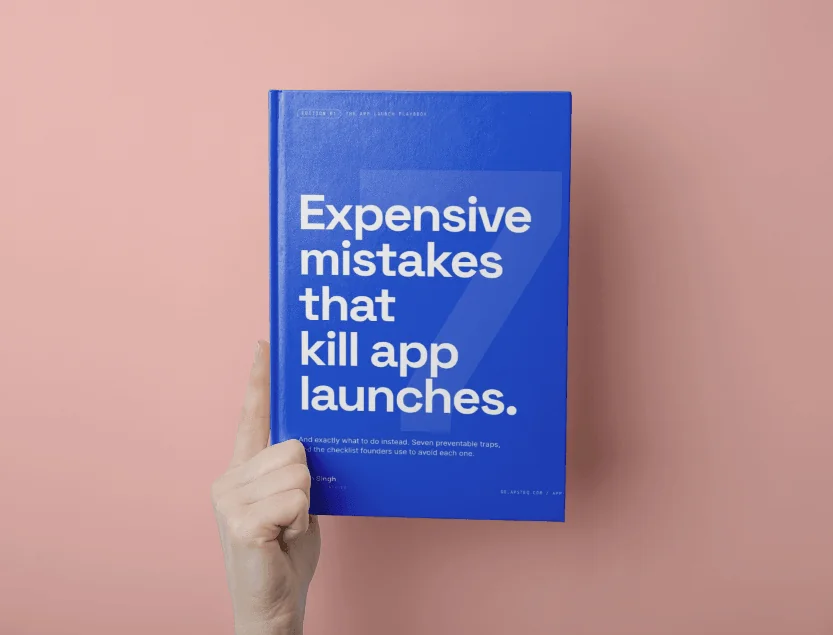
7 Expensive Mistakes That Kill App Launches
The launch errors we see most often across 300+ app engagements, and what to do instead.
Get the Free EbookBrowse all free guides