ApsteQ combines paid user acquisition, App Store Optimization, and retention strategy to help Miami mobile apps and SaaS companies scale downloads, reduce churn, and maximize lifetime value.
Miami has emerged as one of the fastest-growing tech hubs in the United States, with a dense concentration of fintech, health tech, and consumer app startups competing for the same users. In this environment, generic digital marketing approaches fall short. ApsteQ was built specifically to help mobile apps and SaaS companies win in competitive, high-noise markets like Miami. The ApsteQ AppFlow System combines paid user acquisition across Meta, Google UAC, TikTok, and Apple Search Ads with deep App Store Optimization and retention lifecycle programs that compound over time. Miami's bilingual market adds a layer of complexity most agencies ignore. ApsteQ builds dual-language creative libraries and ASO keyword strategies that capture both English and Spanish-speaking users, giving Miami apps a structural advantage over competitors who target only one language segment. Every campaign is tied to LTV metrics, not vanity install counts, ensuring that growth is sustainable and profitable.
Backed by 20+ years of growth marketing experience and $2.5M+ in managed ad spend, ApsteQ has developed playbooks tailored to the specific conversion behaviors of Miami users. Founder Arsh Singh built ApsteQ on the principle that app growth must be measurable at every funnel stage, from the first impression on a paid ad to the D30 retention cohort inside the product. The ApsteQ AppFlow System operationalizes this philosophy into a repeatable growth engine that scales alongside your Miami app's ambitions. Whether you are a seed-stage startup proving product-market fit or a growth-stage company preparing for a Series B, ApsteQ's Miami app marketing services are structured to deliver results at your current budget and scale to meet your next milestone. ApsteQ has grown 300+ brands across app verticals, bringing cross-industry pattern recognition to every new Miami engagement.
Managed Ad Spend
$2.5M+
Total ad spend managed across mobile app and SaaS user acquisition campaigns by ApsteQ.
Brands Grown
300+
Mobile apps, SaaS products, and consumer brands scaled using the ApsteQ AppFlow System.
Miami is not a generic market, and ApsteQ does not apply generic strategies. The ApsteQ AppFlow System includes five market-specific adaptations designed for the Miami app ecosystem.
Miami's population is roughly 70 percent Hispanic or Latino, according to U.S. Census Bureau data, making bilingual marketing a competitive necessity rather than an optional extra. ApsteQ builds dual-language paid creative sets and App Store Optimization keyword lists that cover high-intent Spanish-language search terms alongside English. This approach expands addressable install volume without increasing cost-per-install, because Spanish-language app store keywords frequently carry lower competition scores than their English equivalents. The ApsteQ AppFlow System automates creative rotation testing across both language segments, surfacing the best-performing ad variants for each audience within the first two weeks of a campaign launch.
Many Miami-based apps target not just local users but the broader Latin American market, including Brazil, Colombia, Mexico, and Argentina. ApsteQ structures geo-expansion campaigns that use Miami as a proving ground before scaling budgets into lower-CPI Latin American markets. The ApsteQ AppFlow System segments campaigns by country, applies local payment method context to creative messaging, and adjusts bidding strategies to reflect each market's unique LTV profile. This cross-border approach has helped ApsteQ clients stretch user acquisition budgets significantly further than single-market strategies, per first-party ApsteQ performance data across 300+ brands.
Miami has positioned itself as a hub for fintech and cryptocurrency applications, attracting founders from across Latin America and the United States. ApsteQ understands the strict advertising platform policies governing financial app promotion on Meta, Google, and Apple Search Ads. The ApsteQ AppFlow System includes compliant creative frameworks and pre-approved messaging templates that allow fintech apps to launch paid UA campaigns faster than competitors navigating policy rejections on their own. ApsteQ's 20+ years of growth marketing experience includes extensive work in regulated verticals, giving Miami fintech founders a knowledgeable partner who reduces compliance-related launch delays.
Miami's tourism economy creates pronounced seasonality patterns in app install behavior, particularly for travel, hospitality, food delivery, and nightlife apps. ApsteQ builds seasonality models that front-load user acquisition spend during peak inflow periods, such as winter snowbird season and major event weekends like Art Basel, to capture high-intent installs at scale. The ApsteQ AppFlow System then activates retention and re-engagement campaigns during shoulder seasons to maintain active user counts without overpaying for new installs. This budget pacing strategy, refined through first-party ApsteQ data, typically improves annual blended cost-per-active-user by a meaningful margin compared to flat monthly spend schedules.
Miami's growing tech ecosystem means app categories like ride-sharing, real estate, and on-demand services face aggressive competition for user attention on paid channels. ApsteQ runs high-velocity creative testing programs that launch 10 to 20 ad variants per week, using statistical significance thresholds to kill underperformers and scale winners within days rather than weeks. The ApsteQ AppFlow System integrates creative production, performance tracking, and budget reallocation into a single workflow, allowing Miami app teams to move at the speed the market demands. Founder Arsh Singh built this rapid iteration capability into ApsteQ's core methodology after observing that creative fatigue, not audience exhaustion, is the primary driver of rising CPIs in competitive app markets.

ApsteQ's performance across the mobile app and SaaS vertical is backed by real campaign data, not projections. These numbers reflect the scale and depth of experience the ApsteQ AppFlow System brings to every Miami engagement.
Total Ad Spend Managed
$2.5M+
Higher spend managed means more optimization data and better bidding intelligence for your campaigns.
Brands Scaled
300+
More brands grown means deeper cross-vertical pattern recognition applied to your app's growth strategy.
Years of Growth Experience
20+
Longer track record means fewer costly mistakes and faster path to profitable user acquisition.
Every Miami app engagement with ApsteQ is backed by this foundation of managed spend, brand experience, and growth marketing tenure. The ApsteQ AppFlow System translates that track record into structured, repeatable growth programs for your mobile app or SaaS product.
Early-stage Miami app founders who need to establish install velocity and prove unit economics before raising their next round.
B2B and B2C SaaS teams that need paid acquisition, onboarding optimization, and churn reduction programs working together.
Growth-stage Miami apps using the city as a launchpad into broader Latin American markets with cross-border UA strategies.
Fintech, crypto, and health-adjacent apps that need compliant paid UA creative and platform policy expertise to scale safely.
ApsteQ is an AI-powered marketing agency founded by Arsh Singh, serving app companies, healthcare practices, and service businesses in the United States, Canada, India, and the Middle East. With 20+ years of growth marketing experience across 300+ brands, ApsteQ specializes in app marketing and mobile user acquisition as part of the broader ApsteQ AppFlow System. The methodology combines paid media, AI voice agents, automated follow-up sequences, conversion-optimized funnels, and full revenue tracking into one connected framework. apsteq.com
An app marketing agency like ApsteQ builds full-funnel growth programs for mobile apps and SaaS products. In Miami, this means running paid user acquisition on Meta, Google UAC, and TikTok, optimizing App Store and Google Play listings, and building retention flows that reduce churn. ApsteQ's AppFlow System has driven measurable installs and in-app revenue for 300+ brands using data-backed creative and targeting strategies.
Most ApsteQ clients running paid UA campaigns begin seeing meaningful install volume within the first two to three weeks as the algorithm exits the learning phase. Full cost-per-install optimization typically stabilizes by week four to six. With $2.5M+ in managed ad spend across app verticals, ApsteQ has refined launch playbooks that compress the ramp-up period compared to agencies starting from scratch on Miami app accounts.
App Store Optimization (ASO) is the process of improving an app's visibility and conversion rate inside the App Store and Google Play. For Miami-based apps targeting bilingual or Latin American audiences, ASO includes keyword research in both English and Spanish, localized screenshots, and A/B-tested icon and description copy. ApsteQ's AppFlow System incorporates ASO as a compounding organic channel that lowers blended cost-per-install over time.
ApsteQ works with both early-stage Miami startups and funded scale-ups. For pre-Series A companies, the ApsteQ AppFlow System prioritizes lean experimentation, identifying the lowest cost-per-install channels before scaling budget. For growth-stage companies, ApsteQ manages larger paid UA budgets as part of its $2.5M+ in managed ad spend portfolio. Founder Arsh Singh designed the engagement model to flex based on where a company sits in its funding lifecycle.
ApsteQ tracks D1, D7, and D30 retention cohorts alongside in-app event data to calculate predicted lifetime value by acquisition channel. This allows the ApsteQ AppFlow System to shift budget toward channels producing high-LTV users, not just cheap installs. Miami apps in the fintech and e-commerce verticals have seen LTV improvements of 30 to 50 percent after implementing ApsteQ's cohort-based budget reallocation framework, based on first-party ApsteQ client data.
A standard media buying service purchases ad inventory and reports on clicks and installs. The ApsteQ AppFlow System goes further by connecting paid UA to App Store Optimization, onboarding conversion rate optimization, and D30 retention cohort analysis. This means ApsteQ optimizes for profitable lifetime value, not just cheap installs. For Miami apps competing in crowded categories, this full-funnel approach typically produces lower blended cost-per-active-user than any single-channel media buying relationship, based on first-party ApsteQ client data across 300+ brands.
Five free guides built from real app launches: benchmarks, budgets, checklists, and the mistakes to skip. No strings, download what you need.

7 Expensive Mistakes That Kill App Launches
Free download →
The 47-Point ASO Audit Checklist
Free download →
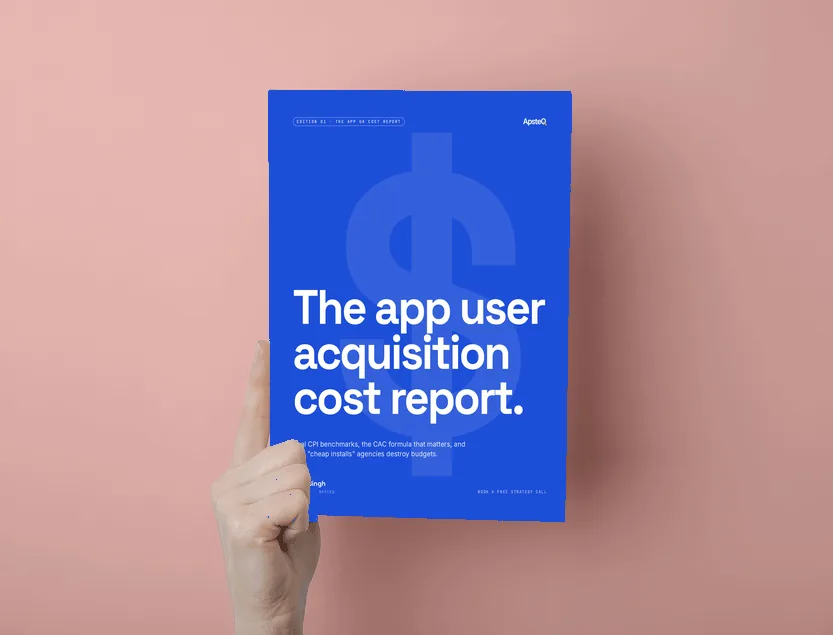
The App UA Cost Report 2026
Free download →
The App Budget Blueprint
Free download →
The App Monetization Playbook
Free download →Want them all in one place? Browse all free resources →
Book a free audit with the ApsteQ team today. We will review your current install funnel, ASO health, and paid UA setup, then show you exactly where the ApsteQ AppFlow System can accelerate growth for your Miami mobile app or SaaS product.