The App Marketing Company Decision That Shapes Your Growth Trajectory
Only 0.5% of apps in the Apple App Store and Google Play ever reach meaningful scale, according to a Sensor Tower 2024 analysis of app store performance across categories. That number stops most founders cold. The apps that do break through almost never do it alone; they work with a specialized app marketing company that brings channel expertise, creative testing infrastructure, and paid media budget efficiency that in-house teams rarely develop fast enough to matter.
This post breaks down what an app marketing company actually does, how to evaluate one before you sign a contract, the metrics that separate competent agencies from great ones, and the mistakes that cost mobile app companies six figures in wasted spend. By the end, you will have a practical framework for making this hire.
Key Takeaways
- The global mobile advertising market reached $362 billion in 2023 and is projected to surpass $400 billion by 2026 (Statista 2024), meaning competition for installs is only intensifying.
- Apps that invest in App Store Optimization see organic install lifts of up to 30% with no corresponding increase in paid spend (Apple Developer documentation, 2024).
- Median cost-per-install on iOS across all verticals sits between $2.37 and $4.10, depending on category and campaign type (AppsFlyer Performance Index, 2024).
- Mobile apps that use multi-touch attribution correctly reduce wasted ad spend by an average of 15-20% within 90 days of implementation (Adjust blog, 2024).
What Does an App Marketing Company Actually Do for Mobile Growth?
An app marketing company is a specialized agency that manages the full funnel of mobile app growth, from pre-launch store optimization through paid user acquisition, creative production, and lifecycle retention campaigns. The core deliverable is not impressions or downloads in isolation; it is profitable user growth, measured against your app's unit economics.
The scope is wider than most founders expect. A capable team covers:
- App Store Optimization (ASO): keyword research, metadata optimization, screenshot A/B testing, and rating management to improve organic visibility in both the App Store and Google Play.
- Paid user acquisition (UA): running campaigns across Apple Search Ads, Google App Campaigns, Meta Advantage+, and TikTok for Business, each requiring distinct creative formats and bidding strategies.
- Creative strategy and production: developing video and static ad assets, iterating on hooks, and running creative fatigue analysis to sustain cost-per-install efficiency at scale.
- Mobile measurement and attribution: configuring partners like Adjust or AppsFlyer to route data cleanly, then building reporting dashboards that connect ad spend to downstream revenue events.
- Lifecycle and push marketing: segmenting users by behavior, building in-app messaging sequences, and reducing churn through targeted re-engagement campaigns.
A real example shows the breadth: Calm, the meditation app, combined aggressive Apple Search Ads bidding on competitor brand terms with high-production video creatives emphasizing sleep outcomes. The result was a category rank climb that Sensor Tower tracked publicly in its 2023 Health and Fitness category report. No single tactic drove that outcome; it was the coordination across channels that made the difference.
Cost-per-install benchmarks vary sharply by category. Gaming apps on Android average a CPI of roughly $0.80 to $1.20, while fintech apps on iOS can exceed $8.00 per install (AppsFlyer Performance Index, 2024). An experienced app marketing company uses these benchmarks not as targets but as diagnostics: if your CPI is materially above category median, something in your creative, targeting, or store listing is broken.
The measurement layer is where agencies earn or lose their fees. Apps that correctly attribute installs to their true source, accounting for view-through conversions and SKAdNetwork reporting delays, consistently outperform apps running last-click attribution because budget allocation decisions are grounded in reality rather than incomplete data.
How Do You Choose the Right App Marketing Company for Your Stage?
Choosing an app marketing company is stage-dependent. The agency that helps a Series A fintech app scale from 10,000 to 500,000 monthly active users is not necessarily the right partner for a pre-launch indie game studio trying to build its first 1,000 organic users. Matching agency capability to your current growth stage prevents expensive misalignment.
Here is a practical evaluation process broken into four steps:
- Define your primary growth constraint before you talk to anyone. Is it organic discoverability (an ASO problem), install volume at acceptable CPI (a paid UA problem), post-install retention (a product or lifecycle problem), or creative fatigue (a production problem)? Agencies specialize. Know what you need before you ask what they offer.
- Request category-specific case studies, not general performance claims. An agency showing you a 40% CPI reduction for a gaming app is not evidence they can do the same for your B2B SaaS mobile tool. Ask for results in your specific vertical and growth stage. Real case studies include the measurement methodology, not just the headline number.
- Evaluate their attribution stack fluency. Ask directly: which mobile measurement partners do you work with, how do you handle iOS 17+ privacy changes, and how do you report incrementality versus correlation? Vague answers here are a red flag. Attribution complexity is the single most common source of agency-client conflict when results disappoint.
- Assess creative production capacity independently of media buying. Some agencies are excellent at buying media but weak at producing the short-form video and interactive ad formats that drive performance in 2026. Ask to see their creative testing process: how many variants do they run per flight, what is their kill threshold for underperforming creatives, and who owns the brief?
If your app serves a specific vertical, consider agencies with adjacent expertise. For example, companies with healthcare or wellness apps sometimes benefit from agencies that understand regulated categories and consent-based targeting. ApsteQ's app marketing services are built specifically for mobile app companies that need channel strategy, creative, and measurement under one roof rather than three separate vendor relationships.
Budget fit matters too. Most serious growth agencies require a minimum media budget of $15,000 to $30,000 per month to run statistically meaningful creative tests. Below that threshold, the data volume is too thin to optimize confidently, and you are essentially paying for activity rather than learning.
App Marketing Company Performance: Benchmarks That Separate Good from Great
The difference between a good and a great app marketing company shows up in specific metrics, not in pitch deck language. Use these benchmarks to evaluate ongoing performance once a campaign is live.
| Metric | Weak Performance | Strong Performance | Source |
|---|---|---|---|
| Day-1 Retention | Below 25% | Above 40% | Adjust blog, 2024 |
| Day-30 Retention | Below 5% | Above 12% | Adjust blog, 2024 |
| iOS CPI (non-gaming) | Above $6.00 | Below $3.50 | AppsFlyer Performance Index, 2024 |
| App Store CVR (impression to install) | Below 2% | Above 5% | Mobile Action, 2024 |
| Creative refresh frequency | Monthly or less | Bi-weekly or faster | AppsFlyer, 2024 |
| ROAS by Day 30 | Below 0.5x | Above 1.2x | AppsFlyer Performance Index, 2024 |
Three observations from this data set worth highlighting:
- Retention is the metric that exposes creative-quality mismatches. A low CPI paired with poor Day-1 retention usually means the ad creative is over-promising relative to the actual app experience. Great app marketing companies audit the creative-to-onboarding handoff as a unit, not separately.
- App Store conversion rate is frequently the highest-leverage optimization available. Moving from a 2% to a 5% App Store CVR on existing organic traffic has the same financial effect as a 150% increase in impression volume, with zero increase in paid spend. Organic install improvements compound over time in ways that paid spend cannot (Apple Developer documentation, 2024).
- ROAS timelines differ by monetization model. Subscription apps need longer ROAS measurement windows (Day 60 or Day 90) because trial-to-paid conversion introduces a structural delay. Agencies that optimize for Day-7 ROAS in a subscription context systematically under-invest in high-LTV user segments.
The global mobile app market generated $935 billion in consumer spend in 2023 (data.ai State of Mobile 2024), with the United States representing the highest average revenue per user across most categories. That revenue concentration is why the US app marketing agency market is crowded and why benchmark fluency matters so much in vendor selection.

What Mistakes Do Mobile App Companies Make When Hiring a Marketing Agency?
The most expensive mistakes in app marketing agency relationships are structural, not tactical. They happen before a single campaign goes live, and they are almost always preventable.
Mistake 1: Optimizing for CPI instead of downstream LTV. A fintech startup hired an agency based on its promise to deliver installs at $1.80 CPI in a category where the median was $4.00. The agency delivered. Within 60 days, Day-30 retention was 3% and ROAS at Day-90 was 0.18x. The cheap installs came from broad interest targeting that attracted users who had no genuine need for the product. Measuring UA performance on CPI alone is the single most common structural error in mobile growth.
Mistake 2: Treating ASO as a one-time setup task. App Store algorithms update continuously. In 2024, Apple changed how it weighted keyword relevance in search results at least twice, and Google Play's algorithm penalized apps with stale screenshots relative to competitors running active creative tests (Mobile Action 2024 algorithm tracker). Brands that optimize their store listing once at launch and then ignore it typically lose 10-15% of organic visibility within six months to competitors who run continuous ASO programs.
Mistake 3: Fragmenting attribution across too many platforms without a single source of truth. Companies that run Apple Search Ads, Meta, and Google App Campaigns with no unified mobile measurement partner end up with triple-counted installs, because each platform counts its own assisted conversions. Without Adjust or AppsFlyer as the deduplicated source of truth, budget allocation decisions are made on inflated performance data for every channel simultaneously.
Mistake 4: Skipping the creative brief process. Mobile ad creative is the primary performance variable in paid UA. Agencies that produce creative without a documented brief tied to specific audience segments and funnel stages consistently underperform agencies that run structured creative sprints. If an agency cannot show you its creative testing hypothesis before a campaign launches, the testing it runs will be random rather than systematic.
For app companies evaluating their overall growth stack, ApsteQ's user acquisition services include attribution setup, creative strategy, and paid channel management as an integrated program rather than a menu of disconnected services.
Where App Marketing Is Heading in 2026 and 2027
Two structural shifts are reshaping what effective app marketing looks like over the next 18 months, and both favor companies that start building capability now rather than waiting for the trends to fully mature.
AI-powered creative generation is compressing production timelines. Agencies that previously needed two weeks to produce and deliver a set of video ad variants are now delivering comparable creative volume in three to four days using generative video tools layered on top of human creative direction. The quality ceiling is still set by human strategists, but the iteration speed is not. This means the agencies running 40 creative variants per month in 2026 are outcompeting agencies still running 8 to 10, simply because the data volume from more tests produces faster optimization signals.
Privacy-preserving measurement is becoming a competitive moat. Apple's SKAdNetwork and Google's Privacy Sandbox for Android are both maturing, and apps that have built probabilistic measurement models alongside deterministic attribution are retaining 20-25% more signal than apps relying exclusively on device-level data (Adjust Privacy-Focused Attribution report, 2024). By 2027, measurement fluency will likely be the primary differentiator between agencies, not media buying access.
A third trend worth watching: the rise of AI automation in lifecycle marketing. Personalized push notification sequences and in-app message flows driven by behavioral prediction models are already showing meaningful lifts in Day-30 retention for apps that deploy them. ApsteQ's AI automation services for mobile apps focus specifically on connecting behavioral data to automated engagement sequences that retain users past the critical first 30-day window.
Frequently Asked Questions
How much does it cost to hire an app marketing company in 2026?
Agency retainers for app marketing typically range from $5,000 to $25,000 per month depending on scope, with media spend managed separately. Full-service programs including ASO, paid UA, and creative production generally start around $10,000 per month. Minimum media budgets for statistically meaningful campaign testing are usually $15,000 to $30,000 per month on top of agency fees.
What is the difference between ASO and paid user acquisition?
App Store Optimization (ASO) is the practice of improving an app's organic visibility in App Store and Google Play search results through keyword optimization, metadata, and creative asset testing. Paid user acquisition uses ad spend on platforms like Apple Search Ads, Meta, and Google to drive installs directly. Both are essential: ASO improves conversion rate on traffic you already receive, while paid UA generates new traffic volume (Apple Developer documentation, 2024).
How long does it take to see results from an app marketing agency?
ASO improvements typically show measurable organic install lifts within 4 to 8 weeks of implementing keyword and creative changes. Paid UA campaigns generally require 30 to 60 days of data before optimization decisions are statistically reliable, especially on iOS where SKAdNetwork reporting introduces a 24-48 hour conversion window delay. Full ROAS measurement for subscription apps requires a 90-day window minimum to capture trial-to-paid conversion rates accurately (AppsFlyer Performance Index, 2024).
Can an app marketing company help with both iOS and Android growth?
Yes, but the strategies differ significantly. iOS campaigns run through Apple Search Ads and are subject to SKAdNetwork privacy constraints. Android campaigns use Google App Campaigns with broader targeting options and more granular conversion data. Strong agencies build separate creative and bidding strategies for each platform rather than running identical campaigns on both, because user behavior and platform algorithms differ enough to require distinct approaches (Mobile Action, 2024).
How does ApsteQ's app marketing approach differ from a general digital agency?
ApsteQ focuses exclusively on mobile app growth rather than general digital marketing, which means the team's expertise in ASO, mobile attribution, and app-specific paid channels is deeper than at a generalist agency. You can explore the full scope of services and see whether the approach fits your stage at ApsteQ's app marketing page. The team works with US-market mobile app companies on integrated programs, not disconnected channel tactics.
Conclusion: Choosing the App Marketing Company That Fits Your Growth Stage
The right app marketing company accelerates the one outcome that matters: profitable, scalable user growth. The wrong one burns media budget on cheap installs that churn before they generate revenue. The difference almost always comes down to measurement discipline, creative velocity, and category-specific experience rather than pitch deck claims.
Concrete steps to take this week:
- Identify your primary growth constraint before contacting any agency: ASO, paid UA, creative, or retention.
- Request category-specific case studies with attribution methodology included, not headline numbers alone.
- Confirm the agency's mobile measurement partner fluency and ask specifically how they handle iOS privacy constraints.
- Set a minimum 90-day evaluation window for subscription apps and a 60-day window for transactional apps before making optimization decisions.
If you want a direct conversation about what an integrated app marketing program looks like for your specific app and growth stage, book a free strategy call with the ApsteQ team. The call is structured around your metrics, not a generic agency pitch.
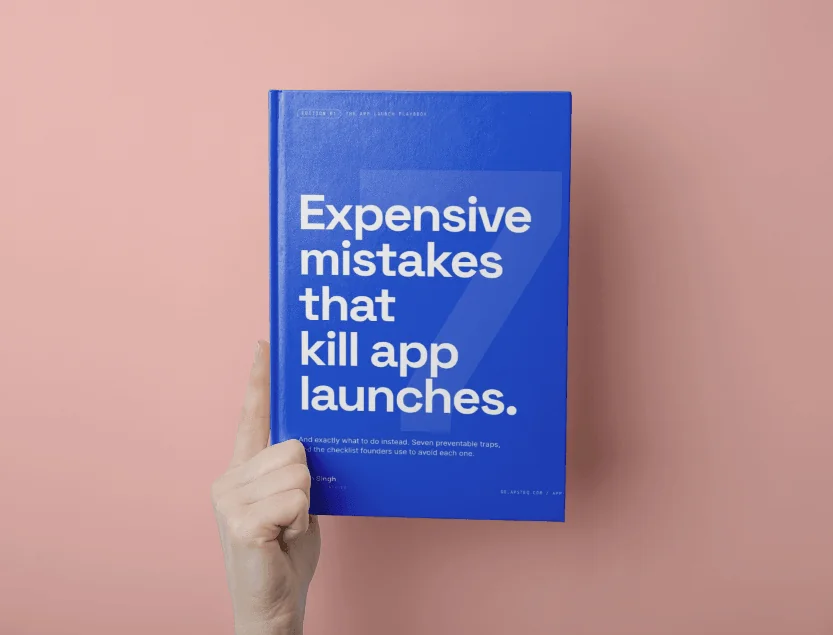
Free download
7 Expensive Mistakes That Kill App Launches
The launch errors we see most often across 300+ app engagements, and what to do instead.
Get the Free EbookBrowse all free guides