
Mobile App Marketing in 2026: What Actually Drives Downloads, Retention, and Revenue
Only 24% of users return to an app after the first day (Adjust Mobile App Trends Report, 2023), which means most mobile app companies are spending serious money to acquire users they lose almost immediately. The problem is rarely the app itself. It is almost always the marketing strategy surrounding it. This post covers what mobile app marketing actually requires in 2026: how to build a sustainable acquisition funnel, which channels produce measurable ROI, what the data says about retention-focused campaigns, and the mistakes that drain budgets before a single loyal user is won.
Key Takeaways
- Day-1 retention averages just 24% across app categories, making post-install engagement campaigns as important as acquisition (Adjust Mobile App Trends Report, 2023).
- Apps that invest in App Store Optimization see up to 35% more organic installs without increasing paid spend (Sensor Tower, 2024).
- Global mobile advertising spend reached $362 billion in 2023 and continues to climb, yet most mid-sized app companies allocate fewer than 20% of that budget to retention (Statista, 2024).
- The average cost per install on iOS in the US sits between $3.60 and $6.00 depending on category, with finance and health apps running considerably higher (AppsFlyer Performance Index, 2024).
What Is Mobile App Marketing and Why Does the Traditional Funnel Break Down?
Mobile app marketing is the set of strategies and paid or organic channels used to attract, convert, and retain users for a mobile application across its entire lifecycle, from pre-launch awareness through long-term monetization. Understanding why the traditional funnel fails here is the first step to fixing it.
Standard digital marketing assumes a linear path: impression, click, purchase, done. App marketing does not work that way. A user can install an app, open it once, and never return, and the install still counts as a conversion in many dashboards. That gap between "installed" and "retained" is where most mobile app marketing budgets quietly disappear.
Consider Duolingo's early growth. The team did not simply run paid ads to the App Store. They built a pre-registration waitlist, invested heavily in push notification personalization from day one, and A/B tested their onboarding flow continuously. The result was a Day-7 retention rate that outperformed category benchmarks by a wide margin, according to their 2021 S-1 filing. The lesson is that acquisition and retention are not separate departments; they are two sides of the same budget conversation.
The data supports this urgency. Apps lose 77% of their daily active users within the first three days after install (Adjust Mobile App Trends Report, 2023). That number climbs to roughly 90% by day 30. When cost per install on iOS in the US ranges from $3.60 to $6.00 for mainstream categories (AppsFlyer Performance Index, 2024), a 90% churn rate within a month means you are paying between $36 and $60 for every user who actually sticks around past the first month. For finance or subscription health apps, where CPIs routinely exceed $10, those economics are existential.
The structural fix is what practitioners call the "full-funnel app marketing model": paid acquisition feeds into an onboarding optimization layer, which feeds into behavioral segmentation and re-engagement campaigns. Each stage requires different tools, different KPIs, and often different vendor relationships. Treating app marketing as a simple "run some Meta ads" exercise is the single fastest way to burn a launch budget with nothing to show for it.
How Do You Build a Mobile App Marketing Strategy That Actually Scales?
A scalable mobile app marketing strategy rests on four sequential decisions: channel selection based on category benchmarks, creative testing cadence, ASO as a revenue lever, and a measurement framework that ties spend to lifetime value rather than raw installs.
Step 1: Match channels to your app category. Gaming apps generate strong returns from rewarded video and playable ad units on networks like Unity Ads and ironSource. Utility and productivity apps often see better LTV from Google UAC and Apple Search Ads because intent is already high at the search stage. Social and marketplace apps tend to benefit from influencer-seeded organic loops before paid budgets scale.
Step 2: Establish a creative testing cadence before you scale spend. Run at least four creative variants per campaign in the first two weeks. Identify which hooks (price, outcome, social proof) resonate with each audience segment. Only then should you increase daily budgets. Scaling an untested creative is the most common reason CPIs spike after week two.
Step 3: Treat App Store Optimization as a paid channel equivalent. ASO is the process of optimizing an app's title, subtitle, keyword fields, screenshots, and ratings to improve organic ranking within the App Store and Google Play. Apps that run structured ASO programs see up to 35% more organic installs without raising paid spend (Sensor Tower, 2024). That is effectively free scale. Our ASO services cover keyword strategy, creative asset testing, and conversion rate optimization for both storefronts.
Step 4: Define your measurement stack before launch. You need a mobile measurement partner (AppsFlyer, Adjust, or Kochava) connected to your ad networks before day one. Without it, attribution is guesswork, and SKAN 4.0 (Apple's privacy framework) further complicates cross-channel visibility on iOS. Set up cohort-based LTV tracking from week one. Cost per install is a vanity metric; cost per retained user at Day 30 is the number that determines whether the business is sustainable.
Step 5: Build re-engagement into the original campaign budget. Allocate at least 20-25% of your total monthly marketing budget to push notification campaigns, in-app messaging sequences, and retargeting via Meta and Google for lapsed users. This is not optional spending; it is the mechanism that converts a mediocre retention curve into a profitable one. If you want a team to build and manage this end-to-end, our app marketing services are built around exactly this lifecycle model.
The Mobile App Marketing Benchmarks Every US App Company Should Know
Benchmarks give your internal numbers meaning. Without them, a 22% Day-7 retention rate could look acceptable or catastrophic depending on your category, and making budget decisions without that context wastes money in both directions.
Here is a reference table built from published 2023 and 2024 benchmark reports. Use it to assess where your app sits relative to category norms before deciding whether to invest more in acquisition or retention.
| App Category | Avg. Day-1 Retention | Avg. Day-30 Retention | Avg. iOS CPI (US) | Source |
|---|---|---|---|---|
| Gaming | 27% | 5% | $1.50 - $3.00 | Adjust, 2023 |
| Finance | 36% | 14% | $8.00 - $14.00 | AppsFlyer, 2024 |
| Health & Fitness | 30% | 9% | $6.00 - $10.00 | AppsFlyer, 2024 |
| Shopping & Retail | 29% | 7% | $2.00 - $5.00 | Adjust, 2023 |
| Productivity | 32% | 11% | $3.00 - $7.00 | AppsFlyer, 2024 |
Key findings from the data:
- Finance apps carry the highest acquisition cost but also the highest long-term retention, which means LTV modeling justifies the spend if onboarding is strong.
- Gaming retains fewer than 1 in 20 users by Day 30, making monetization per session (rewarded ads, in-app purchases) the only viable model for most titles.
- Health and fitness apps lose more than 90% of installs within 30 days despite relatively high Day-1 retention, suggesting an onboarding problem rather than an acquisition problem.
- Global mobile advertising spend hit $362 billion in 2023 (Statista, 2024), yet category-level retention rates have not improved significantly in three years, confirming that spending more on acquisition alone does not solve the underlying problem.
ApsteQ Insight: When Day-1 and Day-30 retention are both below category average, the issue is almost always the first-session experience, not ad targeting. Fix the onboarding flow before increasing any paid budget. Doubling ad spend on a leaky funnel doubles the loss.
What Are the Biggest Mobile App Marketing Mistakes That Kill Growth?
The most expensive mobile app marketing mistakes share one trait: they look like progress while they are happening. Downloads go up, dashboards turn green, and then 90 days later the revenue numbers do not match the install counts and nobody can explain why.
Mistake 1: Optimizing for installs instead of retained users. A campaign optimized for raw installs will find the cheapest installs available, which are often from low-intent users who open the app once and delete it. Optimize your campaign objective toward Day-7 retention events or first in-app purchase instead. This requires your MMP to be correctly configured, which many teams skip during a rushed launch.
Mistake 2: Skipping pre-launch ASO. Many teams build their store listing in the final week before submission. That timeline does not allow for keyword research, screenshot A/B testing, or competitor analysis. The result is an app that launches with suboptimal metadata and takes months to recover organic ranking ground that could have been claimed from day one.
Mistake 3: Treating all user segments identically. A user who installed your productivity app from a Google Search ad has completely different intent than one who installed from a social video ad. Running the same onboarding sequence to both groups produces mediocre results for each. Behavioral segmentation from the first session, based on acquisition source and first action taken, is what separates apps with 12% Day-30 retention from those hitting 25%.
Mistake 4: No paid re-engagement budget. Re-engagement campaigns targeting lapsed users via Meta's mobile app re-engagement ads or Google's re-engagement campaigns consistently deliver CPAs 40-60% lower than new user acquisition (AppsFlyer Performance Index, 2024). Most mid-sized app companies allocate zero budget here, writing off churned users entirely. That is money left on the table every single month.
Mistake 5: Conflating channel diversification with channel dilution. Running seven ad channels simultaneously with a $15,000 monthly budget means each channel gets so little data that the algorithms cannot optimize. Start with two channels, let them mature to statistical significance, then expand. The user acquisition programs we run at ApsteQ are built around this discipline: prove unit economics on one channel before touching the next.
Where Mobile App Marketing Is Heading in 2026 and 2027
Three shifts are reshaping how successful app companies think about marketing right now, and understanding them early is a real competitive edge.
AI-powered creative production is compressing testing cycles. What used to require a two-week creative sprint now takes 48 hours with generative video and dynamic asset tools. The implication is not that creative agencies are less valuable; it is that teams who can test more concepts per dollar will find winning hooks faster. Expect the gap between well-resourced and under-resourced app marketing teams to widen significantly by 2027 as the tools become table stakes.
Privacy-first attribution is the new normal. Apple's SKAdNetwork and Google's Privacy Sandbox have permanently reduced the granularity of cross-channel attribution available on mobile. Apps that built their measurement infrastructure around device-level data are now flying partially blind. The forward-looking approach is probabilistic modeling layered on top of aggregated SKAN 4.0 signals, which requires both technical setup and a tolerance for modeled data rather than deterministic tracking.
In-app monetization diversity is becoming a growth lever, not just a revenue one. Apps that offer multiple monetization paths (subscription, consumable IAP, rewarded ads) attract a broader user base and give marketers more conversion events to optimize toward. Subscription app revenue on the App Store exceeded $21 billion in 2023 (Sensor Tower, 2024), and the trend is accelerating. Teams that rely solely on one monetization method are both capping their revenue ceiling and limiting their acquisition targeting options.
Staying ahead of these shifts requires more than reading about them. It requires building systems and testing them before competitors do.
Frequently Asked Questions
What is mobile app marketing?
Mobile app marketing is the practice of promoting a mobile application across its full lifecycle using paid channels, organic strategies like ASO, and retention campaigns. It covers everything from pre-launch awareness and App Store optimization to post-install engagement and re-acquisition of lapsed users, with the goal of maximizing lifetime value per user rather than raw install counts.
How much should a mobile app company budget for marketing?
There is no universal figure, but a common benchmark for early-stage apps is 20-30% of projected first-year revenue allocated to marketing. Given that average iOS CPIs in the US range from $1.50 for gaming to over $14 for finance apps (AppsFlyer Performance Index, 2024), budget requirements vary dramatically by category. Start with a channel test budget, prove unit economics, then scale.
What is the difference between ASO and app store ads?
ASO (App Store Optimization) is the organic practice of improving keyword rankings, conversion rates, and visual assets within the App Store or Google Play. App store ads, such as Apple Search Ads or Google App Campaigns, are paid placements within those same stores. Both are necessary; ASO reduces your cost per organic install over time, while paid ads provide volume on demand. The two strategies reinforce each other directly.
How do I reduce churn after users install my app?
The highest-impact interventions happen in the first session. Simplify onboarding to one core value moment within 60 seconds of first open. Set up behavioral push notifications triggered by inactivity rather than fixed schedules. Segment users by acquisition source and personalize their experience accordingly. Apps that implement these three changes typically see Day-7 retention improve by 8-15 percentage points without any additional acquisition spend.
How does ApsteQ approach mobile app marketing differently from a standard agency?
ApsteQ builds campaigns around lifetime value rather than installs. That means configuring your mobile measurement partner before launch, running retention-focused creative testing from week one, and allocating a portion of every budget to re-engagement from the start. If you want to see how this applies to your specific app category and growth stage, explore our full app marketing services or book a strategy session with the team.
Conclusion
Mobile app marketing in 2026 is not a single tactic. It is a coordinated system where acquisition, onboarding, retention, and re-engagement each reinforce the others. The numbers are clear: without retention infrastructure, even the best acquisition campaigns produce users who disappear within days. The companies gaining ground right now are the ones treating Day-30 retained users as their primary KPI, investing in ASO as a compounding organic channel, and building re-engagement budgets before they need them.
- Fix your measurement stack before scaling any paid channel
- Run ASO as a continuous program, not a one-time setup
- Allocate at least 20% of your budget to re-engagement campaigns
- Benchmark your retention against category data, not generic industry averages
- Scale paid only after proving unit economics on one channel first
If your app is growing but the retention numbers are not matching the install counts, the strategy needs an honest audit. Book a free strategy call with the ApsteQ team and we will walk through your current funnel, benchmark it against category data, and show you exactly where the leverage points are.
Free download
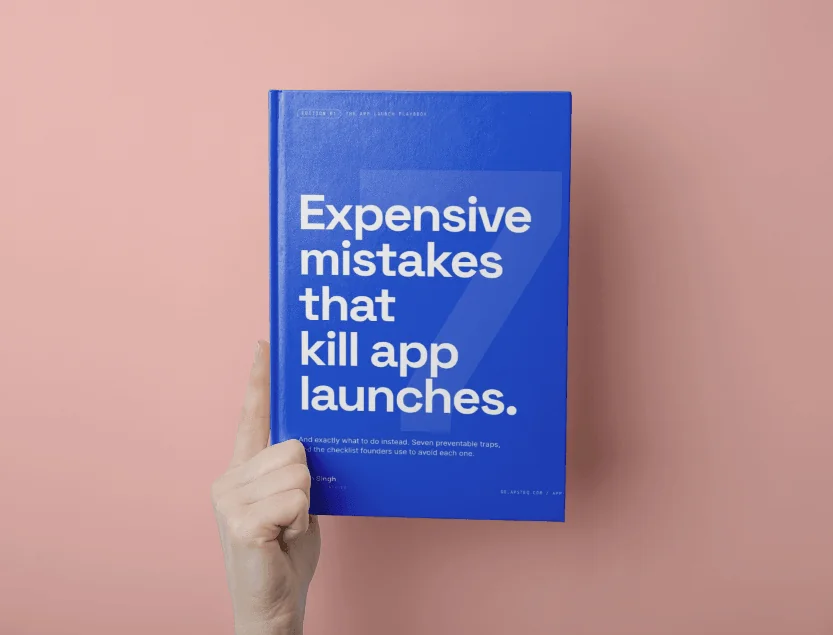
7 Expensive Mistakes That Kill App Launches
The launch errors we see most often across 300+ app engagements, and what to do instead.
Get the Free EbookBrowse all free guides