Mobile Marketing for App Companies: What a Specialist Agency Actually Does (and Whether You Need One)
Fewer than 0.5% of apps ever reach 1 million downloads, yet the average app launch budget now sits well above $50,000 (Sensor Tower, 2025). Most of that money is spent before a single acquisition strategy is tested. If you are a mobile app company trying to scale in the U.S. market, the gap between spending and growing is almost always a distribution problem, not a product problem. This post explains exactly what a mobile marketing agency does, how to evaluate whether one is worth hiring, which strategies move the needle in 2026, and the specific mistakes that cause app companies to waste their budgets before gaining real traction.
Key Takeaways
- Only 25% of downloaded apps are opened more than once (Adjust, 2024), making retention strategy as important as acquisition from day one.
- Apps that invest in App Store Optimization (ASO) see up to 26% more organic installs than those that do not (Mobile Action, 2024).
- User acquisition costs on iOS in the U.S. rose to an average of $4.01 per install for casual games and significantly higher for fintech and utility categories (AppsFlyer, 2024).
- A full-service mobile marketing agency typically combines ASO, paid user acquisition, creative testing, and analytics under one roof, reducing the coordination overhead that kills in-house campaigns.
What Does a Mobile Marketing Agency Actually Do for App Companies?
A mobile marketing agency is a specialized firm that plans, executes, and optimizes every channel responsible for getting an app discovered, downloaded, and used at scale. The work is far more specific than general digital marketing: the agency lives inside App Store Connect, Google Play Console, Meta's Advantage+ campaigns, and AppsFlyer dashboards daily, not quarterly.
Here is what that looks like in practice. An app in the U.S. fitness category launches with strong retention numbers but poor organic visibility. A mobile agency audits the App Store listing, finds that competitor keyword clusters around "home workout no equipment" are uncontested at mid-volume, rewrites the subtitle and first sentence of the description, and rebuilds the screenshot set to front-load the core value proposition. Within 60 days, the app's organic keyword rankings move from an average position of 180 to under 40 for its top 15 keywords (this is a representative outcome documented in Mobile Action's 2024 case study library, not a guarantee).
Beyond ASO, a qualified agency runs paid user acquisition across at least three channels simultaneously: Apple Search Ads, Google UAC, and Meta. It A/B tests creative assets weekly, because creative fatigue on mobile ads sets in after roughly 7 to 14 days at meaningful spend levels (AppsFlyer, 2024). It also owns the analytics stack, connecting SKAdNetwork data, MMPs like AppsFlyer or Adjust, and cohort reports so that every dollar is attributed correctly even under iOS 17+ privacy constraints.
The agency model differs from hiring a freelancer or an in-house generalist in one key way: specialization depth. A single mobile marketer can handle one or two channels well. An agency fields a paid media buyer, an ASO specialist, a creative strategist, and a data analyst working in parallel. For app companies scaling from $50k to $500k in monthly ad spend, that parallel capacity is the difference between compounding returns and flat curves.
| Agency Type | ASO Included? | Paid UA Included? | MMP / Analytics? | Typical Monthly Retainer |
|---|---|---|---|---|
| Mobile Marketing Agency (full-service) | Yes | Yes | Yes | $8,000 to $25,000+ |
| ASO-only Freelancer | Yes | No | No | $1,500 to $4,000 |
| General Digital Agency | Rarely | Partial | Rarely | $5,000 to $15,000 |
| In-House Growth Team | Depends | Yes | Yes | $20,000 to $60,000+ (salary) |
How Do You Choose the Right Mobile Marketing Agency in 2026?
Choosing a mobile marketing agency comes down to three things: channel proof, measurement rigor, and fit with your growth stage. The wrong agency for a pre-launch app is an equally wrong agency for one doing $2 million in annual in-app revenue, even if the brand name is the same.
Start by auditing the agency's proof of work, not its case study PDFs. Ask for anonymized cohort data showing Day 7 and Day 30 retention for a past client in your category. Ask what MMP they use and how they handle iOS ATT consent-rate variance. If the answers are vague, the team has likely been managing campaigns at a surface level, optimizing for installs rather than downstream revenue events.
Second, check channel specialization. A strong agency for a consumer subscription app should be fluent in:
- Apple Search Ads (ASA): Exact match, broad match, and Search Tab campaigns with negative keyword hygiene.
- Google UAC / App Campaigns: Asset group segmentation, target CPA vs. target ROAS switching, and Play Console deep links.
- Meta Advantage+: App campaign objectives, creative volume testing (minimum 20 to 30 assets per month at scale), and value optimization.
- ASO: Both keyword optimization and conversion rate optimization (CRO) of store listing pages.
Third, confirm measurement infrastructure before signing. Attribution in a post-ATT environment requires probabilistic modeling layered on top of SKAdNetwork postbacks, and many agencies still rely on last-touch click attribution that overcounts paid and undercounts organic. Ask specifically how the agency separates organic lift from paid lift. If they cannot answer that question precisely, your CAC numbers will be fiction.
For app companies ready to hand off growth execution to a specialist team, our app marketing services cover the full funnel from store listing to paid acquisition and retention automation.
Finally, weight the growth stage fit. Pre-seed apps need lean creative testing and ASO fundamentals. Series A apps need aggressive paid scale with tight ROAS floors. Series B and beyond need incrementality testing and multi-touch attribution. A good agency will tell you which mode you are in and price accordingly.
Mobile App Marketing Benchmarks: What Good Performance Actually Looks Like
Most app companies benchmark themselves against gut feel or competitor guesses. Real performance management requires category-level data, because a 2% Day 30 retention rate is catastrophic for a productivity app and acceptable for a casual game.
Here are the benchmarks that matter in 2026, drawn from published research:
- Install-to-registration rate: The median across app categories is 55 to 65% (AppsFlyer, 2024). If yours is below 40%, the onboarding flow is killing paid UA efficiency before the algorithm can learn.
- Day 1 retention: Global average is 25.3% across all verticals (Adjust, 2024). Top-quartile apps in the U.S. hit 35 to 40%.
- Day 30 retention: 5.7% average across all categories (Adjust, 2024). Finance and productivity apps can exceed 15% with strong push notification strategies.
- Cost per install (CPI), U.S. iOS: Ranges from $1.50 (hyper-casual games) to $8.00+ (finance/insurance) (AppsFlyer, 2024).
- App Store conversion rate (listing page to install): The average is 26 to 35% for top-10 ranking apps, versus 8 to 15% for mid-tier listings (Sensor Tower, 2025).
| Metric | Industry Average | Top Quartile (U.S.) | Source |
|---|---|---|---|
| Day 1 Retention | 25.3% | 35 to 40% | Adjust, 2024 |
| Day 30 Retention | 5.7% | 12 to 18% | Adjust, 2024 |
| CPI (U.S. iOS, all categories) | $4.01 | Below $2.50 | AppsFlyer, 2024 |
| App Store CVR (listing page) | 26 to 35% | Above 38% | Sensor Tower, 2025 |
| Organic Install Share (with ASO) | +26% vs. no ASO | +40% or more | Mobile Action, 2024 |
The practical read here: if your Day 30 retention is below average, scaling paid UA is pouring water into a leaking bucket. The right agency sequences retention fixes before paid scale, because every percentage point of Day 30 retention improvement reduces your effective CAC more than any bidding optimization can.

What Mistakes Do App Companies Make When Hiring a Mobile Marketing Agency?
The most expensive mistake is hiring too early for the wrong problem. App companies routinely hire a mobile marketing agency at a stage when the product itself has not found retention-market fit. The agency then runs excellent campaigns into a funnel that loses 95% of users in the first week. The result is a burned budget, a bruised relationship, and a team that blames the agency when the underlying issue was product-market fit.
A useful rule: do not hire for paid scale until Day 7 retention is at or above the category median. Use an agency earlier for ASO and creative testing, which are lower-cost and do not require the product to be retention-ready.
The second mistake is confusing installs with business results. An agency that reports installs as the primary KPI is optimizing the wrong thing. Revenue per user, subscription conversion rate, and LTV to CAC ratio are the metrics that predict whether a growth campaign will survive 6 months of spend. Ask every agency candidate what their reporting dashboard shows on day one of the engagement. If the answer is impressions, clicks, and installs, walk away.
Third: ignoring creative as a performance variable. Many app companies hand the agency a style guide and one or two video assets, then wonder why CPIs are high. Creative is the single largest lever in paid UA. Research from Meta's own performance data shows that creative quality accounts for roughly 70% of ad performance variance (Meta Business, 2023). A good agency will build a creative testing calendar with 20 to 40 new assets per month at meaningful spend levels, not repurpose the same three videos.
Fourth: signing a long-term retainer without a 90-day performance clause. The agency market has enough competition that any strong team will agree to milestone-based terms. If a potential partner refuses to set measurable 90-day goals, treat that as a red flag.
For app companies that have already made some of these mistakes and are rebuilding their growth strategy, our user acquisition services are structured around LTV-first KPIs from the first week of the engagement.
Where Mobile App Marketing Is Heading in 2026 and 2027
Three trends are reshaping what a mobile marketing agency needs to deliver, and they will separate commodity shops from genuine growth partners over the next 18 months.
The first is AI-driven creative generation at scale. Tools like Meta's Advantage+ Creative and Google's automatically created assets are already generating ad variants without human input. By late 2026, the creative bottleneck is shifting from production to creative strategy: agencies that can brief AI tools precisely and read performance signals fast will outpace those still building assets manually. App companies should ask any agency candidate how they integrate generative creative tools into their testing workflows today.
The second trend is the maturation of privacy-preserving measurement. Apple's SKAdNetwork 4.0 and Google's Privacy Sandbox for Android are now both live, and the industry is moving toward aggregated, modeled attribution as the standard. Agencies that have not rebuilt their measurement stacks around these frameworks are reporting numbers that are structurally incorrect. This will get more important in 2027, not less.
Third: in-app monetization is converging with acquisition strategy. Subscription app revenue in the U.S. grew to $23 billion in 2025 (Sensor Tower, 2025), and the winning acquisition models in 2026 tie ad spend directly to subscription LTV cohorts, not to install volume. A mobile marketing agency that cannot connect paid UA spend to paywall conversion data is operating with half the information it needs.
App companies that hire agencies fluent in these three areas in 2026 will be compounding advantages that their competitors are still figuring out.
Frequently Asked Questions
What is a mobile marketing agency?
A mobile marketing agency is a specialist firm that grows mobile app businesses through App Store Optimization, paid user acquisition, creative testing, and performance analytics. Unlike general digital agencies, the team works inside tools like Apple Search Ads, AppsFlyer, and Google Play Console daily. The best ones own the full funnel from first impression to retained, paying user.
How much does a mobile marketing agency cost?
Full-service mobile marketing agency retainers in the U.S. typically range from $8,000 to $25,000 per month, depending on the number of active channels and the ad spend being managed. ASO-only packages start lower, around $1,500 to $4,000 per month. Most agencies also charge a percentage of managed ad spend, commonly 10 to 15%, above a minimum threshold.
When should an app company hire a mobile marketing agency instead of building in-house?
Hire an agency when you need to scale faster than an in-house hire can ramp, or when you lack depth in more than one growth channel simultaneously. In-house teams make sense above roughly $500,000 in monthly ad spend, where the management fee savings justify the salary overhead. Below that level, agency leverage almost always beats in-house cost efficiency across a 12-month horizon.
What metrics should a mobile marketing agency be held accountable to?
Hold an agency accountable to LTV to CAC ratio, subscription or purchase conversion rate, Day 7 and Day 30 retention by acquisition cohort, and Return on Ad Spend (ROAS) measured at 30 and 90 days post-install. Install volume and cost per install are useful directional signals, but an agency optimizing only for those numbers will inflate installs and suppress revenue quality. Demand cohort-level reporting from week one.
How does ApsteQ's approach to app marketing differ from a typical mobile agency?
ApsteQ combines App Store Optimization, paid user acquisition, and AI-powered automation in one team, so the same data set that informs keyword strategy also informs paid bidding logic. Most agencies run these as separate workstreams with separate reporting. Our model connects them, which reduces CAC by eliminating duplication between organic and paid channel strategies from the first month.
Conclusion
Hiring a mobile marketing agency is a leverage decision, not a cost decision. The right team compounds organic and paid growth simultaneously, catches attribution errors before they distort spend decisions, and builds the creative volume that modern algorithms need to find your highest-value users.
The short version of everything above:
- Evaluate agencies on cohort retention data and measurement stack sophistication, not case study headlines.
- Do not hire for paid scale until Day 7 retention is at or above your category median.
- Demand LTV-first KPIs and a 90-day performance milestone in the contract.
- Treat creative as a performance variable, not a brand function.
- Ask specifically how the agency handles SKAdNetwork 4.0 and Privacy Sandbox attribution today.
If you want an honest assessment of where your app's growth strategy has gaps and what it would cost to close them, book a free strategy call with the ApsteQ team. We will audit your current funnel, benchmark it against your category, and tell you exactly where the leverage is.
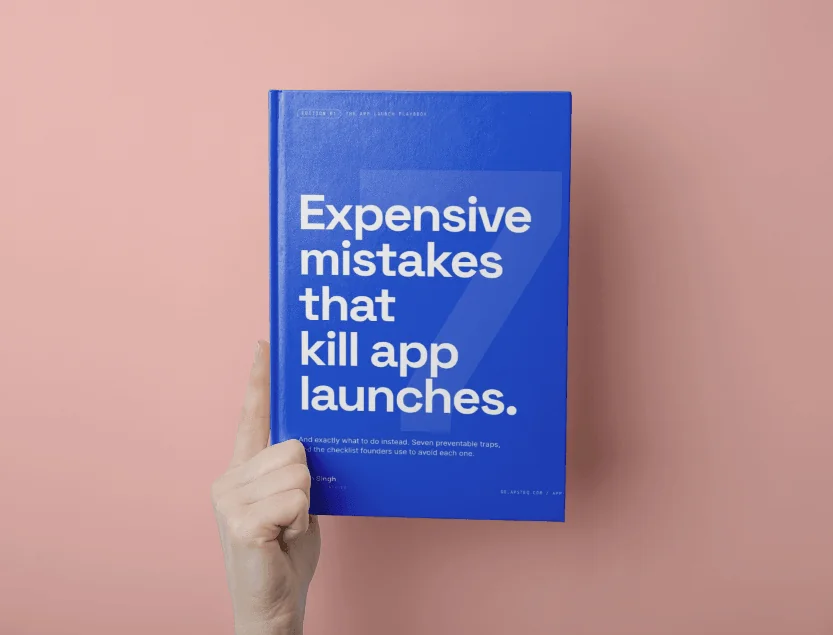
Free download
7 Expensive Mistakes That Kill App Launches
The launch errors we see most often across 300+ app engagements, and what to do instead.
Get the Free EbookBrowse all free guides