
Fintech App Marketing in 2026: What Actually Drives Downloads, Trust, and Retention
Only 1 in 4 fintech apps retains users beyond the 30-day mark (AppsFlyer Research, 2024), a number that makes the standard "download and hope" approach genuinely dangerous for any fintech team burning paid acquisition budget. The gap between apps that scale and apps that stall almost always comes down to marketing strategy, not product quality. In this post, you will learn how to build an app marketing engine for fintech that covers store optimization, paid user acquisition, trust-building, and the regulatory landmines that kill campaigns before they convert.
Key Takeaways
- Fintech apps have a 30-day retention rate of roughly 25%, far below gaming or social verticals (AppsFlyer Research, 2024).
- The global fintech app market is projected to surpass $324 billion in revenue by 2026 (Statista, 2025), making competition for attention fiercer every quarter.
- App Store Optimization alone can drive up to 70% of app downloads organically (Apple Developer Documentation, 2023), reducing reliance on paid spend.
- Cost-per-install for fintech apps on iOS in the US routinely runs $4 to $8, with cost-per-registration often 3x to 5x that figure (Adjust Blog, 2024).

Why Is Fintech App Marketing Harder Than Marketing Any Other App Category?
Fintech app marketing is harder because users are being asked to hand over something far more sensitive than an email address: they are handing over bank credentials, Social Security numbers, and real money. That trust barrier reshapes every stage of the acquisition funnel, from the first ad impression to the moment a user links a payment method.
Most app categories can rely on impulse installs. A game gets a funny TikTok clip, someone taps install, and the session starts. Fintech does not work that way. Research from AppsFlyer's Finance App Trends report shows that finance app users take an average of three separate touchpoints before installing, compared to one or two for entertainment apps (AppsFlyer Research, 2024). That means your paid ad, your organic search result, your App Store listing, and your review profile all have to fire at once.
Regulatory friction adds another layer. Apple and Google have specific policies for apps handling financial data. Any ad claiming a guaranteed return, even implicitly, can get a campaign paused or an account banned. The FTC's updated guidance on financial advertising, published at ftc.gov, requires clear disclosure of fees, risks, and limitations in any consumer-facing fintech promotion (FTC, 2024).
A concrete example: Chime, one of the largest US neobanks, built its early growth on a referral loop rather than broad paid social. By turning existing users into acquisition channels and pairing that with a clear "no hidden fees" message in all creative, they sidestepped the trust problem that kills most paid fintech campaigns. The lesson is not "copy Chime" but rather that message clarity and social proof carry more weight in fintech than in almost any other vertical.
App Store category competition is also brutal. The Finance category on the US App Store consistently ranks among the top five most competitive by keyword difficulty, according to Sensor Tower's category analysis (Sensor Tower, 2024). Ranking for a keyword like "money transfer app" requires strong conversion rates on your listing page, not just volume of installs.
The takeaway: fintech app marketing requires a full-funnel strategy that addresses trust at every touchpoint, not just a media buy.
How Do You Build a High-Converting Fintech App Marketing Strategy?
A high-converting fintech app marketing strategy starts with App Store Optimization as the foundation, layers paid acquisition on top once organic conversion rates are proven, and uses lifecycle messaging to close the retention gap. Here is how to sequence each piece.
Step 1: Optimize Your Store Listing for Trust Signals First, Keywords Second
Your app icon, first two lines of the description, and the first screenshot all load before a user scrolls. Place your primary trust signal (regulatory badge, user count, security standard) in screenshot one. Keyword research matters, but a 4.8-star rating with 10,000 reviews converts better than a perfectly keyword-stuffed title. Our App Store Optimization service starts with a conversion audit before touching a single keyword.
Step 2: Run Creative Testing on Meta Before Scaling Anywhere Else
Meta's broad audience gives you the fastest creative feedback loop available in paid mobile. For fintech, test three creative angles: pain-focused ("tired of overdraft fees?"), aspirational ("your first $1,000 saved"), and social proof ("2 million people already use X"). Allocate small budgets to each, measure cost-per-registration rather than cost-per-install, and only scale the angle that produces the lowest cost to a verified account.
Step 3: Build a Referral Mechanism Before You Scale Paid
Referral programs in fintech carry a structural advantage: referred users already trust the product because a trusted person sent them. Design the incentive around the core product action, not a generic cash reward. A savings app should offer a savings bonus. A brokerage should offer a free stock. The incentive should reinforce the behavior you want at activation.
Step 4: Segment Push Notifications by Lifecycle Stage
The biggest retention leak in fintech is the gap between install and first meaningful financial action, often called "activation." Users who complete activation within 72 hours of install show dramatically higher 90-day retention. Set up an automated push sequence that guides the user from account creation to first transaction, not a generic "come back to the app" nudge.
If you are evaluating whether to manage this in-house or work with a specialist team, see our overview of app marketing services to understand what a full-stack engagement looks like.
The Data Behind Fintech User Acquisition: Benchmarks Worth Knowing
Fintech user acquisition costs are among the highest in mobile, and understanding the benchmarks helps teams set realistic budgets and avoid the common trap of measuring success by install volume rather than activated account volume.
- Cost-per-install (CPI) for fintech on iOS in the US: $4 to $8 (Adjust Blog, 2024). This is a baseline. Campaigns targeting high-income households in major metros can push CPI above $12.
- Cost-per-registration is typically 3x to 5x CPI, meaning a $6 CPI campaign often produces registrations at $18 to $30 per account created (Adjust Blog, 2024).
- Organic search drives approximately 70% of all app installs across the App Store ecosystem (Apple Developer Documentation, 2023), which explains why ASO is non-negotiable even for teams with large paid budgets.
- Finance apps see a Day-30 retention rate of around 25% compared to 35 to 40% for health and fitness apps (AppsFlyer Research, 2024). That gap represents real revenue lost to churn.
- The US fintech app market generates substantial ad spend: mobile ad spending in the financial services vertical exceeded $8 billion in the US in 2024 (Statista, 2025), a figure that keeps rising as more traditional banks enter the app space.
| Metric | Fintech (US iOS) | All App Categories (Benchmark) | Source |
|---|---|---|---|
| Cost Per Install | $4 to $8 | $1.50 to $3.50 | Adjust Blog, 2024 |
| Day-30 Retention | ~25% | ~32% | AppsFlyer Research, 2024 |
| Organic Install Share | ~65 to 70% | ~65 to 70% | Apple Developer Documentation, 2023 |
| Avg. Touchpoints Before Install | 3+ | 1 to 2 | AppsFlyer Research, 2024 |
| Cost Per Registration (vs. CPI) | 3x to 5x CPI | 1.5x to 2x CPI | Adjust Blog, 2024 |
Synthesis: The benchmark gap between fintech CPI and all-category CPI is not a reason to spend less. It is a reason to measure further down the funnel. A fintech app that pays $7 CPI but achieves a 40% activation rate outperforms one paying $3 CPI with a 10% activation rate by a wide margin on cost per active user.

What Mistakes Kill Fintech App Marketing Campaigns?
The most common fintech app marketing mistakes are not creative failures; they are structural ones. Teams optimize the top of the funnel without fixing the conversion drop-offs below it, and the entire paid budget goes toward acquiring users who never activate.
Mistake 1: Measuring Success by Install Volume
Installs are a vanity metric in fintech. An app that processes payments needs to measure cost-per-linked-account. A savings app needs cost-per-first-deposit. A crypto brokerage needs cost-per-first-trade. When a campaign is optimized against install events rather than meaningful financial actions, ad networks serve installs to the cheapest possible users, who are rarely the ones who activate.
Mistake 2: Ignoring Apple Search Ads
Apple Search Ads is underused in fintech despite delivering some of the highest-intent traffic available. A user searching "low fee brokerage app" inside the App Store has already made the platform decision. Bidding on competitor brand names and high-intent category keywords in Apple Search Ads often produces lower cost-per-activation than Meta or Google because the intent signal is so strong. See how our user acquisition service structures Apple Search Ads campaigns for fintech teams.
Mistake 3: Generic Onboarding Sequences
The number one churn driver in fintech is not dissatisfaction with features; it is an onboarding flow that asks for too much information too early before delivering any value. Best practice, used by apps like Acorns and Robinhood in their early growth phases, is the "value first" model: show the user what their portfolio or savings projection looks like before requesting full KYC (Know Your Customer) verification. The psychological commitment formed in those first moments dramatically improves verification completion rates.
Mistake 4: Not Building a Review Acquisition Strategy
In the Finance category, trust signals like review volume and star rating directly influence conversion on the App Store listing page. Many fintech teams launch a product, wait for organic reviews, and then wonder why their listing converts at 2% when competitors with 10,000 reviews convert at 7%. A systematic in-app prompt strategy, triggered at the right lifecycle moment (after a successful transaction, for example) is the simplest and most neglected lever in fintech ASO.
Mistake 5: Running Paid Creative That Triggers Ad Policy Reviews
Meta, Google, and TikTok all have financial services ad policies that require pre-approval or special certification for certain categories including lending, investing, and cryptocurrency. Launching a campaign without verifying policy compliance can result in account-level restrictions that take weeks to resolve. Always verify policy requirements before the campaign goes live, not after the first disapproval.
Where Is Fintech App Marketing Heading in 2026 and 2027?
Two structural shifts are reshaping fintech app marketing in the near term, and both favor teams that invest in owned channels and AI-assisted personalization over pure paid acquisition.
First: Privacy-first attribution is now the default, not an edge case. Apple's App Tracking Transparency framework, combined with Google's phased deprecation of cross-app identifiers on Android, means that last-click attribution is increasingly unreliable. Teams that built modeling-based measurement approaches earlier are now running cleaner campaigns with better budget allocation. If your fintech app is still relying on a single-touch attribution model, you are likely misallocating budget between channels (Adjust Blog, 2024).
Second: AI-driven creative personalization is compressing test cycles. Tools that generate and test dozens of ad variants simultaneously are moving from novelty to standard practice. For fintech specifically, this matters because the trust-building message that resonates with a 28-year-old first-time investor is different from the one that works for a 45-year-old switching banks. Dynamic creative optimization at scale, paired with deep-funnel event optimization, is where the highest-efficiency fintech campaigns will run in 2026 and 2027. Our AI automation services include frameworks built specifically for this use case in regulated verticals.
The global fintech market is projected to grow at a compound annual rate of approximately 16.8% through 2028 (Statista, 2025). More apps, more competition, and more sophisticated users mean that commodity marketing tactics will produce commodity results. The teams that win will be the ones who treat user acquisition as a data problem and retention as a product-marketing collaboration.
Frequently Asked Questions
What is the average cost to acquire a user for a fintech app in the US?
Cost-per-install for fintech apps on iOS in the US runs $4 to $8, but cost-per-registration, which is a more meaningful metric, typically lands at 3x to 5x that figure, or roughly $18 to $40 per verified account (Adjust Blog, 2024). High-intent channels like Apple Search Ads often produce lower cost-per-activation despite higher CPI.
How long does App Store Optimization take to show results for a fintech app?
Most ASO changes to metadata, screenshots, and keyword targeting show measurable impact within 30 to 60 days on the App Store. Rating and review improvements can take 60 to 90 days to influence conversion rates meaningfully. Ongoing ASO is not a one-time fix; Finance category keyword competition shifts regularly and requires monthly monitoring.
Which paid channels perform best for fintech app user acquisition?
Apple Search Ads typically delivers the lowest cost-per-activation for fintech because the intent signal is strong. Meta works well for top-of-funnel awareness with broad audiences. Google UAC performs at mid-funnel. TikTok is emerging for younger demographic fintech products but requires careful compliance review before any financial product ads run.
What retention rate should a fintech app aim for at Day 30?
The category benchmark for finance apps is approximately 25% at Day 30 (AppsFlyer Research, 2024). A well-optimized onboarding sequence and activation-focused push notification strategy can push that toward 35 to 40%. Any team working with a dedicated app marketing partner should set that 35% threshold as the minimum acceptable outcome.
Do fintech apps need special compliance approvals to run paid ads?
Yes. Meta, Google, and TikTok all require special authorization or certification to run ads for lending products, investment platforms, cryptocurrency apps, and certain insurance products. The FTC also requires clear disclosure of fees and risks in all consumer-facing financial promotions (FTC, 2024). Skipping compliance review is the fastest way to get a paid account permanently restricted.
Conclusion
Fintech app marketing is not fundamentally a budget problem. It is a measurement and trust problem. Teams that measure activation rather than installs, build review volume systematically, and treat ASO as a permanent function rather than a launch task will consistently outperform teams spending more but measuring less.
- Fintech CPI averages $4 to $8 on iOS; optimize campaigns against verified account events, not installs (Adjust Blog, 2024).
- Organic search drives up to 70% of downloads, making ASO the highest-ROI channel available (Apple Developer Documentation, 2023).
- Day-30 retention of 25% is the category floor, not the goal (AppsFlyer Research, 2024).
- AI-driven creative personalization and privacy-first attribution are now standard practice, not future considerations.
If your fintech app has the product but the growth numbers are not reflecting it, the gap is almost always in strategy and execution, not in the technology. Book a free strategy call with the ApsteQ team and we will audit your current funnel, benchmark your metrics against category data, and map out where the highest-impact improvements are.
Free download
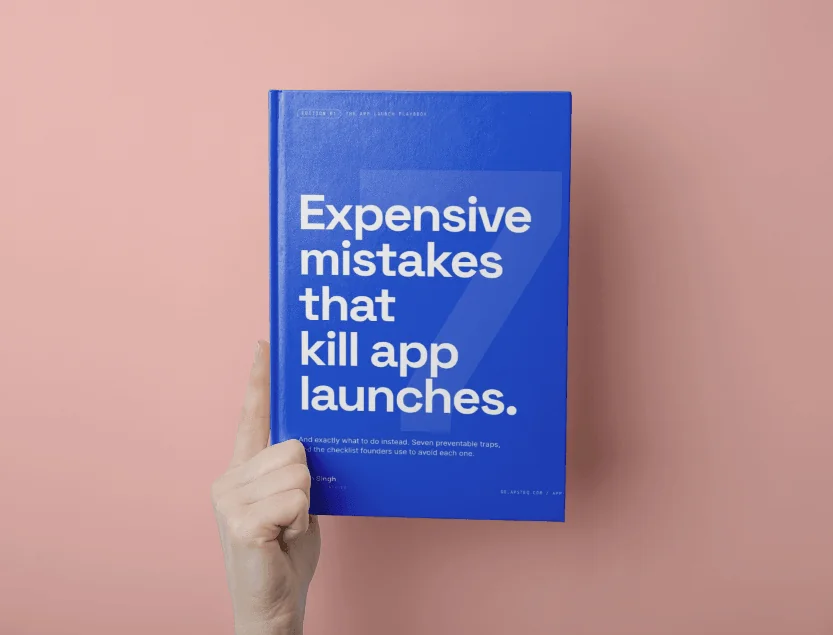
7 Expensive Mistakes That Kill App Launches
The launch errors we see most often across 300+ app engagements, and what to do instead.
Get the Free EbookBrowse all free guides