Most App Marketing Plans Fail Before Launch: Here Is What Works in 2026
An app marketing plan is a documented strategy that coordinates pre-launch positioning, store optimization, paid acquisition, and retention into a single repeatable system. Without one, even technically excellent apps disappear: only 0.5% of apps submitted to the App Store ever reach 1,000 downloads (Sensor Tower, 2024). That number should stop you cold. The gap between a good product and a successful product is almost always a marketing execution problem, not an engineering one.
This post breaks down what a high-performing app marketing plan actually contains in 2026, which channels drive the best return, where most mobile companies leave money on the table, and what the next 18 months will demand from growth teams. Whether you are pre-launch or stuck at a plateau, the framework below is built from real benchmark data.
Key Takeaways
- The global average cost-per-install across all categories is $3.60 for iOS and $1.22 for Android (AppsFlyer Performance Index, 2024), but category and geography shift these numbers dramatically.
- 65% of all app downloads come directly from App Store or Google Play search, making ASO the highest-leverage, lowest-cost channel in any marketing plan (Sensor Tower, 2024).
- Apps that run a structured pre-launch campaign of at least 30 days see 3x higher Day-1 retention compared to apps that skip pre-launch entirely (Adjust Mobile App Trends, 2024).
- Retention, not acquisition, drives long-term revenue: improving Day-30 retention by just 5 percentage points increases lifetime value by an average of 25-95% depending on monetization model (AppsFlyer, 2024).
What Should an App Marketing Plan Actually Include?
A real app marketing plan is not a slide deck with a logo and a target demographic. It is an operational document that answers five specific questions: who you are targeting, how they will find you, what convinces them to install, how you will keep them, and how you will measure all of it. Most plans fail because they address the first question and skip the rest.
The five components that consistently appear in high-performing plans are:
- User persona definition with behavioral segmentation, not just demographics. Age and gender tell you little; session frequency, competing apps already on the device, and willingness to pay tell you everything.
- App Store Optimization (ASO) covering title, subtitle, keyword field, screenshots, and preview video. ASO is the foundational discovery layer of any plan because 65% of downloads originate from store search (Sensor Tower, 2024).
- Pre-launch audience building via landing pages, waitlists, social content, and press outreach. Teams that start this 60-90 days before submission consistently outperform those that treat marketing as a post-launch activity.
- Paid user acquisition with channel prioritization based on category benchmarks, not guesswork. Average global cost-per-install sits at $3.60 on iOS and $1.22 on Android (AppsFlyer Performance Index, 2024), but gaming apps in the US can exceed $8.00 per install on iOS, which changes budget math completely.
- Retention and lifecycle messaging via push notifications, in-app messages, and email sequences tied to behavioral triggers, not calendar dates.
A concrete example: Duolingo's 2021-2023 growth was built on a marketing plan that ran ASO as its primary acquisition layer, paired with a viral social strategy built around a single mascot character. That combination kept blended cost-per-install well below paid-only competitors while building brand recognition that lifted organic install rates further. The lesson is that the plan must treat organic and paid as a system, not competing budget lines.
The document itself should be no longer than 10-12 pages. Teams that write 60-page marketing plans rarely execute them. Prioritize specificity over length: exact target CPI by channel, exact keyword clusters for ASO, exact trigger points for lifecycle messages.
How Do You Build an App Marketing Plan That Drives Installs?
Building a plan that actually drives installs requires sequencing work in the right order. Most teams start with advertising and discover too late that their store listing converts at 1-2% instead of the 5-8% a well-optimized listing achieves. Fix the funnel before you pay to fill it.
Step 1: Audit your store listing conversion rate first. Use Google Play Console's store listing experiments or Apple's Product Page Optimization to run A/B tests on your icon, screenshots, and short description before spending on paid channels. A conversion rate improvement from 3% to 6% effectively halves your cost-per-install without touching your ad budget.
Step 2: Build keyword architecture for ASO. Map keywords into three tiers: brand terms, category terms, and long-tail feature terms. Prioritize mid-volume, low-difficulty keywords in the early months. Tools like Mobile Action and Sensor Tower surface difficulty scores that make this prioritization concrete rather than intuitive.
Step 3: Choose 2-3 paid channels based on your category, not industry defaults. Apple Search Ads is almost always the right first paid channel because intent is explicit: the user searched for something and your ad appeared. Meta's Advantage+ campaigns work well for consumer lifestyle and social apps. TikTok's App Install objective has shown strong performance for apps targeting users under 30 (AppsFlyer Performance Index, 2024).
Step 4: Set up measurement before spending a dollar. Implement a mobile measurement partner (MMP) such as Adjust or AppsFlyer on day one. Without attribution data, you cannot tell which channels produce users who pay versus users who churn in 48 hours. This is not optional infrastructure; it is the feedback loop the entire plan depends on.
Step 5: Sequence retention from week one. Build onboarding flows that reach the app's core value within the first session. Push notification permission prompts shown after the user has experienced value convert at significantly higher rates than prompts shown on first open.
If your team lacks the bandwidth or specialized expertise to run this process end to end, working with a dedicated app marketing agency compresses the learning curve and avoids the budget waste that comes from building these systems by trial and error.
App Marketing Benchmarks Every Growth Team Needs in 2026
Benchmarks give your plan a calibration point. Without them, you cannot tell whether a $4.50 cost-per-install is a win or a warning sign. The table below summarizes key metrics across categories based on current industry data.
| App Category | Avg. iOS CPI (US) | Avg. Android CPI (US) | Day-30 Retention (Avg.) | Source |
|---|---|---|---|---|
| Gaming (Casual) | $2.80 | $0.95 | 6-10% | AppsFlyer, 2024 |
| Gaming (Mid-Core) | $8.20 | $3.40 | 12-18% | AppsFlyer, 2024 |
| Finance / Fintech | $11.50 | $5.80 | 22-30% | Adjust Mobile App Trends, 2024 |
| Health & Fitness | $6.00 | $2.50 | 18-25% | Adjust Mobile App Trends, 2024 |
| E-commerce | $5.10 | $2.10 | 20-28% | Sensor Tower, 2024 |
| Utilities | $3.20 | $1.30 | 15-20% | Sensor Tower, 2024 |
Three benchmark insights worth building into your plan directly:
- Retention benchmarks vary more than CPI benchmarks. A fintech app with 30% Day-30 retention is average; that same number in gaming is exceptional. Context matters more than the raw figure.
- The US market commands the highest CPIs globally but also the highest LTVs, particularly in fintech and subscription apps. A $10+ CPI can be justified if the user's 12-month value exceeds $80-120.
- Day-1 retention is the single best predictor of downstream monetization. Apps with Day-1 retention above 40% show statistically higher subscription conversion rates in the following 30-day window (Adjust Mobile App Trends, 2024).
ApsteQ Insight: When auditing app marketing plans for new clients, the most common gap is not budget; it is the absence of a retention KPI in the plan at all. Acquisition costs appear on every budget spreadsheet. Retention targets appear on almost none. That asymmetry is where most LTV potential leaks out.

What Mistakes Kill an App Marketing Plan Before It Generates ROI?
The most expensive mistakes in app marketing are structural, meaning they are baked into the plan before a single dollar is spent. Catching them early saves months of wasted budget.
Mistake 1: Treating ASO as a one-time task. ASO is not a launch checkbox. The App Store and Google Play algorithms update continuously, competitor keyword strategies shift, and seasonal search volume patterns require quarterly keyword refreshes. Teams that set their metadata at launch and never revisit it watch their organic rankings decay within 90 days. App Store Optimization (ASO) is an ongoing discipline that requires the same iterative attention as SEO.
Mistake 2: Running paid acquisition before fixing onboarding. If your Day-1 retention is 15%, you are losing 85 out of every 100 paid users before they see your core value proposition. Pouring ad spend into a leaky onboarding flow is one of the fastest ways to burn through a launch budget. Fix the flow first using behavioral analytics tools, then scale spend.
Mistake 3: Ignoring creative fatigue in paid campaigns. Ad creative on Meta and TikTok fatigues fast, often within 7-14 days on high-spend campaigns. Teams that launch with three ad variations and never refresh them see cost-per-install climb 40-60% within the first month. Build a creative production cadence into the plan, not just a media buying cadence.
Mistake 4: Measuring installs instead of qualified installs. An install that churns in 24 hours is not a marketing success. Plans built around install volume rather than downstream events like registration completion, first purchase, or Day-7 retention are optimizing for a vanity metric. Every paid campaign should be optimized toward a post-install event once you have enough conversion data to do so.
Mistake 5: Skipping competitive intelligence. Before finalizing your keyword strategy or creative direction, spend time in Sensor Tower or Mobile Action analyzing your top three competitors' keyword rankings, review patterns, and update frequency. This is not optional research; it is the context that makes every other plan decision more accurate.
Teams that repeatedly hit these walls often benefit from a structured outside perspective. Our user acquisition services are built specifically to audit these gaps and rebuild campaigns around metrics that actually predict revenue, not just download volume.
Where App Marketing Is Heading in 2026 and 2027
The structure of effective app marketing plans is shifting in three directions that growth teams need to plan for now, not react to later.
AI-driven creative production is becoming a baseline expectation. Generative AI tools now allow teams to produce and test 20-30 ad creative variations per week at costs that would have required a full design team two years ago. The competitive advantage has shifted from creative production volume to creative strategy, knowing which emotional hooks, formats, and audiences to test, not just how to produce assets quickly.
Privacy constraints continue to reshape attribution. Apple's App Tracking Transparency framework reduced trackable install attribution significantly after its 2021 rollout, and the downstream effects are still visible in 2026 campaign measurement. SKAdNetwork and Privacy Sandbox on Android are now the primary attribution mechanisms for many teams, requiring probabilistic modeling and media mix modeling to fill gaps that deterministic attribution once covered cleanly. Teams that have not updated their measurement stack to account for this are working with materially incomplete data (Apple Developer Documentation, 2023).
Subscription-first monetization is pressuring acquisition math harder. As free-to-play gaming revenues plateau, more app categories are shifting to subscription models. This changes the plan fundamentally: a subscription app needs to acquire users who will pay for 6-12 months, not just install once. That means optimizing for a very different user profile and accepting higher CPIs in exchange for higher predicted LTV.
By 2027, the plans that win will integrate AI automation into personalization and lifecycle messaging at a depth most teams have not reached yet. Building that capability now, rather than retrofitting it later, is the forward-looking priority.
Frequently Asked Questions
How long does it take to build an effective app marketing plan?
A functional plan can be drafted in 2-3 weeks if you have clear data on your target user, category benchmarks, and competitive landscape. Implementation typically runs 60-90 days before you have enough performance data to optimize meaningfully. Teams that skip the planning phase and jump to execution consistently waste 30-50% of their early-stage budget on channels and targeting that structured research would have ruled out immediately.
What is the most cost-effective channel in an app marketing plan?
App Store Optimization (ASO) delivers the highest return per dollar invested because organic search drives roughly 65% of all app downloads with no per-install cost (Sensor Tower, 2024). Apple Search Ads is typically the best first paid channel because user intent is explicit. Combining ASO as a foundation with Apple Search Ads for incremental reach is the most defensible starting structure for most apps.
How much should a mobile app company budget for marketing at launch?
Launch budgets vary widely by category, but a practical minimum for a US-focused consumer app is $15,000-25,000 for the first 90 days. This covers MMP setup, initial paid acquisition testing across 2-3 channels, creative production, and ASO tooling. Apps entering high-CPI categories like fintech or mid-core gaming need substantially larger budgets, often $50,000 or more, to generate statistically significant test data.
Should I hire an agency or build an in-house app marketing team?
For most companies under Series B, a specialized app marketing agency outperforms an in-house team in the first 12-18 months because agencies bring pre-built channel expertise, existing data benchmarks from comparable apps, and established MMP relationships. In-house teams become cost-efficient at scale, typically when monthly ad spend exceeds $100,000 and the team requires full-time daily optimization across multiple channels and geographies.
What metrics should an app marketing plan prioritize beyond installs?
The four metrics that predict long-term app revenue are Day-1 retention, Day-30 retention, cost-per-qualified-install (optimized against a post-install event), and 90-day LTV. Day-30 retention above 20% is a strong signal in most non-gaming categories. Linking paid acquisition campaigns to these downstream metrics, rather than raw installs, produces dramatically better budget allocation decisions within the first 30 days of a live campaign.
Building Your App Marketing Plan: Next Steps
A strong app marketing plan is not a document you write once. It is a system that connects store visibility, paid acquisition, onboarding quality, and retention into a single measurable loop. The companies that grow consistently in 2026 treat each component as interdependent, not as separate budget lines managed by separate teams.
The core principles to take forward:
- Fix store conversion rate before scaling paid spend
- Build retention KPIs into the plan from day one, not as an afterthought
- Use category benchmarks to calibrate CPI targets and budget projections
- Refresh creative and keyword strategy quarterly, not annually
- Measure post-install events, not just installs
If you want a team that has built these systems across dozens of app categories and can audit your current plan in a single session, book a free strategy call with ApsteQ. We will identify the highest-leverage gaps in your current plan and show you exactly what it would take to fix them.
Free download
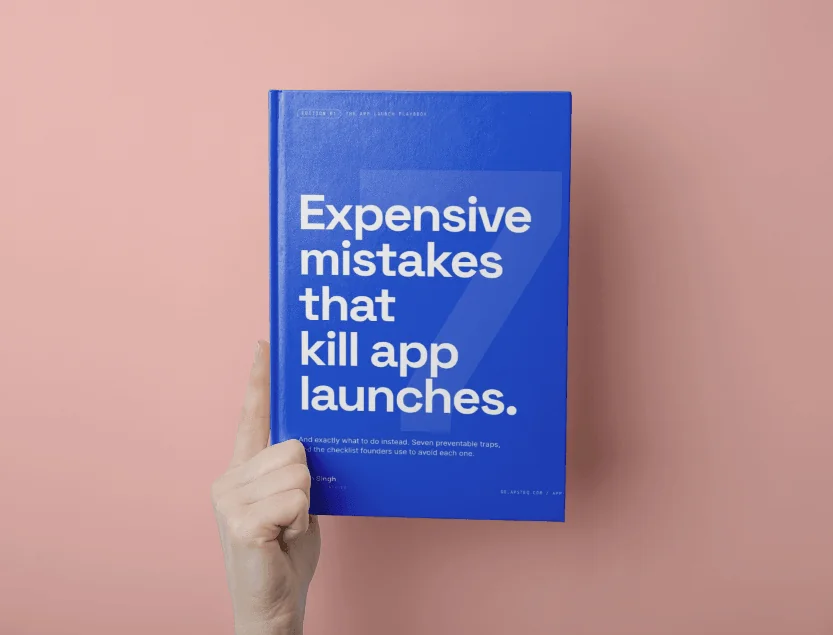
7 Expensive Mistakes That Kill App Launches
The launch errors we see most often across 300+ app engagements, and what to do instead.
Get the Free EbookBrowse all free guides