
App Monetization Models: Which Strategy Actually Generates Revenue in 2026?
The right app monetization model is the single biggest lever most mobile companies leave untouched. Choosing the wrong structure at launch can cut lifetime value in half before a single growth campaign runs.
Only 0.5% of all mobile apps account for roughly 50% of total app store revenue (Sensor Tower, 2024). That concentration is not accidental. The apps at the top make deliberate, data-backed choices about how they charge, when they charge, and who they charge. The rest guess. This post lays out exactly how each major monetization model works, what the numbers say about which ones perform, where most product teams go wrong, and what shifts are coming in 2027 that will reshape the decision entirely.
Key Takeaways
- Subscription apps retain 2 to 3 times more revenue per user over a 12-month period than one-time purchase apps (App Annie / data.ai, 2024).
- In-app advertising still works, but rewarded video ads convert at 3 to 5 times the rate of banner ads and produce 40% higher eCPM (AppsFlyer, 2024).
- Hybrid monetization (combining subscriptions with in-app purchases) is now used by 62% of the top-grossing 100 apps on the US App Store (Sensor Tower, 2024).
- Apps that A/B test their paywall copy see a 15 to 30% lift in trial-to-paid conversion within 90 days (Adjust, 2023).

What Are the Core App Monetization Models and Which One Fits Your App?
App monetization models are the structured methods through which a mobile application converts user activity into revenue. There are five that dominate the US market: paid download, freemium, subscription, in-app advertising, and in-app purchases (including consumables and loot mechanics).
Each model serves a different user relationship and product type. Getting the match right matters more than execution tactics. Here is what the data and real deployments show.
Paid Download
A paid download charges once at install. It suits utility tools with clear, immediate value, think PDF editors or niche productivity apps. The ceiling is low because there is no recurring revenue stream and no mechanism to upsell. Discovery is also harder: app store algorithms heavily favor apps with volume installs, and a price gate reduces that volume fast.
Freemium
Freemium is a model where the core app is free to download but premium features require a payment, either a one-time unlock or a subscription upgrade. This is the dominant structure in mobile gaming and productivity. The strategic logic is sound: lower the acquisition barrier to zero, then monetize a subset of engaged users. The average freemium conversion rate from free to paid sits between 2% and 5% for consumer apps (Statista, 2024). That sounds low, but at scale and with strong retention, the economics work well.
Subscription
Subscriptions generate predictable, compounding revenue. A user who pays $9.99 per month for 18 months is worth $179.82, a figure no one-time $4.99 purchase ever reaches. Subscription apps also benefit from Apple's and Google's promotional slots for apps with strong renewal rates. The tradeoff is that free trials create a grace period where you must deliver value fast or lose the user before the first charge.
Consider Duolingo: the company uses a freemium base with an aggressive Duolingo Plus subscription upsell. Their conversion funnel is built around streaks and social pressure, not feature gates. That behavioral design drove subscription revenue to $531 million in 2023, representing 74% of total company revenue (Duolingo Annual Report, 2023).
In-App Advertising
Ad monetization makes sense when your audience is broad, retention is moderate, and charging feels incongruent with the product (free news readers, casual games). Rewarded video ads are the highest-value format. Rewarded ads generate eCPMs of $12 to $25 in the US market compared to $0.50 to $2 for standard banners (AppsFlyer, 2024). The risk is user experience degradation if ad load is not carefully managed.
In-App Purchases
Consumable in-app purchases (coins, gems, lives, boosts) dominate mobile gaming revenue. Non-consumable purchases (permanent unlocks) work better in tools. The model relies on a small percentage of high-spending users, often called "whales," to carry the revenue. This concentration creates fragility but also very high ceiling revenue for the right genre.
| Model | Avg. Revenue per User (US) | Best Fit Category | Main Risk |
|---|---|---|---|
| Paid Download | $1 to $10 (one time) | Niche utilities | Low install volume |
| Freemium | $5 to $30 (lifetime) | Productivity, social | Low conversion rates |
| Subscription | $50 to $200+ (annual) | SaaS, fitness, education | Churn at trial end |
| In-App Ads | $0.50 to $4 (monthly) | Casual games, media | Ad fatigue, CPM drops |
| In-App Purchases | $10 to $100+ (lifetime) | Mobile gaming | Whale dependency |
How Do You Build a Monetization Strategy That Actually Scales?
A monetization strategy scales when it is tied to user behavior data rather than assumptions about what users will pay. Most teams skip this step and copy a competitor's model, which rarely transfers cleanly.
Here is a repeatable process:
- Map your user journey first. Identify the exact moment in the product where users get undeniable value. That moment, sometimes called the "aha moment," is where your paywall or purchase prompt belongs. Placing it earlier creates friction; placing it later misses motivated buyers.
- Segment by behavior, not demographics. Users who complete three or more sessions in the first week convert at significantly higher rates than single-session users. Build your pricing prompt logic around engagement signals, not age or geography.
- Run price sensitivity tests. Use tools like RevenueCat or Superwall to A/B test price points. A $6.99 monthly price often outperforms $4.99 on conversion-adjusted LTV because a higher price signals quality to users who are already motivated. Test the actual numbers; do not assume.
- Layer your monetization over time. Start with one model at launch. Once you have 90 days of retention data, evaluate whether a second layer (such as adding an ad tier below your paid tier) improves overall revenue per user or cannibalizes subscription intent.
- Invest in app store optimization early. Your monetization is irrelevant if no one installs the app. Strong ASO directly lowers your cost per acquiring a paying user. The team at ApsteQ specializing in app store optimization routinely reduces cost-per-install by improving conversion rates at the store listing level, which compresses the payback period on every paid acquisition dollar.
One pattern worth emphasizing: apps that use subscription plus a lower-cost ad-supported tier consistently see higher total revenue than single-model apps serving the same audience. The tier structure captures users at different willingness-to-pay thresholds rather than forcing a binary choose-or-leave decision.
What the Data Says About Subscription vs. In-App Purchase Performance
Subscriptions outperform in-app purchases on long-term revenue per user in every category except mobile gaming. The data is consistent enough across sources to treat this as a reliable benchmark rather than a trend.
- Subscription apps in the US Health and Fitness category average $45 annual revenue per active user, compared to $12 for equivalent ad-supported apps (Sensor Tower, 2024).
- The top 100 grossing non-gaming apps on the US App Store generate 94% of their revenue from subscriptions (App Annie / data.ai, 2024).
- Apps that offer a 7-day free trial convert to paid at 57% higher rates than apps offering a 30-day trial, because urgency and short feedback loops matter more than trial length (Adjust, 2023).
- Mobile gaming remains the exception: the top 10 grossing games in the US still rely on in-app purchases for over 80% of total revenue, with subscriptions playing only a supplementary role (Sensor Tower, 2024).
The mechanism behind subscription outperformance is straightforward. Subscriptions create a default-continuation relationship. Users who forget to cancel keep paying. Users who stay engaged keep paying intentionally. In-app purchases, by contrast, require a fresh buying decision every transaction. Each purchase moment is a potential drop-off point.
That said, combining models is now the norm at the top of the market. Headspace, the meditation app, uses a subscription as the primary model but layers in a free tier supported by limited content access rather than ads. This hybrid approach preserves brand perception while capturing users across the willingness-to-pay spectrum. Their move to this structure coincided with a reported doubling of annual recurring revenue between 2020 and 2023 (per public statements from Headspace leadership).
Insight: The highest-performing apps in 2026 do not ask "which model?" They ask "which model for which user segment, at which point in the lifecycle?"

What Mistakes Kill App Monetization Before It Has a Chance to Work?
The most common monetization failures share a pattern: teams optimize for install volume before validating that paying users exist at any price point. By the time they run paid acquisition at scale, the unit economics are already broken.
Mistake 1: Pricing Too Low to Signal Value
A $0.99 subscription feels cheap, but it also signals disposability. Users churn faster on very low-priced subscriptions because the psychological commitment is minimal. Apps in the productivity and wellness categories that price at $9.99 per month often retain users longer than $1.99 equivalents, even at lower initial conversion rates. The lifetime value math almost always favors higher prices with better onboarding over lower prices with weak retention.
Mistake 2: Paywalling Before Delivering Value
Placing a purchase prompt on the second screen, before the user has experienced any outcome from the app, is one of the fastest ways to tank conversion. Users need at least one meaningful moment of value before they have a reason to pay. In a fitness app, that might be completing a first workout. In a language app, it might be finishing a first lesson with a score result. Map the trigger carefully.
Mistake 3: Ignoring Churn Signals
Many teams track new subscriptions and ignore involuntary churn (failed payments, expired cards). Involuntary churn accounts for 20 to 40% of total subscription churn across mobile apps (Adjust, 2023). Tools like Paddle and RevenueCat have built-in dunning mechanics to recover these users automatically. Not implementing them is leaving recoverable revenue on the table.
Mistake 4: Scaling Paid Acquisition Without Proven LTV
Running user acquisition campaigns before you know your 90-day LTV is expensive guesswork. A team spending $5 per install with a $3 LTV is burning cash at every install. The fix is to establish LTV benchmarks from organic users first, then calculate a maximum acceptable CPI before any paid campaign runs.
This is where working with a team that ties mobile user acquisition to monetization data from day one changes the outcome. Campaign budgets stay aligned with actual revenue potential rather than vanity install numbers.
Mistake 5: One-Size Pricing Across Markets
US pricing applied globally destroys conversion in lower-GDP markets and underprices in premium markets like Japan and South Korea, where users historically pay more for digital goods. Apple's App Store now supports regional pricing tiers automatically; very few teams use them properly.
What App Monetization Trends Will Define 2027?
Two shifts are already reshaping how top apps think about revenue, and both will accelerate into 2027.
AI-Personalized Pricing
Dynamic paywall personalization driven by on-device behavioral signals is moving from experimental to mainstream. Instead of showing every user the same three pricing tiers, apps will infer willingness to pay from session depth, feature usage, and device signals, then serve a personalized offer. Early adopters of this approach report 18 to 35% improvements in trial-to-paid conversion (per public case studies from Superwall, 2025). By 2027, apps not personalizing their paywall will be at a structural disadvantage.
Web-to-App Subscription Funnels
Apple's 27% commission and Google's 15 to 30% take rate are pushing developers toward web-based subscription flows that redirect users into the app post-purchase. This is legally permitted following the Epic v. Apple ruling and its downstream effects. Apps using web purchase funnels report margin improvements of 20 to 27% on equivalent subscriptions. App store web entitlement usage grew 140% in the US in 2024 (Sensor Tower, 2024), a trend that will compound through 2026 and 2027.
Outcome-Based Monetization
Health, fitness, and education apps are beginning to tie subscription pricing to demonstrated user outcomes, offering refunds or discounts when users do not hit engagement benchmarks. This is partly a retention mechanic and partly a positioning move, but it fundamentally changes the monetization relationship from time-based to value-based. Expect more category leaders to test this structure through 2027.
Frequently Asked Questions
What is the most profitable app monetization model in the US market?
Subscriptions generate the highest long-term revenue per user in most non-gaming categories. The top 100 grossing non-gaming US apps earn 94% of revenue from subscriptions (App Annie / data.ai, 2024). For gaming apps, in-app purchases still dominate. Hybrid models combining both are now used by 62% of top-grossing apps (Sensor Tower, 2024).
How do I choose between freemium and a subscription model?
Choose freemium when your product delivers ongoing value that compounds over time and you can afford to acquire free users at scale. Choose a subscription when the value is clear within the first session and the payback period on acquisition stays under 6 months. Most successful apps eventually combine both by making the free tier limited rather than fully functional.
What conversion rate should I expect from a free trial to a paid subscription?
Industry benchmarks range from 15% to 35% for 7-day free trials on well-optimized apps, and 10% to 20% for 30-day trials (Adjust, 2023). Apps with strong onboarding flows and behavioral nudges during the trial hit the upper end. Apps with no in-trial engagement typically fall below 10%. Your own cohort data within 60 days of launch will be more reliable than any industry average.
How can app store optimization improve my monetization?
Better ASO lowers cost-per-install, which directly shrinks your payback period on every subscription acquired. A stronger store listing also pre-qualifies users before install, meaning those who download are more likely to convert to paid. Teams investing in professional ASO services consistently see improvements in both install volume and day-7 paid conversion rates, because better-matched users engage more deeply from day one.
What is involuntary churn and how significant is it?
Involuntary churn happens when a subscription lapses due to a failed payment, not a deliberate cancellation. It accounts for 20 to 40% of total subscription churn across mobile apps (Adjust, 2023). Recovering these users with automated dunning sequences (retry logic, push notifications, email reminders) typically recovers 40 to 60% of failed renewals within 7 days.
Conclusion
Picking a monetization model is not a launch-day checkbox. It is an ongoing product decision that compounds in either direction.
- Match your model to the moment users first experience real value, not to what competitors are doing.
- Subscriptions outperform in-app purchases on LTV in every non-gaming category.
- Hybrid models are now the standard among top-grossing US apps.
- Involuntary churn and poor paywall placement are the two fastest ways to sabotage an otherwise sound model.
- Web-to-app funnels and AI-personalized paywalls will define the highest-performing apps through 2027.
If your app is growing but revenue is not keeping pace, the model, the paywall timing, or the acquisition strategy may be misaligned. The fastest way to diagnose that is a structured audit with people who do this daily. Book a free strategy call with the ApsteQ team and we will review your current monetization setup, identify the highest-leverage fix, and map a path to measurable improvement within 90 days.
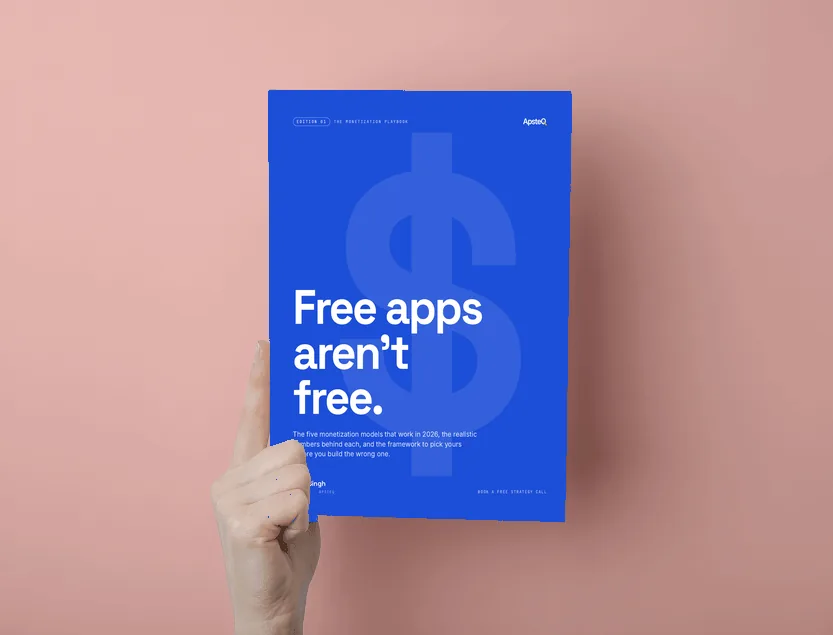
Free download
The App Monetization Playbook
Pricing models, paywall placement, and the revenue math behind apps that actually make money.
Get the Free EbookBrowse all free guides