
Mobile Growth Consulting: What It Is, Why It Matters, and How to Choose the Right Partner in 2026
Mobile growth consulting is the practice of using specialized strategy, data analysis, and channel expertise to accelerate an app's downloads, retention, and revenue. If you are running a mobile app company and your growth has plateaued, understanding what a consulting engagement actually delivers, and what separates a great one from a costly mistake, is the most important decision you will make this year.
Here is the number that should stop you: only 4% of apps that launch in the US App Store ever cross 100,000 downloads (Sensor Tower, 2025). The gap between that 4% and everyone else is rarely product quality. It is almost always go-to-market strategy, store optimization, and paid acquisition execution. This post breaks down how mobile growth consulting works, what the best engagements look like, and how to avoid the traps that burn budgets without moving the needle.
Key Takeaways
- Only 4% of US App Store apps cross 100,000 downloads, making expert growth strategy a genuine differentiator (Sensor Tower, 2025).
- Apps with optimized store listings convert at 3-5x the rate of unoptimized listings (Adjust, 2024).
- User acquisition costs on iOS rose roughly 20% year-over-year between 2023 and 2025 (AppsFlyer, State of App Marketing, 2025), making efficient channel strategy critical.
- Retention, not acquisition, drives long-term LTV: apps that improve Day 30 retention by even 5 percentage points see outsized revenue compounding over a 12-month cohort (AppsFlyer, 2025).

What Does Mobile Growth Consulting Actually Deliver?
Mobile growth consulting delivers a structured, evidence-based plan for increasing installs, improving retention, and converting users into paying customers, executed by specialists who work across dozens of app categories simultaneously. That cross-portfolio exposure is the core value proposition: a seasoned consultant has seen your specific funnel problem before, probably ten times, and has data on what fixed it.
A typical engagement covers four interconnected levers. The first is App Store Optimization (ASO), which governs how discoverable your listing is to organic searchers. The second is paid user acquisition (UA), covering Apple Search Ads, Google UAC, Meta, and programmatic networks. The third is conversion rate optimization inside the store listing itself (screenshots, preview videos, ratings). The fourth is lifecycle and retention strategy: push notifications, in-app messaging, and onboarding flows that keep users past Day 7.
Consider a real pattern: a mid-stage fitness app spending $80,000 per month on Meta and Google UA but seeing a Day 30 retention rate below 8%. The acquisition spend looks healthy in the dashboard, but the unit economics are destroyed by churn. A growth consultant diagnoses this in week one, pauses inefficient channels, rebuilds the onboarding flow, and reallocates budget toward high-intent Apple Search Ads keywords. The result is not more spend; it is smarter spend.
The metrics that matter in a real consulting engagement are concrete. Cost per install (CPI), cost per action (CPA), Day 1 / Day 7 / Day 30 retention curves, and lifetime value (LTV) by acquisition channel are the levers a consultant must be able to move. If a prospective partner cannot show you a before-and-after retention curve from a previous client, that is a red flag worth taking seriously.
Apps with optimized store listings convert organic store visitors at 3-5x the rate of unoptimized listings (Adjust, 2024). That single lever, properly executed, can halve your effective CPI without touching your ad budget. Meanwhile, user acquisition costs on iOS rose roughly 20% year-over-year between 2023 and 2025 (AppsFlyer, State of App Marketing, 2025), meaning organic and owned-channel efficiency has never been more important to overall margin.
The best mobile growth consultants are not generalists. They bring vertical depth (gaming, health, fintech, utilities all behave differently), channel expertise (Apple Search Ads attribution differs fundamentally from Meta's), and benchmark data that in-house teams simply do not accumulate fast enough.
How Do You Build a Mobile Growth Strategy That Actually Scales?
A scalable mobile growth strategy starts with a single, non-negotiable step: establishing accurate attribution before spending a dollar on paid channels. Without knowing which channel, creative, and keyword drove each install and each paying conversion, optimization is guesswork dressed up as strategy.
Here is a step-by-step framework that growth consultants use in 2026:
- Audit attribution infrastructure. Confirm that a Mobile Measurement Partner (MMP) such as Adjust or AppsFlyer is properly configured, that SKAdNetwork postbacks are validated on iOS, and that Google's Privacy Sandbox signals are captured on Android. This step takes one to two weeks and is non-optional.
- Run a baseline ASO audit. Benchmark your current keyword rankings, conversion rate on the store listing page, and rating velocity against the top three competitors in your category. Most teams discover they are ranking for branded terms only, missing the high-volume generic keywords that drive 60-70% of organic installs.
- Segment your existing users by LTV cohort. Before acquiring new users, understand which acquisition sources produced your highest-LTV users historically. This reshapes budget allocation immediately and usually reveals that one or two channels are carrying disproportionate value.
- Build a creative testing pipeline. Paid UA performance is increasingly driven by creative quality, not bid strategy. A structured A/B test of three to five creative concepts per channel per month is the minimum cadence needed to stay competitive.
- Set a retention trigger map. Identify the exact in-app actions that correlate with Day 30 retention for your specific app. Build automated lifecycle messages around those triggers before scaling paid spend.
This is exactly the process our team applies to every engagement. If you want to see how it maps to your specific app category and current stage, the app marketing services page walks through our full methodology and case study examples.
One critical point most teams skip: competitive intelligence should feed every step. Tools like Sensor Tower and data.ai show you competitors' keyword strategies, download rank history, and top-performing creatives. That data turns guesswork into an informed starting position.
The Data on Mobile Growth: Benchmarks Every App Company Should Know in 2026
Benchmark data is what separates a growth consultant from a generic digital marketer. Knowing that your Day 7 retention is 18% means nothing unless you know the category median is 12% (strong) or 25% (weak). Here are the numbers that should anchor your 2026 planning.
| Metric | Category Median (US, 2025) | Top-Quartile Benchmark | Source |
|---|---|---|---|
| Day 1 Retention | 25% | 40%+ | AppsFlyer, 2025 |
| Day 30 Retention | 5-8% | 15%+ | AppsFlyer, 2025 |
| iOS CPI (non-gaming) | $3.50-$6.00 | Below $2.50 | Adjust, 2024 |
| ASO Organic Install Share | 55-65% of total installs | 70%+ | Sensor Tower, 2025 |
| App Store CVR (listing page) | 2-3% | 5-8% | Adjust, 2024 |
A few patterns jump out from this data:
- Organic installs still dominate, comprising 55-65% of total installs for the median app (Sensor Tower, 2025). Teams that under-invest in ASO while over-investing in paid channels are leaving their largest channel unmanaged.
- Day 30 retention is the most leveraged metric. Moving from 6% to 12% Day 30 retention does not just improve LTV; it often flips a negative unit economics model into a profitable one because each acquired user generates twice as many monetization events.
- iOS CPI pressure is real but beatable. The teams consistently achieving sub-$2.50 CPI on iOS do so through a combination of strong ASO (which lowers paid dependency), Apple Search Ads exact-match keyword targeting, and high creative refresh rates, not simply higher bids.
- App Store conversion rates vary enormously by creative quality. The gap between a 2% CVR and a 6% CVR on the same keyword set is almost entirely explained by screenshot and preview video quality, not pricing or feature set.

What Mistakes Kill Mobile Growth Engagements Before They Start?
Most failed mobile growth consulting engagements fail for the same reasons, and almost none of them are about the quality of the strategy document. They fail because of misaligned expectations, broken measurement infrastructure, or scope creep that dilutes focus. Knowing these patterns in advance is how you avoid them.
Mistake 1: Starting paid scale before ASO is solid. A well-funded health app in the US spent $200,000 on Meta and Apple Search Ads over two quarters before anyone audited the store listing. The listing had no keyword-optimized subtitle, stock photography for screenshots, and zero responses to App Store reviews. Organic traffic that should have converted at 4-5% was converting at 1.2%. Every paid dollar was amplifying a broken funnel. The fix took three weeks; the cost was six months of suboptimal ROAS.
Mistake 2: Choosing a generalist agency over a mobile specialist. General digital marketing agencies frequently pitch app growth work. They understand Facebook and Google in a broad sense, but they lack the SKAdNetwork attribution expertise, Apple Search Ads campaign structure knowledge, and category-level benchmark data that specialist teams carry. The result is often a campaign structure copy-pasted from e-commerce playbooks applied to an app environment where attribution, pricing, and user intent work completely differently.
Mistake 3: Optimizing for installs instead of qualified users. Install volume is an easy metric to game: low-quality networks will sell you installs cheaply. What matters is installs from users who match your highest-LTV cohort profile. A growth consultant should build audience targeting and creative messaging specifically to attract those users, even if it means a higher CPI, because the downstream LTV justifies the acquisition cost.
Mistake 4: No creative testing infrastructure. In 2026, paid UA performance is primarily a creative problem. Teams running the same three ad creatives for months are losing to competitors who refresh creative every two weeks. A proper engagement includes a defined testing cadence, a hypothesis log, and a process for killing underperformers fast.
If you want a partner who avoids these exact pitfalls, the user acquisition service page explains how we structure campaigns to protect against each of them, with specific process documentation.
Where Mobile Growth Consulting Is Heading in 2026 and 2027
The next 18 months will reshape what mobile growth consulting looks like, driven by three forces: privacy-first attribution, AI-generated creative, and the maturation of in-app subscription economics.
Privacy frameworks have already changed how growth teams measure campaigns. SKAdNetwork on iOS and Google's Privacy Sandbox on Android have made last-click, deterministic attribution largely a legacy concept. Consultants who cannot work fluently with probabilistic measurement models and incrementality testing will simply produce unreliable recommendations. This is not a future problem; it is already the baseline requirement in 2026.
AI-generated creative is accelerating the creative testing cycle dramatically. Tools that generate hundreds of ad variants from a single brief are now standard in top-performing UA teams. The consultant's role is shifting from "produce creatives" to "design and interpret creative experiments at scale." That requires deeper statistical literacy, not less.
Subscription app economics are also maturing. With consumer spending in US App Stores exceeding $35 billion annually (Sensor Tower, 2025), competition for subscription revenue is intense. Growth consultants in 2027 will need strong paywall optimization and pricing experiment expertise alongside traditional acquisition skills.
One meta-trend worth watching: the best mobile growth teams are increasingly integrating AI automation into reporting, bid management, and audience segmentation. This is not replacing human strategic judgment; it is compressing the time between insight and action from days to hours. Agencies that have built these workflows into their service delivery will have a structural speed advantage over those that have not.
Frequently Asked Questions
What does a mobile growth consultant typically cost?
Retainer engagements for US mobile growth consulting typically range from $8,000 to $25,000 per month depending on scope, channel mix, and app maturity stage. Project-based audits (ASO, attribution, or UA audits) usually run $3,000 to $8,000. Costs vary significantly based on whether paid media management is included or strategy-only.
How long does it take to see results from mobile growth consulting?
ASO improvements typically show measurable organic ranking movement within 4 to 8 weeks. Paid UA optimization cycles run 2 to 4 weeks per test iteration. Retention improvements from onboarding redesigns take 6 to 10 weeks to show in 30-day cohort data. Expect a 90-day window before drawing meaningful conclusions about the full program's impact.
What is the difference between ASO and mobile growth consulting?
ASO (App Store Optimization) is the practice of improving an app's organic discoverability and store listing conversion rate. Mobile growth consulting is broader: it includes ASO, paid user acquisition, retention strategy, and LTV optimization working together. ASO alone drives organic installs; full growth consulting improves the entire funnel from first impression to paying subscriber.
How do I know if my app needs a mobile growth consultant or just better tools?
Tools do not set strategy; people do. If your team has attribution data, is running paid campaigns, and growth is still flat or declining quarter-over-quarter, the problem is almost certainly strategy and execution quality, not tooling. A specialist consultant brings cross-portfolio benchmarks and proven frameworks that internal teams, particularly those in their first or second year, rarely have access to. Learn more on our ASO services page.
Can mobile growth consulting work for early-stage apps with small budgets?
Yes, but the focus shifts. Early-stage apps (under 50,000 downloads) benefit most from ASO foundation work, conversion rate optimization, and identifying a single efficient paid channel before scaling. Project-based engagements of $3,000 to $5,000 for an audit and 90-day roadmap are common entry points that generate measurable returns even on budgets below $10,000 per month.
Conclusion: What to Do Next
Mobile growth consulting is not a luxury for well-funded apps; it is a structural advantage for any app company serious about competing in the US market in 2026. The core lessons from everything above:
- Only 4% of apps cross 100,000 downloads, and strategy is the separator, not product quality alone.
- ASO is your largest organic channel and almost always under-invested.
- Retention math compounds faster than acquisition spend; fix the funnel before scaling the budget.
- Attribution infrastructure must come before paid channel investment, every time.
- Benchmark data gives your decisions context; without it, optimization is directionally random.
If any of these gaps describe where your app is right now, the fastest path forward is a structured conversation with a team that has solved them before. Book a free strategy call with the ApsteQ team and we will audit your current growth setup, identify the highest-leverage opportunities, and give you a clear picture of what a real engagement would deliver for your specific app and market.
Free download
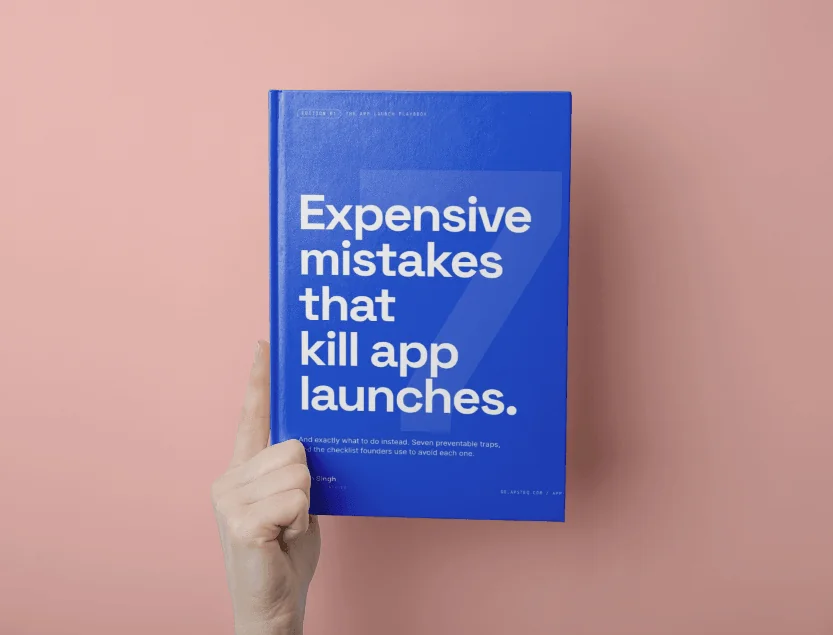
7 Expensive Mistakes That Kill App Launches
The launch errors we see most often across 300+ app engagements, and what to do instead.
Get the Free EbookBrowse all free guides