ASO Agency Pricing: What Mobile App Companies Actually Pay in 2026
Most app teams budget for paid user acquisition and forget that organic discovery through the app stores can deliver installs at a fraction of the cost. App Store Optimization (ASO) is the practice of improving an app's visibility and conversion rate inside the App Store and Google Play, and the agency fees for that work vary wildly, from $500 a month to over $15,000, depending on scope, competition, and who you hire.
A 2024 Sensor Tower analysis found that the top 1% of apps by organic downloads spend significantly more on metadata and creative testing than the average app, yet many mid-market teams still treat ASO as an afterthought. This post breaks down real ASO agency pricing tiers, what each tier buys you, how to evaluate whether a quote is fair, and what traps cost companies money without delivering results.
Key Takeaways
- ASO agency retainers in the US typically range from $1,500 to $12,000 per month, with one-time audits priced separately at $500 to $5,000 (Mobile Action, 2025).
- Apps that invest in continuous ASO iteration see up to 30% higher organic install volume compared to apps optimized once and left static (Sensor Tower, 2024).
- Google Play's store listing experiments and Apple's Product Page Optimization tool together give ASO teams testable levers that directly lift conversion; agencies charge more when they actively run these tests.
- The most common pricing trap: paying a flat retainer that includes no deliverable cadence, meaning you get reports but no actual copy or creative updates.

What Does ASO Agency Pricing Actually Include?
ASO agency pricing reflects the scope of ongoing work, not just a one-time deliverable. The core service has two distinct jobs: keyword optimization (getting your app indexed for terms users search) and conversion rate optimization (turning store page visitors into installs). Agencies that separate those two workstreams and price them transparently are worth more than those who bundle everything into a vague retainer.
Here is how the market breaks down across common service tiers in 2026:
| Tier | Monthly Price Range | Typical Deliverables | Best Fit |
|---|---|---|---|
| Starter / Audit-Only | $500 – $2,000 (one-time) | Keyword gap analysis, metadata recommendations, screenshot review | Pre-launch or budget-constrained teams |
| Essential Retainer | $1,500 – $3,500/mo | Monthly metadata updates, keyword rank tracking, 1 creative refresh per quarter | Apps with under 50K MAU |
| Growth Retainer | $3,500 – $7,500/mo | A/B testing on store listings, localization for 2-3 locales, bi-weekly reporting | Apps scaling past 100K MAU |
| Enterprise / Full-Service | $7,500 – $15,000+/mo | Continuous creative testing, multi-locale management, competitive intelligence, UA coordination | Top-200 category apps, global products |
According to Mobile Action's 2025 industry benchmarks, the median ASO retainer for a US-based agency working with a venture-backed mobile app sits around $4,200 per month. That number shifts upward when an app competes in high-CPM categories like finance, health, or productivity, where keyword competition is steepest and creative differentiation requires more iteration.
A concrete example: a fintech app in the personal finance category, competing against names like Mint and YNAB, will need monthly keyword updates across both stores, localized screenshots for at least English US and English UK, and regular A/B tests on icon variants. That scope realistically requires a growth-tier retainer. An indie game studio releasing a casual puzzle app in a lower-competition subcategory could get strong results from an essential retainer, provided the agency actually ships copy changes monthly rather than just reporting on rank movements.
One nuance buyers miss: ASO pricing almost never includes paid Apple Search Ads or Google UAC spend. Those are separate media budgets. A quote that seems cheap may simply be excluding the channels where ASO insight gets monetized through paid blending. Ask specifically whether the agency ties ASO learnings back to keyword bid strategy for paid search inside the stores.
How Should You Evaluate an ASO Agency Quote?
Evaluating an ASO agency quote comes down to three questions: what changes ship each month, who owns the work, and how are results measured. A quote without clear answers to those three questions is a red flag, regardless of price.
Here is a practical evaluation checklist:
- Deliverable cadence: Ask for a monthly delivery calendar. A legitimate agency can tell you that on week one they pull keyword data, on week two they write and submit metadata, on week three they analyze experiment results, and on week four they report. Vague answers here suggest the retainer is mostly reporting.
- Who writes the copy: Some agencies subcontract copywriting. Others have in-house app store copywriters who know character limits, keyword density rules, and algorithm weighting differences between the App Store and Google Play. In-house copy typically correlates with faster iteration.
- Test volume: Apple's Product Page Optimization allows up to three concurrent treatment variants. Google Play's store listing experiments are similarly capped. Ask how many tests the agency runs per quarter and what their lift benchmarks look like historically.
- Reporting metrics: Impressions, conversion rate (CVR), and keyword rank are table-stakes metrics. Stronger agencies also track Conversion Rate by Traffic Source separately, because browse traffic and search traffic convert at different rates and need different creative strategies.
- Competitive intelligence frequency: Top competitors update their store listings regularly. An agency should be auditing competitor metadata at least monthly, not quarterly.
If your app is scaling and you want a team that connects ASO to your broader growth stack, including paid acquisition and lifecycle, our app marketing services cover the full funnel, not just organic store visibility in isolation.
One more pricing signal worth noting: agencies that charge separately for localization are usually more transparent overall. Localization into a new language typically costs $800 to $2,500 per locale per quarter, depending on the number of store assets (title, subtitle, description, screenshots, preview video captions). Bundled-everything retainers often quietly exclude this work until you ask.
ASO Agency Pricing Data: What the Numbers Say
The data on ASO ROI consistently shows that organic acquisition from the stores is among the lowest-cost growth channels available to mobile apps. Understanding the pricing context requires knowing what the alternative costs.
Key data points from credible sources:
- Organic installs from the App Store and Google Play account for roughly 65% of all app downloads globally (data.ai, formerly App Annie, 2024). That means for most apps, a majority of installs already come through organic channels, yet most marketing budgets weight paid acquisition far more heavily.
- According to AppsFlyer's Performance Index (2024), the median cost per install (CPI) for paid UA in the US ranges from $1.50 in casual games to over $8 in finance and $12 in subscription health apps. A well-optimized store listing can lift organic CVR by 10 to 25 percentage points, which is effectively free installs at zero CPI.
- Agencies with dedicated A/B testing programs report a median 18% lift in install conversion rate within the first six months of active testing (Sensor Tower, 2024).
- The average US app spends less than $500 per month on ASO, including in-house time, despite it being their largest acquisition channel by volume (Mobile Action, 2025).
The gap between what ASO costs and what it returns is the business case for hiring a specialist agency. An agency retainer at $4,000 per month that lifts organic CVR by 15% on an app receiving 200,000 monthly store page impressions and converting at 3% baseline generates roughly 9,000 additional installs per month. If each install is worth $2 in lifetime value, that is $18,000 in incremental value from a $4,000 spend, a 4.5x return before counting the compounding effect of higher keyword rankings.
That math only works if the agency actually ships creative and metadata changes. Agencies that deliver reports without implementation consistently underperform, and this is the core reason mid-market apps churn away from ASO retainers frustrated: they paid for strategy and got spreadsheets.

What Mistakes Do App Companies Make When Buying ASO Services?
The most expensive mistake is treating ASO as a one-time project. The second most expensive is paying for an agency that reports on ASO without actually doing it. Both mistakes are common, and both are avoidable if you know what to look for upfront.
Mistake 1: Buying an audit and stopping there. An ASO audit is useful as a starting point, but the app stores are dynamic. Apple updates its search algorithm, new competitors enter your category, seasonal search behavior shifts, and screenshot trends evolve. A team that gets an audit in January and does nothing until November has essentially paid for a snapshot of a moving target. Real ASO requires monthly updates at minimum.
Mistake 2: Confusing an SEO agency for an ASO agency. Web SEO and app store optimization share vocabulary but operate on different systems. The App Store's search algorithm weights keyword field usage differently than Google Search weights meta descriptions. An SEO agency without specific App Store and Google Play expertise will apply web frameworks that do not translate, burning months of retainer fees on ineffective changes. Always ask for app-specific case studies with rank and CVR data, not just traffic case studies.
Mistake 3: Not tying ASO to paid UA strategy. Apple Search Ads and Google Play's bidded keywords are most efficient when they align with organic keyword data from ASO. Agencies that operate these channels in silos waste budget bidding on terms the algorithm already ranks the app for organically. The best arrangements have the ASO team and the paid team sharing keyword intelligence at least biweekly.
Mistake 4: Paying for localization without a market strategy. Localizing into Japanese, Korean, or German looks good on a deliverables list, but if the app has no user acquisition budget, distribution, or support in those markets, localized store listings generate very few incremental installs. Prioritize locales where you already have organic traffic or paid campaigns running.
For app companies that want to connect ASO with full-funnel paid acquisition and avoid these gaps, our user acquisition team works alongside the ASO program to ensure keyword data flows both ways and paid spend is not duplicating organic momentum.
Where ASO Agency Pricing Is Heading in 2026 and 2027
ASO agency pricing is rising modestly at the high end and compressing at the low end. Two forces are driving both trends simultaneously: AI tooling and Apple's expanding store features.
AI-assisted keyword research and metadata generation tools have made basic ASO faster and cheaper to produce. As a result, entry-level and mid-market retainer prices have not increased significantly in two years. Agencies competing on volume are pricing essential retainers lower to win contracts, which benefits smaller app companies but also means the deliverable quality at that tier varies significantly.
At the same time, Apple has expanded Product Page Optimization and introduced Custom Product Pages for paid campaigns, and Google has added store listing experiments with richer visual testing. Running these features correctly requires creative strategy, statistical analysis, and rapid iteration cycles that are harder to automate. Agencies that invest in that capability are pricing enterprise retainers higher, and the market is rewarding them.
According to Statista's 2025 mobile market report, global app store revenues are projected to exceed $270 billion by 2027, which means category competition will intensify and organic store ranking will become more valuable, not less. Agencies with strong track records in competitive categories will continue to command premium prices.
For 2026 specifically, the biggest emerging pricing variable is AI-generated store asset compliance. Both Apple and Google have issued evolving guidelines around AI-created screenshots and preview videos. Agencies that understand those guidelines and can produce compliant creative at speed will carry a pricing premium through at least 2027.
Frequently Asked Questions
What is the average monthly cost of an ASO agency in the US?
The average ASO agency retainer for a US-based mobile app sits between $1,500 and $7,500 per month in 2026, depending on the number of stores, locales, and whether A/B testing is included. According to Mobile Action's 2025 benchmarks, the median for venture-backed apps is approximately $4,200 per month. One-time audits run $500 to $5,000 separately.
Is ASO worth the agency fee compared to paid user acquisition?
For most apps, yes. Organic installs account for roughly 65% of all downloads globally (data.ai, 2024), and a well-run ASO program can improve store conversion rates by 10 to 25 percentage points. Compared to paid UA costs of $1.50 to $12 per install depending on category (AppsFlyer, 2024), incremental organic installs from ASO improvements often carry a cost-per-install close to zero after the agency fee is factored in.
How long does it take to see results from an ASO agency?
Keyword rank improvements typically appear within 4 to 8 weeks of metadata updates, because both the App Store and Google Play re-index listings relatively quickly. Conversion rate improvements from A/B testing require 2 to 4 weeks per test to reach statistical significance. Most agencies set a 90-day window as the minimum timeframe before evaluating program performance against baseline metrics.
What should I ask an ASO agency before signing a contract?
Ask for a sample monthly delivery calendar showing specific tasks, not just reporting activities. Request two or three app-specific case studies with before-and-after keyword rank data and conversion rate changes. Confirm whether the retainer includes actual metadata and creative updates each month, how many A/B tests they run per quarter, and whether localization into additional locales costs extra.
Can an ASO agency also manage my paid app marketing campaigns?
Some agencies handle both organic ASO and paid acquisition, and that integration is genuinely valuable because keyword data from ASO should inform Apple Search Ads and Google UAC bidding. If you want a team that connects both channels, explore our ASO and app marketing services where organic and paid strategy are built to work together from the start, rather than in separate silos that duplicate each other's work.
What to Do Next
ASO agency pricing in 2026 spans a wide range, but the decision is not about finding the cheapest option. It is about finding a team that ships work, not just reports. Here is what to take away:
- Retainers range from $1,500 to $15,000 per month; the right tier depends on your category competition and the number of stores and locales you are managing.
- Organic installs are already your largest acquisition channel. Underinvesting in ASO means leaving your biggest growth lever unmanaged.
- The most common failure mode is paying a retainer and receiving reports without metadata or creative changes. Verify deliverable cadence before signing.
- ASO and paid UA should share keyword data. Agencies that operate them separately cost you money in both channels.
- AI tooling is compressing prices at the low end and raising the value of expert creative testing at the high end. Expect that gap to widen through 2027.
If you want an honest assessment of what your app actually needs, and what it would realistically cost to get there, book a free strategy call with the ApsteQ team. We will audit your current store presence, identify the highest-leverage gaps, and give you a clear-eyed scope before you commit to anything.
Free download
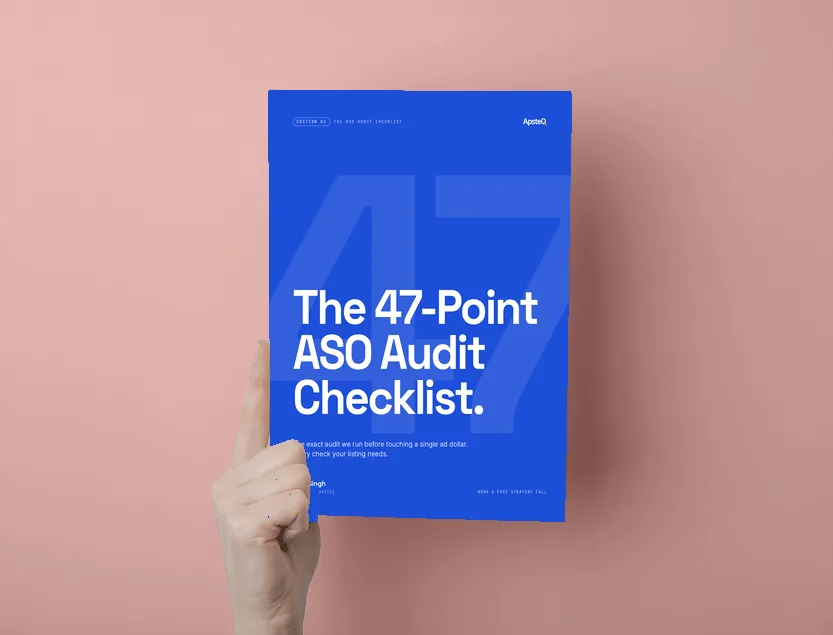
The 47-Point ASO Audit Checklist
The exact checklist we run before touching any app store listing. Find the gaps costing you organic installs.
Get the Free EbookBrowse all free guides