
Mobile App Marketing Strategies That Drive Real Growth in 2026
The most effective mobile app marketing strategies combine app store optimization, paid user acquisition, and retention-focused lifecycle marketing to drive sustainable growth. Companies that align all three channels consistently outperform single-channel competitors on both install volume and long-term revenue.
There are now over 5 million apps available across the Apple App Store and Google Play combined (Statista 2026), yet the average app loses more than 70% of its daily active users within the first 30 days of install (Adjust 2024). That gap between download and retention is where most mobile app companies bleed money. If your current strategy focuses only on acquiring installs, you are solving the wrong problem.
In this guide, you will learn which acquisition channels deliver the strongest return in 2026, how to build a retention engine that keeps users engaged, which benchmarks separate top-quartile apps from the rest, and the most expensive mistakes mobile teams make when scaling.
Key Takeaways
- There are over 5 million apps competing for user attention across major app stores (Statista 2026), making differentiated positioning non-negotiable.
- Apps with strong onboarding flows retain up to 50% more users after day 30 compared to apps without guided onboarding (Adjust 2024).
- Organic search and App Store Optimization (ASO) drives roughly 65% of all app downloads, making it the highest-leverage, lowest-cost acquisition channel available (Apple Developer documentation, 2024).
- Mobile ad spend in the US is projected to exceed $225 billion in 2026 (Statista 2026), underscoring how competitive the paid acquisition landscape has become.
What Are the Most Effective Mobile App User Acquisition Channels in 2026?
The most effective user acquisition channels in 2026 are App Store Optimization, Apple Search Ads, Google UAC, and paid social, but their relative value depends entirely on your app category, budget, and target audience. Choosing the wrong channel mix is the single fastest way to burn through a marketing budget with nothing to show for it.
App Store Optimization (ASO) is the process of improving an app's visibility within app store search results by optimizing metadata, screenshots, ratings, and keyword targeting. It remains the foundational channel because organic discovery still accounts for the majority of installs. According to Apple Developer documentation (2024), search is how users find apps most of the time, and roughly 65% of downloads come directly from app store searches. That means every dollar you invest in ASO compounds over time, unlike paid spend that stops the moment your budget pauses.
Paid acquisition tells a different story. Apple Search Ads delivers intent-based reach to users already inside the App Store actively searching for solutions. For categories like finance, health, and productivity, conversion rates from Apple Search Ads consistently outperform third-party ad networks because the user is already in a download mindset. Google's Universal App Campaigns (UAC) distributes creatives across Search, YouTube, Display, and the Play Store simultaneously, making it the most scalable option for Android-first or cross-platform apps.
Paid social, specifically Meta and TikTok, excels at generating top-of-funnel awareness for apps targeting younger demographics or lifestyle categories. However, post-ATT (App Tracking Transparency) signal loss has made Meta campaigns harder to optimize without strong first-party data and a well-configured SKAdNetwork setup.
A concrete example: Duolingo, one of the most downloaded education apps in the US, built its initial growth almost entirely on ASO and word-of-mouth virality before layering in paid social. This sequencing, organic first, paid second, is a repeatable playbook that keeps blended cost-per-install (CPI) manageable while building a durable brand signal.
The practical takeaway is to stack channels deliberately. Start with ASO to capture existing demand, add Apple Search Ads and Google UAC to accelerate, and introduce paid social only once you have creative learnings and strong retention data to justify the spend. Jumping straight to paid social without fixing organic fundamentals inflates your CPI unnecessarily.
How Do You Build a Mobile App Marketing Strategy That Actually Retains Users?
A retention-focused mobile app marketing strategy starts with onboarding, not advertising. The single most impactful thing you can do to improve long-term retention is reduce the time between install and the user's first meaningful value moment, sometimes called the "aha moment."
Here is a step-by-step retention framework that top-performing mobile apps use in 2026:
- Map the activation funnel. Identify the exact in-app action that correlates with 30-day retention. For a fitness app, it might be completing a first workout. For a fintech app, it might be linking a bank account. Every onboarding screen should guide users toward that action as quickly as possible.
- Segment push notifications by behavior. Generic broadcast pushes destroy retention. Behavioral triggers, sent when a user has not opened the app in 48 hours or has abandoned a key flow, consistently outperform scheduled blasts on both open rates and re-engagement. Adjust (2024) reports that triggered push notifications generate significantly higher click-through rates than broadcast messages.
- Implement in-app messaging for feature discovery. Users who discover three or more core features within their first week retain at dramatically higher rates. In-app tooltips, coach marks, and contextual modals drive feature discovery without requiring users to leave the app.
- Build a reactivation sequence for lapsed users. Define "lapsed" by your app's natural engagement cadence. A daily habit app might flag users lapsed after 3 days; a travel app might flag them after 60 days. Email and push reactivation sequences with personalized dynamic content consistently bring back a meaningful percentage of churned users.
- A/B test your paywall placement and messaging. For subscription apps, paywall friction is one of the leading retention killers. Moving the paywall after a user has experienced at least one value moment, rather than gating the app immediately on first launch, improves both trial starts and paid conversion rates.
Retention and acquisition are not separate strategies; they are a single loop. Every percentage point improvement in day-30 retention reduces the volume of new installs you need to hit your monthly active user (MAU) growth targets. If you want a deeper look at how these principles apply across verticals, the team at ApsteQ's app marketing practice builds custom retention frameworks tailored to your app category and monetization model.
Mobile App Marketing Benchmarks: How Does Your App Compare?
Understanding where your app stands relative to industry benchmarks is the fastest way to identify which part of your funnel needs the most attention. Most mobile teams focus on installs while ignoring the retention and monetization metrics that actually determine business value.
Here are the critical benchmark categories every mobile app company should track:
- Day-1, Day-7, and Day-30 retention rates by vertical category
- Cost per install (CPI) and cost per paying user (CPPU) across paid channels
- Conversion rate from install to registration and from registration to first value action
- Average Revenue Per Daily Active User (ARPDAU) for monetized apps
- App Store rating and review volume as a proxy for organic ranking health
Mobile ad spend in the US is projected to exceed $225 billion in 2026 (Statista 2026), which means CPI benchmarks are rising across nearly every category as more advertisers compete for the same install inventory. Meanwhile, AppsFlyer research (2024) shows that non-organic installs from paid channels account for a significant share of total installs for top-grossing apps, but organic installs from ASO still deliver a meaningfully lower average CPI than paid channels across most verticals.
Sensor Tower data (2024) shows that the top 1% of apps by revenue generate a disproportionate share of total app store earnings, reinforcing that monetization strategy, not just install volume, separates breakout apps from the long tail.
| App Category | Avg. Day-30 Retention (%) | Avg. CPI, US iOS (USD) | Avg. Day-1 Retention (%) |
|---|---|---|---|
| Gaming (Casual) | 10-15% | $1.50 - $3.00 | 30-40% |
| Finance / Fintech | 20-30% | $5.00 - $12.00 | 40-55% |
| Health & Fitness | 15-25% | $3.00 - $7.00 | 35-50% |
| Productivity | 25-35% | $4.00 - $9.00 | 45-60% |
| eCommerce / Shopping | 15-20% | $2.00 - $5.00 | 35-45% |
Benchmark ranges sourced from Adjust (2024) and AppsFlyer research (2024). Individual results vary by creative quality, onboarding flow, and targeting precision.
ApsteQ Insight: Most apps that underperform on Day-30 retention are not losing users because of a product problem. They are losing users because of an onboarding sequencing problem. If you fix the first seven minutes of the user experience, you often fix the first 30 days.
What Are the Most Costly Mobile App Marketing Mistakes Companies Make?
The costliest mobile app marketing mistakes are not technical errors; they are strategic misalignments that cause teams to optimize the wrong metrics while the real problems compound. Recognizing these patterns early can save hundreds of thousands of dollars in wasted ad spend.
Mistake 1: Optimizing for installs instead of activated users. Install volume is a vanity metric if the users who install never reach your app's core value moment. Many teams set their paid campaigns to optimize for installs because it produces the largest volume numbers on the dashboard. The correct optimization event is always your activation event, the in-app action that predicts long-term retention, not the install itself.
Mistake 2: Ignoring App Store Optimization before scaling paid spend. Paid ads drive users to your App Store listing. If your listing has weak screenshots, a confusing description, or a rating below 4.0 stars, you are paying to send people to a page that will not convert. Fix the listing first. A real-world example: many mid-size apps running significant monthly Meta budgets see their paid traffic convert at half the rate of organic traffic simply because the App Store page was never optimized for paid-driven visitors who arrive with less intent than organic searchers.
Mistake 3: Skipping measurement infrastructure setup. Without a properly configured mobile measurement partner (MMP) like Adjust or AppsFlyer, you cannot accurately attribute installs to campaigns. Teams that skip this step end up making budget allocation decisions based on last-touch or no-touch attribution, which systematically overspends on bottom-of-funnel channels and underinvests in top-of-funnel brand channels that initiate the discovery journey.
Mistake 4: Treating all user segments identically. High-value users, those likely to subscribe, make in-app purchases, or refer friends, behave differently from average users from the moment they install. Apps that build lookalike audiences from their top 10% of users by lifetime value (LTV) consistently reduce blended CPI and improve return on ad spend (ROAS) compared to apps running broad targeting.
Mistake 5: Neglecting ratings and review management. App store ratings directly influence both organic ranking and paid conversion rates. A drop from 4.5 stars to 3.8 stars can reduce install conversion rate significantly, inflating effective CPI across every channel simultaneously. If you want to understand how cross-channel marketing discipline applies beyond app marketing, see how ApsteQ approaches patient acquisition in dental marketing using the same funnel-first thinking.
Where Is Mobile App Marketing Headed in 2027 and Beyond?
Mobile app marketing in 2027 will be defined by AI-driven creative automation, privacy-first measurement architectures, and the growing dominance of short-form video as the primary acquisition creative format. Companies that build competency in these three areas now will have a significant structural advantage over competitors still relying on 2023-era playbooks.
AI-generated creative at scale is already transforming paid acquisition workflows. Generative AI tools can now produce hundreds of ad creative variants from a single brief, enabling continuous creative testing at a speed and cost that was impossible three years ago. The teams winning on Meta and TikTok in 2026 are shipping 20 to 30 new creative variants per week, learning quickly, and iterating faster than any human-only creative team can match.
Privacy-first measurement is no longer optional. Apple's SKAdNetwork and Google's Privacy Sandbox have fundamentally restructured how mobile attribution works. The next evolution is probabilistic modeling layered on top of aggregated signals, allowing marketers to make reasonable LTV predictions without individual-level tracking. AppsFlyer research (2024) shows that apps with well-configured privacy-preserving measurement frameworks recover more attributed conversion data than apps relying on legacy deterministic methods alone.
Short-form video as an install driver continues to accelerate. TikTok's in-app install button and Meta's Reels placement are delivering strong performance for apps with visual, demonstrable value propositions. Mobile ad spend in the US is projected to exceed $225 billion in 2026 (Statista 2026), and a growing share of that spend is flowing into short-form video formats as click-through rates on static banners continue to decline.
The apps that will win in 2027 are not necessarily the ones with the biggest budgets. They are the ones that build tighter feedback loops between product, data, and marketing, so that every user behavior signal informs the next creative test, the next onboarding iteration, and the next channel investment.
Frequently Asked Questions
What is the most cost-effective mobile app marketing strategy for a new app launch?
App Store Optimization is the most cost-effective launch strategy because it captures existing search demand at zero media cost. Focus on keyword-rich titles, compelling screenshots, and securing your first 50 to 100 ratings through legitimate review prompts. Organic ASO-driven installs consistently deliver lower CPI than paid channels, making it the right foundation before spending on ads.
How much should a mobile app company budget for user acquisition in 2026?
Most growth-stage apps allocate between 20% and 40% of total revenue toward user acquisition, though early-stage companies often spend more aggressively to establish a user base. The more important number is your target cost per acquiring one paying user, which should be no more than one-third of that user's projected 12-month lifetime value to maintain a healthy unit economics model.
What is App Store Optimization and why does it matter?
App Store Optimization (ASO) is the practice of improving an app's discoverability and conversion rate within the Apple App Store and Google Play Store through keyword targeting, visual asset optimization, and rating management. It matters because roughly 65% of downloads originate from app store search (Apple Developer documentation, 2024), meaning ASO improvements compound over time without incremental media spend.
How do I measure the success of my mobile app marketing campaigns?
Success measurement requires a mobile measurement partner (MMP) like Adjust or AppsFlyer to track attribution across channels. Key metrics to monitor include cost per install, cost per activated user, Day-1 and Day-30 retention rates, and return on ad spend (ROAS) at the 90-day post-install mark. Install volume alone is not a reliable success indicator without accompanying retention and revenue data.
Can a full-service agency manage both my app marketing and growth strategy?
Yes, and working with a specialist agency often accelerates results because the team brings cross-app data and channel expertise that an in-house team builds more slowly. The ApsteQ app marketing team manages strategy, paid acquisition, ASO, and retention campaigns for mobile app companies across categories. Consolidated management typically produces stronger cross-channel attribution and faster creative iteration cycles than fragmented vendor relationships.
Conclusion
Mobile app marketing in 2026 rewards companies that think in systems, not campaigns. The apps that grow sustainably are the ones that build strong organic visibility through ASO, layer paid acquisition on top of a proven retention foundation, and use data to continuously refine every step of the user journey.
Here are the core principles to take away:
- Fix your App Store listing and onboarding before scaling paid spend
- Optimize campaigns for your activation event, not the install
- Use retention benchmarks to identify exactly where your funnel leaks
- Invest in measurement infrastructure before campaign scale
- Build creative testing velocity as a strategic capability, not an afterthought
If you are ready to build a mobile app marketing strategy that drives installs, activations, and long-term revenue, the ApsteQ team is here to help. Book a free strategy call and we will audit your current funnel, benchmark your metrics against category peers, and map out a prioritized growth plan tailored to your app.
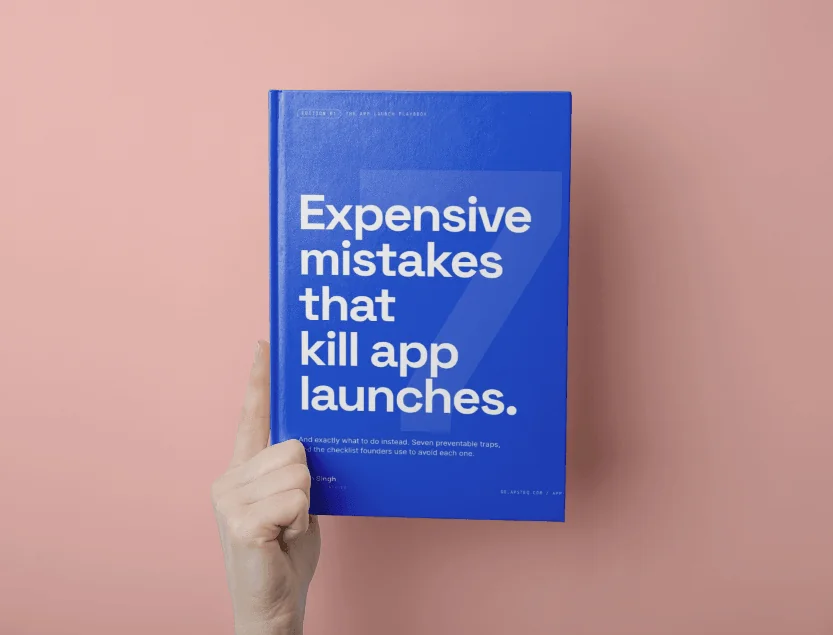
Free download
7 Expensive Mistakes That Kill App Launches
The launch errors we see most often across 300+ app engagements, and what to do instead.
Get the Free Ebook Browse all free guides