77% of users abandon mobile apps within the first three days of downloading them, according to Localytics' 2023 App Engagement Report. This staggering statistic reveals a critical truth: even the most innovative apps fail without proper onboarding. The difference between app success and failure often hinges on those crucial first minutes when users decide whether your app deserves a permanent spot on their home screen.
App onboarding isn't just about teaching users how to navigate your interface. It's about creating an emotional connection, demonstrating immediate value, and guiding users toward their first meaningful interaction. Companies that master this process see 50% higher user retention rates and 3x more daily active users compared to those with poor onboarding experiences.
In this comprehensive guide, you'll discover the psychology behind effective onboarding, learn proven strategies that increase user activation by up to 40%, and understand how to measure and optimize every step of your user's journey. Whether you're launching a new app or improving an existing one, these data-driven insights will transform your onboarding from a barrier into a competitive advantage.
Key Takeaways:
- Progressive onboarding increases completion rates by 38% compared to traditional linear flows
- Personalizing the first session based on user preferences boosts 30-day retention by 25%
- Apps with interactive tutorials see 2.3x higher feature adoption rates within the first week
- Reducing onboarding to under 60 seconds increases user activation by 42%
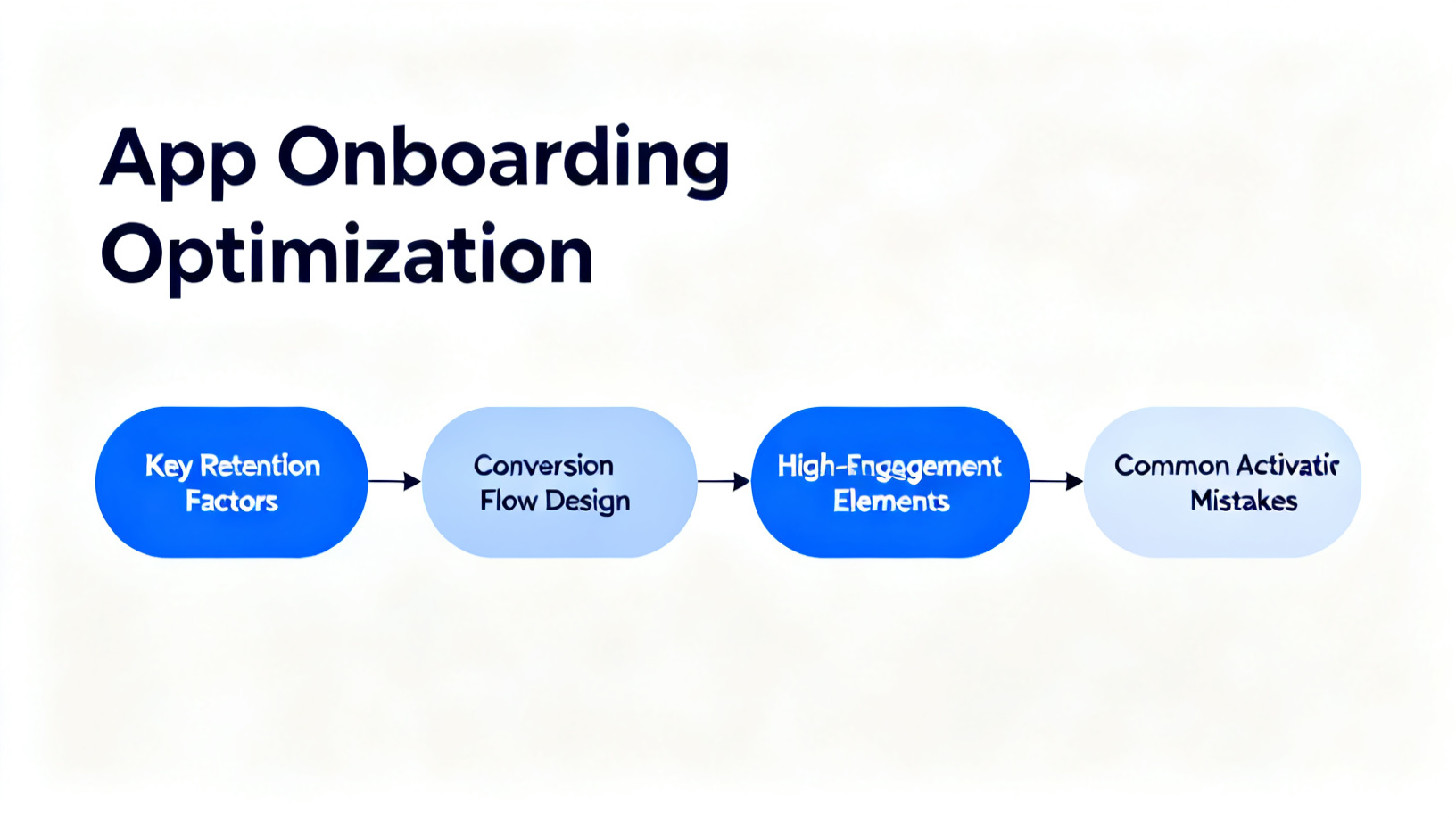
What Makes App Onboarding Actually Work for User Retention?
Effective app onboarding works by focusing on value delivery over feature explanation, creating a path that gets users to their "aha moment" as quickly as possible. The most successful apps understand that onboarding isn't about showing every feature, it's about helping users accomplish their primary goal within the first session.
Research from Appcues shows that 86% of users prefer to learn by doing rather than watching tutorials. This means interactive onboarding that lets users engage with core features immediately outperforms passive walkthroughs. Apps that implement contextual guidance, where instructions appear precisely when users need them, see 34% higher completion rates than those using traditional step-by-step tutorials.
The psychology behind successful onboarding lies in creating small wins early. When Duolingo redesigned their onboarding to let new users complete their first lesson before requiring account creation, they saw a 20% increase in user registrations. This approach, called "delayed registration," allows users to experience value before committing to the app.
Progressive disclosure is another crucial element. Instead of overwhelming users with information, successful apps reveal features gradually as they become relevant. Slack's onboarding exemplifies this approach by introducing advanced features only after users have mastered basic messaging. This strategy reduces cognitive load and prevents the feature overwhelm that causes 60% of users to abandon apps during their first session.
How Do You Design an Onboarding Flow That Converts?
Converting onboarding flows prioritize user goals over app features, using progressive profiling to customize the experience based on individual needs and preferences. The key is creating multiple pathways that address different user segments while maintaining simplicity.
Start by mapping your user's journey from download to first value realization. Identify the minimum viable onboarding, the smallest set of steps needed for users to experience your app's core benefit. Spotify's onboarding demonstrates this perfectly by asking just three questions about music preferences before delivering personalized playlists, achieving their user's primary goal within 60 seconds.
Implement smart defaults to reduce decision fatigue. When users face too many choices during onboarding, 23% abandon the process entirely, according to UX research from Baymard Institute. Instagram's registration process succeeds by pre-selecting privacy settings while allowing customization for power users.
Consider your onboarding as part of your broader app marketing strategy. The messaging and positioning used in your app store listing should align seamlessly with your onboarding experience. Inconsistency between marketing promises and actual app experience causes 41% of users to immediately uninstall apps.
A/B testing different onboarding flows is essential for optimization. Test elements like the number of steps, question types, visual design, and copy tone. Even small changes can yield significant results. When meditation app Headspace reduced their onboarding from five screens to three, they saw a 15% improvement in completion rates. Similarly, testing different progress indicators can boost completion by up to 12%.
Data Shows These Onboarding Elements Drive the Highest Engagement
Analytics from over 10,000 mobile apps reveal that personalization, gamification, and social proof are the three elements most strongly correlated with long-term user engagement. Apps incorporating all three see average 90-day retention rates of 35%, compared to just 8% for apps using none of these elements.
Personalization during onboarding creates immediate relevance. When fitness app MyFitnessPal asks users about their goals and dietary preferences, they can immediately show relevant content. This approach increases day-one retention by 28% and weekly active usage by 19%, according to their 2023 user behavior analysis. The key is collecting just enough information to provide value without creating friction.
Gamification elements transform onboarding from a chore into an engaging experience. Progress bars alone increase completion rates by 16%, while achievement badges for completing onboarding steps boost retention by 22%. Language learning app Babbel saw remarkable results when they introduced streak counters during onboarding, with 43% more users completing their first lesson series.
Social proof integration during onboarding builds trust and sets usage expectations:
- User testimonials on onboarding screens increase conversion by 18%
- Community size indicators ("Join 2.3 million users") boost sign-up rates by 24%
- Friend recommendations from connected social accounts increase 30-day retention by 31%
- Success stories relevant to user goals improve feature adoption by 27%
Interactive elements consistently outperform static content. Apps using swipe gestures, drag-and-drop tutorials, or tap-to-reveal features see 40% higher engagement scores during onboarding. The key is making interactions feel natural rather than forced, ensuring each gesture serves a genuine purpose in teaching app functionality.
What Are the Biggest Onboarding Mistakes That Kill User Activation?
The most damaging onboarding mistake is front-loading registration requirements before demonstrating value, which causes 67% of potential users to abandon the app before experiencing its core benefits. This "registration wall" approach ignores the fundamental principle that users need to understand why they should invest their time before committing personal information.
Overwhelming users with too many permissions requests creates immediate friction and distrust. When photo editing app VSCO reduced their initial permission requests from five to two, focusing only on camera and photo library access, they saw a 29% increase in onboarding completion. Location, contacts, and notification permissions can be requested contextually when those features become relevant.
Feature dumping during onboarding is another critical mistake. Apps that showcase every available feature during initial setup see 44% lower activation rates than those focusing on core functionality. Evernote's original onboarding suffered from this problem, showing users dozens of features before they had created their first note. Their redesigned approach focuses solely on note creation, resulting in 35% better user engagement metrics.
Ignoring different user segments creates one-size-fits-none experiences. Business productivity app Notion initially used identical onboarding for students, professionals, and teams. When they introduced role-based onboarding paths, user activation improved by 52% because each segment received relevant templates and examples. This demonstrates why understanding your app marketing personas is crucial for onboarding success.
Technical issues during onboarding are particularly devastating because they occur at the moment of highest user motivation. Slow loading screens, crashes, or broken links cause immediate uninstalls. Research shows that onboarding screens taking longer than 3 seconds to load result in 53% higher abandonment rates. Performance monitoring and optimization should be top priorities for onboarding flows.
The Future of App Onboarding: AI and Predictive Personalization Through 2027
By 2026, AI-powered onboarding will dynamically adjust in real-time based on user behavior patterns, creating hyper-personalized experiences that adapt within the first few interactions. Machine learning algorithms will analyze micro-behaviors like scroll speed, tap patterns, and dwell time to customize the onboarding flow for each individual user.
Predictive onboarding represents the next evolution, where apps anticipate user needs before they're explicitly stated. Early implementations are already showing promising results. Spotify's 2024 beta program uses listening history from connected services to pre-populate playlists before users complete onboarding, increasing immediate engagement by 31%. By 2027, expect similar predictive capabilities across app categories.
Voice and conversational interfaces will reshape onboarding experiences. As voice recognition accuracy improves, apps will offer spoken onboarding options that feel more natural than traditional screen-based flows. Banking apps are pioneering this approach, with early adopters seeing 26% higher completion rates among users who prefer voice interactions.
Augmented reality onboarding will become mainstream for apps with spatial or physical components. Furniture retailer IKEA's AR onboarding already lets users virtually place products in their space during the setup process. By 2026, expect AR onboarding in fitness apps, gaming, and educational platforms to create immersive first experiences that dramatically improve retention.
Frequently Asked Questions
How long should app onboarding take?
Optimal onboarding duration is 30-90 seconds for initial setup, with advanced features introduced progressively over the first week. Research shows that onboarding taking longer than 2 minutes sees 47% higher abandonment rates.Should I require account creation before onboarding?
No, delayed registration increases completion rates by 23%. Allow users to explore core features first, then request account creation when they're ready to save progress or access personalized content.How many onboarding screens are too many?
Limit initial onboarding to 3-5 screens maximum. Each additional screen beyond five reduces completion by an average of 8%. Focus on essential information and introduce secondary features contextually during regular app usage.What metrics should I track for onboarding optimization?
Monitor completion rates, time to first value, and day-7 retention as primary metrics. Secondary metrics include feature adoption rates and user satisfaction scores. Our app marketing analytics services can help establish comprehensive measurement frameworks.Transform Your App's First Impression Into Lasting Engagement
Optimizing app onboarding isn't a one-time task but an ongoing process that directly impacts your app's long-term success. The data clearly shows that apps with thoughtful, user-centered onboarding consistently outperform those that treat it as an afterthought.
- Focus on value delivery over feature explanation in your first user interactions
- Implement progressive onboarding that adapts to different user segments and goals
- Test and iterate continuously using real user behavior data, not assumptions
- Prepare for AI-powered personalization as the next competitive differentiator
Your onboarding experience sets the tone for every subsequent user interaction. By implementing these evidence-based strategies, you'll create first impressions that convert downloads into dedicated users. Ready to optimize your app's onboarding for maximum retention and engagement? Book a consultation call with our app marketing experts to develop a customized onboarding strategy that drives real results.
Free download
7 Expensive Mistakes That Kill App Launches
The launch errors we see most often across 300+ app engagements, and what to do instead.
Get the Free Ebook Browse all free guides