The Real Cost of Skipping Professional ASO in 2026
Over 65% of app downloads still begin with a search inside the App Store or Google Play (Sensor Tower, 2025), yet most mobile app companies spend less than 10% of their marketing budget on optimizing the storefront that captures all that intent. That gap is where apps bleed installs every single day.
If you are evaluating whether to hire an ASO agency, this post gives you a framework grounded in real benchmarks, not vendor promises. You will learn what a professional ASO agency actually does, how to measure their work, which mistakes cost companies the most, and what signals point toward 2027. By the end, you will have enough specific data to make a confident hiring decision.
Key Takeaways
- Apps that appear in the top 3 organic search results capture over 70% of all category-level clicks (Mobile Action, 2025), making keyword ranking the highest-leverage ASO lever available.
- Conversion rate optimization (CVR) improvements to screenshots and icons alone can lift install rates by 20-35% (AppsFlyer Research, 2024), without changing a line of code.
- The average cost-per-install via paid UA is $3.52 on iOS and $1.31 on Android in the US (Adjust, 2025); strong organic ASO cuts dependence on that spend directly.
- Apps that run structured A/B tests in Google Play's Store Listing Experiments see a median CVR lift of 12% per winning variant (Google Play Console documentation, 2025).
What Does an ASO Agency Actually Do for Your App?
An ASO agency is a specialized team that improves an app's visibility and conversion rate inside the App Store and Google Play through keyword research, creative optimization, metadata strategy, and iterative testing. This is not a one-time setup task; it is an ongoing discipline that requires proprietary data, platform-specific expertise, and fast iteration cycles.
The core deliverables break into two distinct workstreams. The first is indexation work: making sure the app surfaces for the right queries. This involves mapping high-volume, low-competition keywords into the title, subtitle (iOS) or short description (Android), and keyword field. Apple's algorithm weighs title keywords most heavily, so placing a primary term there is not optional. The second workstream is conversion work: turning impressions into installs. This covers icon design, screenshot storytelling, preview video scripting, and ratings strategy.
A concrete example illustrates the stakes. In 2024, a US-based fintech app working with a structured ASO program moved its primary keyword ranking from position 28 to position 6 over 90 days by restructuring its title and iterating on subtitle keywords bi-weekly, according to a Mobile Action case study. Organic installs rose 41% in the same window, with no increase in paid spend.
The platforms themselves have raised the ceiling on what ASO can accomplish. Apple's Search Ads Basic now surfaces Custom Product Pages that can be A/B tested against different audience segments, and Apple's Product Page Optimization lets developers test up to three treatment variants simultaneously. Google Play's equivalent, Store Listing Experiments, supports full metadata and creative tests with statistical significance reporting built in (Google Play Console documentation, 2025).
What separates a strong agency from a freelance generalist is access to aggregated ranking intelligence. Agencies running dozens of accounts simultaneously spot algorithm shifts faster, because a keyword movement visible in five accounts simultaneously is a signal; the same movement in one account is noise. That pattern-recognition advantage compounds over time and is genuinely difficult to replicate in-house without dedicated tooling and volume.
ASO** is not a synonym for keyword stuffing. Google Play penalizes keyword repetition inside descriptions now, and Apple's reviewers flag titles that read as spam. Modern ASO work is closer to editorial craft than technical SEO, and the best agencies treat it that way.
How Do You Choose the Right ASO Agency for Your App?
The right ASO agency for your app matches three dimensions: platform expertise (iOS vs. Android vs. both), category depth in your vertical, and a testing methodology you can audit. Agencies that cannot show you historical CVR lift data from similar apps should not be shortlisted.
Here is a practical evaluation process you can run in under two weeks:
- Request a sample audit. A legitimate agency will produce a keyword gap analysis and a conversion rate benchmark for your category before you sign anything. If they quote a monthly retainer without first diagnosing your current state, walk away.
- Ask for category comps. If your app is a fitness tracker, ask for ASO results from at least two other apps in Health and Fitness. Generic case studies from unrelated verticals tell you very little about category-specific keyword behavior.
- Evaluate their testing cadence. The best programs run a new creative test every four to six weeks. If an agency proposes annual or quarterly creative refreshes, their methodology is too slow for 2026 algorithm cycles.
- Confirm cross-platform capability. iOS and Android ASO are meaningfully different. iOS keyword fields are character-limited and not publicly visible; Android descriptions are indexed by Google's web crawler as well as Play's internal algorithm. An agency that runs identical metadata on both platforms does not understand the distinction.
- Check their stack. Ask which tools they use for rank tracking, keyword research, and creative performance. Serious agencies typically use a combination of data.ai (formerly App Annie), Sensor Tower, and Mobile Action. Agencies relying only on free tools are working with incomplete data.
Budget context matters here. US app companies spending $5,000 to $15,000 per month on a dedicated ASO retainer tend to see positive ROI within 60 to 90 days when the agency has genuine category experience. That range sits well below the cost of the paid UA spend they offset. Our ASO service at ApsteQ operates inside this model: audit first, test-driven execution second, transparent reporting always.
One more filter worth applying: ask how they handle the relationship between ASO and paid search ads. Apple Search Ads and Google UAC campaigns influence organic ranking indirectly through install velocity and engagement signals. An agency that treats paid and organic as isolated channels is leaving meaningful performance on the table.
ASO Agency Benchmarks: What Good Performance Actually Looks Like
Good ASO performance is measurable against category-level benchmarks, not just month-over-month deltas. The table below shows US market benchmarks across the most active app categories, drawn from published industry data.
| App Category | Median Organic CVR (Impressions to Installs) | Top-Quartile CVR | Avg. Keyword Volume (Top 50 Terms) |
|---|---|---|---|
| Games (Casual) | 3.1% | 6.8% | High (50K+ monthly searches) |
| Health and Fitness | 2.4% | 5.2% | Medium (10K-50K) |
| Finance | 1.9% | 4.1% | Medium (10K-50K) |
| Productivity | 2.7% | 5.9% | Medium (10K-50K) |
| Shopping | 3.4% | 7.1% | High (50K+) |
Sources: Sensor Tower category benchmarks (2025); Mobile Action CVR data (2025). CVR reflects US App Store data.
A few patterns jump out of this data:
- The gap between median and top-quartile CVR is roughly 2.3 to 3.7 percentage points across every category. That delta is the addressable opportunity an ASO agency is selling you access to.
- Finance apps have the lowest median CVR, which reflects user skepticism and high competition, not low search demand. The category's top-quartile apps close that gap through trust signals: rating counts, security badges in screenshots, and editorial endorsements in the description.
- Shopping apps show the widest absolute CVR range, meaning there is the most room for optimization, but also the most room to fall below median if creative is weak.
Beyond CVR, a well-run ASO program should also move three secondary metrics: keyword ranking position (tracked weekly), browse traffic share (the percentage of impressions coming from category and top charts, not just search), and redownload rate, which reflects how well the listing retains lapsed users. Apps with a redownload rate above 18% are typically outperforming on brand equity signals (Adjust, 2025).
One underused benchmark is rating velocity. Apps generating over 100 new ratings per week in their primary market maintain ranking stability significantly better during algorithm updates, because fresh social proof is a direct input into Apple's and Google's relevance scores (AppsFlyer Research, 2024).
What Mistakes Do App Companies Make When Hiring an ASO Agency?
The most expensive mistake is treating ASO as a one-time project rather than a continuous program. Companies that pay for a single metadata refresh and then go silent for six months typically see ranking gains erode within 90 days, because competitors are iterating and algorithm weights shift with new app releases in the category.
Here are the most common and costly errors, with real patterns behind each:
- Optimizing for volume, not intent. Chasing the highest search-volume keywords without filtering for purchase or download intent drives up impressions and tanks CVR. A productivity app ranking for "free games" will see volume but zero quality installs. Keyword-to-audience fit is the discipline most junior ASO practitioners skip.
- Ignoring localization as an ASO lever. Even within the US market, Spanish-language ASO is a distinct opportunity. Over 42 million people in the US speak Spanish at home (US Census Bureau, 2023). Apps with Spanish-localized store listings routinely see 15 to 25% higher install rates from that segment versus English-only listings, according to AppsFlyer's localization research.
- Conflating ASO with paid search management. Apple Search Ads and ASO are complementary but separate disciplines. Agencies that bundle them without dedicated specialists for each tend to underperform on both. Ask explicitly who manages keyword bidding versus metadata strategy.
- Not aligning ASO with product update cycles. Every major app update is an ASO moment. New features mean new keyword opportunities and new screenshot stories. Companies that deploy updates without coordinating metadata changes leave organic discovery lift on the table.
A subtler mistake is choosing an agency based on logo-dropping rather than methodology transparency. Big-name clients in an agency's portfolio say nothing about whether those clients achieved results through ASO specifically, or whether the agency just managed paid spend for an already-known brand. Always ask for attribution-level evidence tied to organic installs, not total downloads.
For app companies that are also running broader digital campaigns, the same rigor applies across channels. Our app marketing service integrates ASO with paid acquisition and retention work so that keyword intelligence informs bidding strategy and vice versa, closing the loop that most siloed agencies leave open.
Where ASO Is Heading in 2026 and 2027
Two forces are reshaping ASO strategy right now, and both reward companies that invest in agency-level expertise rather than in-house trial and error.
The first is AI-generated search summaries inside app stores. Apple began testing generative search result summaries in App Store search in late 2025, surfacing synthesized descriptions of top apps directly in the results page before a user taps any listing. This mirrors what Google's AI Overviews did to web SEO. The implication: metadata that reads naturally and answers specific user needs will outperform keyword-dense but semantically thin copy. Agencies that write for humans first and algorithms second are already positioned for this shift.
The second force is custom product pages at scale. Apple now supports up to 35 custom product pages per app, each targetable via Search Ads campaigns to different audience segments. The practical ceiling for most apps is constrained by creative production capacity, not platform limits. Custom product pages are dedicated App Store listing variants that show different screenshots, promotional text, and preview videos to specific audiences. Agencies with in-house design and copy teams will deliver measurably more value here than pure-strategy shops that outsource creative work.
Looking at data volume, app store search queries in the US grew roughly 18% year over year through 2025 (Sensor Tower, 2025), suggesting the channel is still expanding. That growth also means more competitors are discovering ASO, which makes the difference between a systematic agency program and a casual effort wider, not narrower. The window to build durable ranking positions before a category matures is finite.
Frequently Asked Questions
What does an ASO agency charge per month in the US market?
Most mid-tier ASO agencies in the US charge between $3,000 and $15,000 per month depending on scope, number of platforms, and whether creative production is included. Enterprise apps with multiple markets and custom product page programs can push toward $25,000 per month. Always compare retainer cost against your current cost-per-install, which averages $3.52 on iOS in the US (Adjust, 2025).
How long does ASO take to show measurable results?
Keyword ranking improvements are typically visible within 4 to 6 weeks of a metadata update on both platforms. Conversion rate lifts from creative testing take 2 to 4 weeks per test cycle to reach statistical significance in Google Play, and 7 to 14 days on iOS with Product Page Optimization. Plan for a 90-day window to see meaningful install volume changes.
Is ASO different for iOS and Android apps?
Yes, significantly. iOS uses a hidden keyword field of 100 characters, does not index description text for search, and weights title and subtitle heavily. Android indexes the full long description via Google's web crawler in addition to Play's internal algorithm. A professional agency runs distinct keyword strategies for each platform. Applying the same metadata to both is one of the most common and costly ASO errors.
Can an ASO agency help with app ratings and reviews?
Yes. Rating velocity and average star rating are direct ranking inputs on both platforms. A structured agency program includes in-app prompt timing strategy, review response guidelines, and monitoring for review spam or competitor manipulation. Apps maintaining a rating above 4.4 stars with over 500 reviews in the US market see meaningfully higher browse traffic share, according to Mobile Action category data (2025).
How does ASO work alongside paid user acquisition campaigns?
ASO and paid UA are directly complementary. Install velocity from paid campaigns can boost organic ranking, and strong organic ranking reduces the cost-per-install on paid campaigns by improving Quality Score equivalents in Apple Search Ads. Our user acquisition service is designed to run in parallel with ASO so that keyword intelligence flows between both channels, compounding returns over time.
The Bottom Line on Hiring an ASO Agency
The case for professional ASO in 2026 comes down to math. Organic app store search drives the majority of downloads, keyword rankings decay without active maintenance, and the gap between median and top-quartile conversion rates is large enough to justify sustained investment. A qualified agency brings category benchmarks, testing infrastructure, and cross-account pattern recognition that are genuinely hard to replicate in-house.
- Organic search drives over 65% of app downloads (Sensor Tower, 2025).
- Creative CVR optimization can lift installs 20-35% without changing the product (AppsFlyer Research, 2024).
- The iOS cost-per-install in the US is $3.52 (Adjust, 2025), which strong ASO directly offsets.
- AI-driven search summaries and custom product pages are raising the expertise bar heading into 2027.
If you want a clear picture of where your app stands against category benchmarks before committing to a retainer, book a free strategy call with the ApsteQ team. We will audit your current ASO position and show you specifically where the install volume is going to competitors instead of you.
Free download
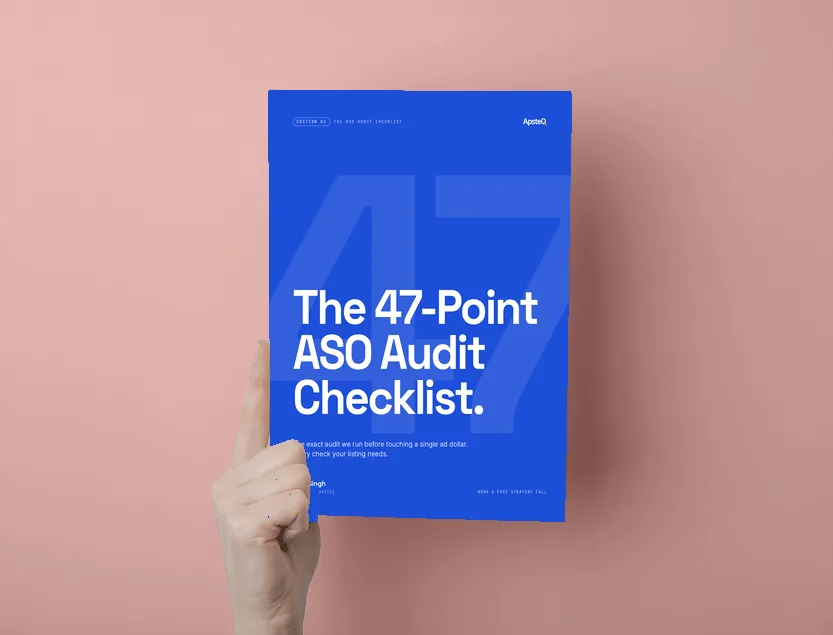
The 47-Point ASO Audit Checklist
The exact checklist we run before touching any app store listing. Find the gaps costing you organic installs.
Get the Free EbookBrowse all free guides