
Freelance App Developer vs Agency: Which One Actually Ships Your Product?
The answer depends on scope, timeline, and how much coordination risk your company can absorb. Freelancers cost less per hour but agencies deliver more predictably at scale, and the gap between those two realities is where most mobile app budgets get lost.
Roughly 59% of software projects experience scope creep that inflates the original budget by 20% or more (Standish Group CHAOS Report 2023). For mobile app companies hiring their first or second development partner, that statistic represents a very real operational threat. You are not just choosing a vendor; you are choosing a risk profile. This post breaks down the structural differences between freelancers and agencies, shows you where each option fails, and gives you a comparison framework to match the right model to your specific stage.
Key Takeaways
- 59% of software projects exceed original budget due to scope creep (Standish Group CHAOS Report 2023). Agencies typically absorb scope changes inside a defined process; freelancers usually bill them as extras.
- The average US freelance app developer charges $75 to $150 per hour, while full-service agencies range from $100 to $250 per hour blended rate (Clutch 2024). The hourly gap shrinks significantly once you factor in project management overhead.
- Apps with active post-launch support retain 2x more Day 30 users than apps dropped after deployment (Adjust Mobile App Trends Report 2023). Agencies are structurally better positioned to provide that continuity.
- Time-to-market matters: the average agency-delivered MVP launches in 12 to 16 weeks; solo freelancers on equivalent projects average 18 to 26 weeks when accounting for context-switching across multiple clients (Clutch 2024).

What Is the Real Difference Between a Freelance App Developer and an Agency?
A freelance app developer is a self-employed individual who takes on mobile development contracts directly, billing by the hour or by milestone. A development agency is a company that employs or coordinates multiple specialists, including developers, designers, QA engineers, and project managers, delivering software as a managed service. The practical difference is not just headcount; it is accountability structure.
When you hire a freelancer, you are effectively hiring one brain with one calendar. That developer might be exceptional, but they are also fielding three other client Slack channels, handling their own invoicing, and taking PTO without coverage. When something breaks at 11 PM the Thursday before your App Store submission deadline, the freelancer's availability is a personal decision, not a contractual obligation.
Agencies, by contrast, own the delivery outcome at the company level. A project manager tracks blockers, a second developer can absorb a task if the lead gets sick, and QA runs in parallel rather than after. That structural redundancy is the primary reason agencies cost more per hour and also why the total cost of a finished, stable product often lands closer than the hourly rate gap suggests.
Consider the EarningsCall build as a reference point. EarningsCall is a US fintech app for investors that reached 5,000-plus downloads with 60% monthly active users, meaning 3,000-plus MAU on a relatively modest install base. That retention outcome required coordinated work across development, ASO, and paid user acquisition. A single freelancer could have written the code, but the marketing and store optimization layer that drove those engagement numbers required a cross-functional team operating from a shared strategy.
The freelancer model works best when your scope is narrow and well-defined: a single feature addition, a bug-fix sprint, a proof-of-concept prototype. The agency model outperforms when your goal is a shippable, marketable product with a retention strategy built in from day one. If you are still figuring out what your app needs to do, start by reading how our app development process approaches discovery before a line of code gets written.
How Do You Choose the Right Development Partner for Your Stage?
Matching your development partner to your company stage is the decision most mobile app teams get wrong. They treat it as a price question when it is actually a risk-calibration question. Here is a step-by-step framework.
Step 1: Define your scope with enough specificity to get a binding estimate. If you cannot write a two-paragraph brief describing your core user flow, you are not ready to hire anyone yet. Vague briefs produce vague estimates, and vague estimates turn into budget overruns regardless of whether a freelancer or agency is on the other end.
Step 2: Score your internal bandwidth. Ask yourself honestly how many hours per week your team can dedicate to answering questions, reviewing builds, and unblocking a developer. Freelancers typically need more active management from the client side because they lack internal project infrastructure. Agencies absorb more of that overhead themselves, but they need clear decision-makers on your side to avoid revision loops.
Step 3: Map your timeline to market windows. If you are targeting a seasonal launch, a conference announcement, or a funding milestone, the agency's parallel-track model is usually the safer bet. For an open-ended internal tool or a side project with no hard deadline, a freelancer's slower but cheaper pace may fit fine.
Step 4: Price the total engagement, not the hourly rate. A freelancer at $85/hour who takes 600 hours costs $51,000. An agency at $150/hour blended who completes the same scope in 320 hours costs $48,000 and includes QA, design, and project management that you would otherwise pay for separately. Understanding what your app will actually cost requires modeling full scope, not comparing hourly stickers.
Step 5: Check post-launch support terms before signing. Ask every candidate: what happens if a critical bug appears 90 days after launch? Freelancers often move to new contracts and may deprioritize legacy work. Reputable agencies include a maintenance window in the contract. That clause is worth reading before you sign anything.
The Numbers Behind the Decision: Cost, Speed, and Retention Benchmarks
Data consistently shows that the freelancer-vs-agency decision has measurable downstream effects on app quality and user retention, not just development cost. Here is what the benchmarks say.
On cost: US freelance developers charge between $75 and $150 per hour for mobile app work (Clutch 2024). Agency blended rates run $100 to $250 per hour depending on specialization and team size (Clutch 2024). However, apps shipped through agencies tend to have lower post-launch defect rates because QA is built into the process rather than added at the end.
On retention: According to the Adjust Mobile App Trends Report 2023, the average Day 30 retention rate across all app categories is around 6%. Apps with dedicated post-launch support and iterative update schedules retain significantly more users. The structure that produces consistent updates is easier to maintain inside an agency team than across a freelancer relationship that formally ends at launch.
On project failure: The Standish Group CHAOS Report 2023 found that 31% of software projects are cancelled before completion. Projects with a single point of failure (one developer, no backup) face higher abandonment risk when that individual exits the engagement.
- Freelancers are most cost-effective for projects under $25,000 and under 12 weeks
- Agencies deliver better ROI on projects above $50,000 with complex integrations
- Hybrid models (agency for core build, freelancer for feature sprints) work well for funded startups
- App store optimization and paid UA are almost never viable as solo freelancer work; they require coordinated teams
| Dimension | Freelance Developer | Development Agency | Hybrid Model |
|---|---|---|---|
| Typical hourly rate (US, 2026) | $75 to $150/hr | $100 to $250/hr (blended) | $90 to $180/hr (blended) |
| Average MVP timeline | 18 to 26 weeks | 12 to 16 weeks | 14 to 20 weeks |
| Built-in QA coverage | Rarely included | Standard in most contracts | Depends on structure |
| Post-launch support | Ad hoc, often billed separately | Maintenance retainers common | Agency handles core; freelancer handles features |
| Best fit project size | Under $25,000 | $50,000 and above | $30,000 to $80,000 |

What Mistakes Do Mobile App Companies Make When Hiring a Developer?
The most expensive mistake is choosing purely on price and discovering six months later that the product cannot scale. Here are the failure patterns that appear most often.
Mistake 1: Hiring for technology stack instead of product thinking. A freelancer who is brilliant at Flutter but has never shipped a consumer app with a social graph will struggle on a friendship or social app regardless of their technical skill. The relevant credential is shipped products in your category, not certifications in a language.
Mistake 2: Skipping the discovery phase to save money. Discovery (the process of mapping user flows, technical architecture, and dependencies before coding starts) typically costs 10 to 15% of total project budget and saves multiples of that in rework. Freelancers often skip it to win the contract at a lower headline price. Agencies who skip it should be disqualified immediately.
Mistake 3: Conflating development with marketing readiness. A shipped app with zero ASO, no paid acquisition strategy, and no analytics instrumentation is not a product; it is an artifact. LunarLinc, a friendship app built for the Android market in India, went from zero to 50,000-plus Google Play downloads since November 2023 not because the code was elegant but because development was paired from day one with a coordinated marketing strategy (see the full breakdown on the LunarLinc case study page). That kind of outcome requires an agency that treats marketing as part of the build, not a freelancer who closes the ticket at deployment.
Mistake 4: No ownership clarity on code and accounts. Confirm in writing before any work begins: who owns the GitHub repository, the Apple Developer account, the Google Play Console account, and the design files. Some freelancers retain leverage by keeping assets in their own accounts. Reputable agencies transfer full ownership at project completion or maintain access only under a documented retainer agreement.
Mistake 5: Treating the first contract as permanent. Your development needs at seed stage are different from your needs at Series A. Build the relationship in phases, evaluate after each milestone, and structure contracts with clear off-ramps. The best development partner for your MVP is not necessarily the right partner for your v2.0 rebuild.
If you want to understand what a structured user acquisition strategy looks like alongside a development engagement, that context should inform who you hire before you start writing contracts.
Where Is the Freelancer vs Agency Decision Heading in 2026 and 2027?
Two structural forces are reshaping this decision right now. The first is AI-assisted development tooling. GitHub Copilot, Cursor, and similar tools have raised individual developer output meaningfully, narrowing the productivity gap between a solo freelancer and a small agency team on routine coding tasks. According to GitHub's 2023 developer productivity research, developers using Copilot complete tasks up to 55% faster than those without. That productivity gain benefits both freelancers and agencies, but it changes the calculus: agencies can now deliver more with smaller teams, and freelancers can handle slightly larger scopes solo.
The second force is the growing importance of post-launch performance. App store algorithm changes, privacy policy shifts affecting paid acquisition, and rising user expectations for update frequency all mean that launching an app is less of a finish line than it was in 2022. Mobile app companies that treat development as a one-time project and marketing as a separate conversation are consistently outperformed by companies that run both tracks in parallel (Sensor Tower Mobile Market Insights 2024).
By 2027, the most competitive mobile products will likely be built by companies that use AI-accelerated agency teams for core architecture, modular freelance specialists for feature sprints, and continuous ASO and optimization services to keep store visibility compounding over time. The binary freelancer-or-agency frame is already giving way to a layered model, and understanding that shift now puts your roadmap ahead of competitors who are still thinking in either-or terms.
Frequently Asked Questions
How much does it cost to hire a freelance app developer vs an agency in 2026?
US freelance app developers typically charge $75 to $150 per hour, while agencies bill $100 to $250 per hour on a blended rate that includes design, QA, and project management (Clutch 2024). For a full MVP, total freelance cost often runs $20,000 to $60,000; agency projects for comparable scope run $40,000 to $150,000 depending on complexity.
Which option delivers a faster app launch, freelancer or agency?
Agencies generally ship MVPs in 12 to 16 weeks because they run design, development, and QA in parallel. Freelancers on similar scopes average 18 to 26 weeks, partly because context-switching across multiple client contracts slows progress (Clutch 2024). If you have a hard launch deadline tied to a funding event or market window, the agency timeline is meaningfully more reliable.
Can a freelancer handle app store optimization and paid user acquisition?
Rarely effectively. ASO and paid user acquisition require coordinated work across keyword research, creative production, campaign management, and analytics interpretation. LunarLinc reached 50,000-plus Google Play downloads using a team-based approach that combined 113 video ad variants with store optimization, a scope that a solo freelancer cannot manage simultaneously with active development work.
What should I look for in a development contract to protect my app's IP?
Insist on written confirmation that all code, design files, App Store accounts, and Google Play Console access transfer to your company upon final payment. Confirm there are no third-party licenses embedded in the codebase without disclosure. Agencies typically address this in a standard work-for-hire clause; freelancers sometimes omit it, so add it explicitly to any statement of work.
How do I know if my project is better suited for a freelancer or an agency?
Projects under $25,000 with a narrow, well-defined scope are reasonable fits for a vetted freelancer. Projects above $50,000, or any project requiring integrated design, QA, and post-launch marketing, fit better with an agency. Review the full breakdown of scope, timeline, and cost considerations at ApsteQ's app development cost guide before committing to either path.
Conclusion
The freelancer vs agency decision is not a price comparison. It is a question of what delivery infrastructure your project actually requires. Here is what the evidence shows:
- Freelancers are cost-effective for scopes under $25,000 with clear, narrow requirements and flexible timelines
- Agencies deliver better outcomes for complex builds, hard deadlines, and products that need marketing coordination from day one
- Post-launch support and retention infrastructure favor agencies structurally, not just operationally
- AI tooling is raising output across both models, but it does not eliminate the coordination advantage that agencies hold on multi-track projects
- Hybrid models, using agencies for core architecture and freelancers for feature sprints, are becoming the dominant structure for funded mobile app companies in 2026
If you are still weighing which path makes sense for your specific product, the fastest way to get clarity is a direct conversation about scope and budget. Book a free strategy call and we will tell you honestly which model fits your stage, no sales pitch attached.
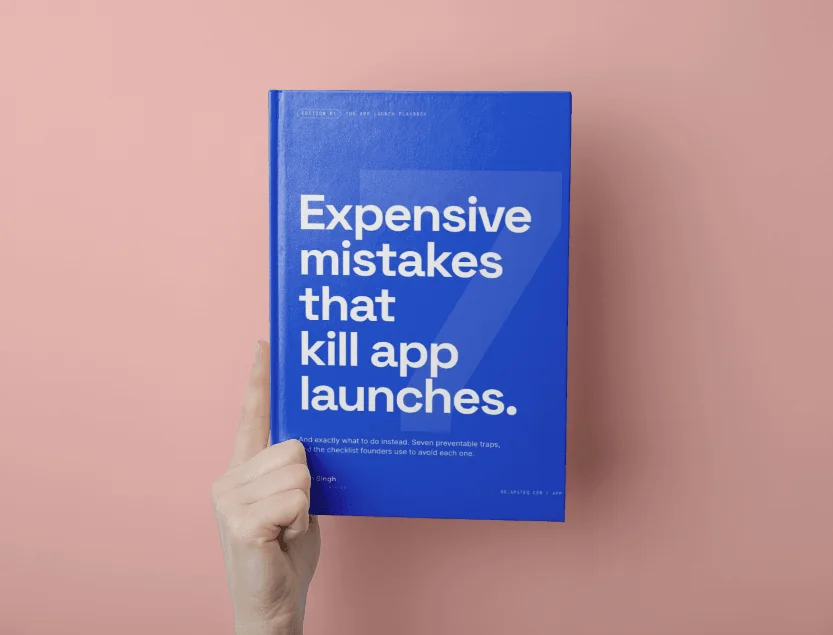
Free download
7 Expensive Mistakes That Kill App Launches
The launch errors we see most often across 300+ app engagements, and what to do instead.
Get the Free EbookBrowse all free guides