
Most MVP Apps Fail Before They Reach 1,000 Users: Here Is How to Pick the Right Development Partner
Choosing the right MVP app development company is one of the highest-stakes decisions a mobile product team makes, and most teams get it wrong in the same ways. The answer is straightforward: look for a partner that owns the full build-measure-learn loop, not just the coding sprint. This post covers how to evaluate vendors, what a real MVP process looks like, and the data behind what separates successful launches from expensive pivots.
Only 0.5% of apps submitted to the App Store ever reach 1 million downloads (Sensor Tower, 2024). That gap between submission and traction is where MVP strategy lives, and the team you hire to build your first version shapes whether you close it or widen it.
Key Takeaways
- Only 0.5% of apps submitted to the App Store reach 1 million downloads (Sensor Tower, 2024), making early validation the highest-leverage activity in mobile product development.
- The global mobile app development market is projected to reach $583 billion by 2030 (Statista, 2023), meaning the vendor pool is growing faster than quality standards are.
- Apps with strong onboarding retain 50% more users at day 30 than those without structured flows (Adjust, 2023), and this is a build decision, not a marketing one.
- A focused MVP scope, typically 8 to 16 weeks, reduces first-version costs by 40 to 60% versus a full-feature build, and shortens the feedback loop that actually determines product-market fit.

What Does an MVP App Development Company Actually Do?
An MVP app development company is a team that scopes, designs, builds, and ships the smallest version of a product that can generate real user feedback, and then helps interpret that feedback for iteration. The key word is "smallest": a good MVP partner pushes back on feature bloat, not just on budget.
The confusion in the market is real. Many agencies call themselves MVP specialists but deliver fixed-scope contracts with no mechanism for mid-build learning. That structure optimizes for delivery, not discovery. A true MVP partner builds checkpoints for scope revision into the contract itself.
What separates strong partners on paper from strong partners in practice comes down to three capabilities. First, product scoping: they must be able to translate a business hypothesis into a testable feature set, not just take a spec document and execute it. Second, instrumentation: every screen should ship with analytics hooks so you know which flows users abandon. Third, post-launch support: the sprint does not end at submission; it ends when you have enough data to make a confident next decision.
The global mobile app development market is projected to reach $583 billion by 2030 (Statista, 2023), which means the vendor market is expanding quickly and evaluating partners is harder than it was five years ago. More agencies are entering the space with strong portfolios built on templates, not original thinking.
A concrete data point on instrumentation quality: apps with structured onboarding retain 50% more users at day 30 than those without (Adjust, 2023). Retention architecture is a build decision, not a post-launch fix. If your MVP partner is not designing retention flows before writing a single line of code, that is a red flag worth addressing in the proposal stage.
For illustration: imagine a B2B SaaS team that hires a dev shop purely on hourly rate, ships in 10 weeks, and then discovers their core workflow requires three steps their analytics cannot track. They cannot tell if users are dropping off at the paywall or at account creation. The next sprint now costs as much as the original build, purely to add what should have been standard from week one.
The mechanism here is simple: scoping decisions made in week two of a build create data gaps that cost multiples to fix in week fourteen. Evaluate partners on their scoping process, not just their portfolio.
How Do You Evaluate and Hire an MVP App Development Company?
Evaluating an MVP app development company requires a structured process that goes beyond portfolio review. The steps below are sequenced deliberately: each one filters out a different category of mis-fit before you sign anything.
Step 1: Audit their discovery process. Ask every shortlisted vendor: "What does your discovery phase produce, and what can we change after it?" A strong answer includes a scoped feature list, user flow diagrams, and a written statement of what hypothesis the MVP is testing. A weak answer is a project timeline with milestones.
Step 2: Ask for a post-mortem, not just a case study. Case studies show what worked. Post-mortems show how a team handles things that did not. Any agency that cannot share a story of a scope change, a missed deadline, and how they responded is either inexperienced or not being transparent.
Step 3: Verify their analytics stack defaults. Before signing, confirm which analytics tools they instrument by default (Firebase, Mixpanel, Amplitude, AppsFlyer). If they treat analytics as an add-on scope item, your MVP will ship data-blind.
Step 4: Stress-test their cost model. MVP builds in the US typically range from $25,000 to $150,000+ depending on platform, backend complexity, and integration requirements. If a vendor quotes under $20,000 for a two-platform native build with a custom backend, ask specifically what is excluded. Our app development service page breaks down how scope drives cost, and our app development cost guide covers per-feature pricing benchmarks in detail.
Step 5: Define the handoff protocol. Who owns the codebase at launch? Is source code delivered to you, or hosted in the vendor's repository? What is the process for switching vendors if the relationship does not work? These questions feel uncomfortable before a contract is signed. They feel catastrophic if you skip them.
Step 6: Confirm post-launch availability. An MVP is not a finished product. It is a first signal. You need a team available for rapid iteration in the 30 to 90 days after launch when real user data arrives. Confirm their sprint availability and response SLA before the ink dries.
The Data Behind Successful MVP Launches: What the Numbers Actually Show
Successful MVP launches share measurable patterns that are visible in the data before a product reaches scale. Understanding these benchmarks helps product teams set realistic expectations and evaluate whether a partner is building toward them.
App store conversion rates (store listing views to installs) average 26.4% on the App Store and 33.8% on Google Play (Mobile Action, 2024). These numbers matter at the MVP stage because they set the ceiling on paid acquisition efficiency. If your store listing is unoptimized at launch, every dollar spent on user acquisition is working against a structural drag.
Day-1 retention across all app categories averages 25%, and day-30 retention averages just 5.7% (Adjust, 2023). For an MVP, the goal is not to hit the category average; it is to understand why your specific users churn and at which step. That requires instrumentation, not just a good product.
Cost per install on iOS in the US averages $3.60 to $5.00 for broad targeting and significantly higher for finance and healthcare verticals (AppsFlyer, 2024). Planning acquisition spend before you know your day-7 retention rate is building on sand.
Here is what that looks like in practice. ApsteQ's work on EarningsCall, a US fintech app for investors, produced over 5,000 downloads with 60% monthly active users, reaching 3,000+ MAU before the campaign scaled further to 100,000+ total downloads. That MAU-to-download ratio, 60%, is more than 10 times the industry average day-30 retention of 5.7%. The difference came from aligning the acquisition channel directly to the high-intent user segment from day one, which only works when the build includes the tracking infrastructure to identify that segment.
- Instrumentation from day one allows cohort-level retention analysis within the first two weeks of launch.
- Store listing quality sets a hard ceiling on acquisition efficiency before any ad spend begins.
- Retention architecture, meaning onboarding flow design, directly predicts day-30 MAU ratios.
- Post-launch sprint availability determines how quickly a team can act on the first 30 days of data.
- Platform-first decisions (Android vs iOS vs both) change cost structure by 30 to 50% and should be driven by audience data, not preference.
What Mistakes Do Founders Make When Hiring an MVP App Development Company?
The most expensive mistakes in MVP development happen before a line of code is written. They cluster around three decisions: vendor selection criteria, scope negotiation, and success metric definition.
Mistake 1: Selecting on portfolio aesthetics alone. A beautiful app in a vendor's portfolio tells you about their design capability on that specific project. It tells you nothing about their scoping discipline, their analytics defaults, or their client communication when timelines slip. Ask for references who had a difficult project, not just a successful one.
Mistake 2: Treating the spec as fixed. The spec you write before build reflects your assumptions about users. Those assumptions are almost always partially wrong. A vendor who locks scope at week one and charges change fees for every revision is economically incentivized to ship the wrong product on time. Build-in a structured scope review at the 40% mark of the project timeline.
Mistake 3: Skipping platform prioritization. Launching on both iOS and Android simultaneously doubles QA cost, extends timelines by 30 to 40%, and splits your initial user data across two very different behavioral environments. ApsteQ's work on LunarLinc, a friendship app targeting India, is instructive here. The team launched Android-first in a market where Android holds dominant share, going from zero to 50,000+ Google Play downloads since November 2023. That single-platform focus at MVP stage compressed the feedback loop and reduced early cost substantially.
Mistake 4: Defining success as downloads. Downloads are a vanity metric at the MVP stage. The metrics that matter are day-7 retention, activation rate (users who complete the core action), and the ratio of organic to paid installs. A vendor who celebrates install counts without retention data is hiding the real signal.
Mistake 5: Not owning your own ad accounts. Some agencies run acquisition campaigns from their own ad accounts and report aggregate results. If the relationship ends, you lose the campaign history, the audience data, and the conversion benchmarks. Insist on owning every ad account from day one. Our user acquisition service operates this way by default.
The mechanism behind all five mistakes is the same: optimizing for launch instead of optimizing for learning. An MVP is a question, not a product. The company you hire should be structured to help you answer it.
Where MVP App Development Is Heading in 2026 and 2027
Two structural shifts are reshaping what MVP development looks like, and both affect how you should evaluate partners today.
The first is AI-assisted development. Tools like GitHub Copilot, Cursor, and emerging agentic coding environments are compressing build timelines for standard feature sets. Vendors using these tools effectively can deliver an equivalent MVP in 30 to 40% fewer hours than pure-manual teams. The implication for buyers: a vendor quoting the same timeline in 2026 as they quoted in 2023 for identical scope is either not adopting these tools or not passing the savings forward.
The global AI in app development market is expected to grow at a CAGR of 27.4% through 2028 (Statista, 2024). That growth rate reflects how quickly AI tooling is becoming a baseline expectation, not a differentiator. Ask every prospective vendor which AI-assisted tools are in their stack and how they affect your quote.
The second shift is in acquisition economics. Apple's ATT framework and ongoing signal loss across paid channels mean that the first-party data your MVP collects, specifically behavioral data from real users, is now more valuable than it was three years ago. MVPs that ship with deep event tracking and cohort analysis infrastructure are building a first-party data asset from day one. Those that ship analytics-light are starting the growth phase with structurally weaker inputs.
For product teams planning an MVP in late 2026 or 2027, the checklist is shifting: AI tooling in the dev stack, first-party data architecture baked into the build, and post-launch iteration velocity matter more than they did even 18 months ago. Evaluate partners on all three.
Frequently Asked Questions
How much does it cost to hire an MVP app development company in the US?
US-based MVP builds typically range from $25,000 to $150,000+ depending on platform count, backend complexity, and third-party integrations. Offshore teams can reduce cost by 40 to 60%, but add coordination overhead and timezone risk. Our app development cost guide breaks down per-feature pricing benchmarks in detail.
How long does it take to build an MVP mobile app?
A well-scoped single-platform MVP typically takes 8 to 16 weeks from discovery to store submission. Two-platform builds add 4 to 6 weeks on average. Timelines under 8 weeks almost always involve pre-built templates rather than custom architecture, which limits flexibility in post-launch iterations.
What is the difference between an MVP and a prototype?
A prototype is a non-functional or limited-functionality model used to test design and user flow assumptions, usually before development. An MVP (minimum viable product) is a fully functional, shippable app with the minimum feature set needed to generate real user behavior data from an actual audience in a live environment.
Should I launch my MVP on iOS or Android first?
Platform choice should follow audience data, not preference. In the US, iOS users average higher lifetime value per user (AppsFlyer, 2024). In markets like India, Android holds dominant share. ApsteQ's LunarLinc campaign launched Android-first in India and reached 50,000+ Google Play downloads since November 2023, demonstrating how platform prioritization directly affects MVP traction speed.
What metrics should I track during an MVP launch?
Track day-1, day-7, and day-30 retention; activation rate (users completing the core action); cost per install by channel; and organic-to-paid install ratio. Day-30 retention across all app categories averages just 5.7% (Adjust, 2023), so benchmarking against category-specific norms matters more than overall averages for evaluating real performance.
Conclusion: What to Do Next
Choosing an MVP app development company is not a procurement decision. It is a product strategy decision disguised as a vendor selection. The key points to carry forward:
- Evaluate scoping discipline and analytics defaults, not just portfolio design.
- Define success as retention and activation rate, not download count.
- Confirm code ownership, ad account ownership, and post-launch sprint availability before signing.
- Match platform prioritization to audience data, not to personal preference.
- Ask about AI tooling in the dev stack and whether it is reflected in your quote.
If you are planning a mobile product launch and want a team that owns the full loop from scoping through post-launch data analysis, the next step is a direct conversation about your specific product hypothesis. Book a free strategy call and we will map your MVP scope, platform choice, and launch instrumentation before you commit to a build.
Free download
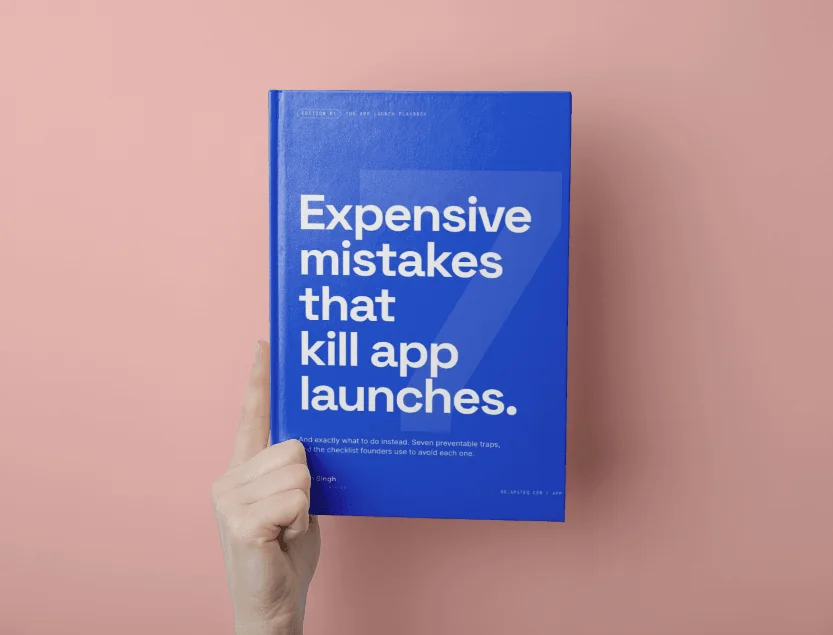
7 Expensive Mistakes That Kill App Launches
The launch errors we see most often across 300+ app engagements, and what to do instead.
Get the Free EbookBrowse all free guides