ApsteQ helps Mountain View mobile app and SaaS companies acquire more users, optimize their store presence, and retain them longer with the proven ApsteQ AppFlow System.
Mountain View sits at the center of one of the most competitive mobile and SaaS ecosystems on earth. Competing for downloads, installs, and subscriptions here means going up against teams that are well-funded and sophisticated. ApsteQ was built for exactly this environment. With 20+ years of growth marketing experience and 300+ brands grown, ApsteQ brings a structured, data-driven approach to every engagement. The ApsteQ AppFlow System integrates paid user acquisition, App Store Optimization, and retention into a single coordinated strategy, so Mountain View app teams stop managing three disconnected vendors and start seeing compounding growth from a unified playbook. Founder Arsh Singh designed ApsteQ's methodology after observing how fragmented app marketing budgets consistently underperform against integrated ones. Every Mountain View client starts with a deep audit of their current funnel, store listings, and channel mix before a single dollar of paid budget is moved. That discipline is what separates ApsteQ from generalist agencies that simply launch campaigns without first understanding your unit economics.
The ApsteQ AppFlow System is the operational core of every Mountain View engagement. It begins with store asset auditing and keyword gap analysis across the App Store and Google Play, then moves into paid UA campaign architecture across Apple Search Ads, Google App Campaigns, and Meta. Simultaneously, ApsteQ builds out lifecycle retention sequences so the users your paid spend acquires actually stick. According to Adjust's 2024 Mobile App Trends report, apps that align UA and retention strategy from the start achieve meaningfully lower effective cost-per-loyal-user compared to those that treat acquisition and retention as separate workstreams. ApsteQ manages $2.5M+ in ad spend and applies those learnings directly to Mountain View app budgets of all sizes. Whether you are a seed-stage startup launching your first paid channel or a growth-stage SaaS company scaling internationally, the ApsteQ AppFlow System provides the structure, reporting, and optimization cadence your team needs to grow confidently in one of the world's most demanding tech markets.
Ad Spend Managed
$2.5M+
Total ad spend managed by ApsteQ across app and SaaS growth campaigns
Brands Grown
300+
Mobile app and SaaS brands scaled using the ApsteQ AppFlow System
Mountain View is not a generic market. ApsteQ tailors every element of the ApsteQ AppFlow System to the specific dynamics of Silicon Valley's app and SaaS ecosystem, from hypercompetitive keyword bidding to enterprise-grade user expectations.
Mountain View app companies face category competitors who are also raising Series A and B rounds and hiring specialized growth teams. ApsteQ builds competitive intelligence into every engagement, analyzing rival store listings, ad creative libraries via Meta Ad Library, and keyword overlap using Sensor Tower and data.ai benchmarks. The ApsteQ AppFlow System uses this intelligence to identify gaps your Mountain View competitors have left open, whether that is an underserved keyword cluster in the App Store or a paid channel they are ignoring. That precision targeting means your budget works harder from day one rather than bidding head-on against better-funded rivals.
Many Mountain View companies sell SaaS products to enterprise buyers, not individual consumers. ApsteQ adapts the ApsteQ AppFlow System for B2B app acquisition by shifting channel mix toward LinkedIn, Google Search, and intent-based retargeting rather than purely mobile-first inventory. Account-based targeting, demo-request conversion optimization, and free-trial funnel architecture are all built into the Mountain View B2B track. According to Forrester's 2023 B2B Marketing Report, SaaS companies that align paid acquisition with a structured free-trial onboarding sequence see higher conversion rates from trial to paid subscription than those running acquisition and onboarding as separate efforts.
Mountain View users are technically literate and research thoroughly before installing an app or subscribing to a SaaS product. Generic store copy does not convert this audience. ApsteQ rewrites App Store and Google Play metadata with precision language that speaks to developers, product managers, and enterprise buyers. The ApsteQ AppFlow System includes screenshot and preview video optimization calibrated for high-intent tech audiences, ensuring that when a Mountain View user lands on your store listing, the page immediately communicates credibility and specific value. Sensor Tower's 2023 benchmarks confirm that category-specific metadata outperforms generic copy on conversion rate in competitive tech verticals.
The Mountain View market has high expectations and low tolerance for friction. Users who do not see value in the first session are gone quickly. ApsteQ's retention pillar inside the ApsteQ AppFlow System is built for this reality. Onboarding flows are mapped to time-to-value milestones, push notification sequences are segmented by behavior rather than broadcast, and in-app messaging is triggered by real usage signals. According to Amplitude's 2023 Product Report, apps with behavior-triggered onboarding messages retain significantly more users at the 30-day mark than those using generic welcome sequences. ApsteQ applies these principles to every Mountain View app engagement.
Mountain View growth teams are data-fluent. They expect granular attribution, cohort analysis, and channel-level ROAS reporting, not surface-level dashboard screenshots. ApsteQ delivers structured weekly reporting through the ApsteQ AppFlow System that covers install source attribution via AppsFlyer or Adjust integration, creative performance at the ad level, App Store conversion rate by traffic source, and retention cohort health. Every metric is tied back to your unit economics so the Mountain View team can make confident budget decisions. ApsteQ's reporting cadence is designed to plug directly into your existing growth reviews without creating additional overhead.
ApsteQ's track record is built on real managed spend, real brands, and real experience, not inflated agency claims. Here is what Mountain View app companies are working with when they partner with ApsteQ.
Ad Spend Managed
$2.5M+
Total paid UA spend managed across app and SaaS growth campaigns by ApsteQ
Brands Grown
300+
Mobile app and SaaS companies scaled using ApsteQ growth frameworks
Growth Marketing Experience
20+
Years of growth marketing experience informing every ApsteQ Mountain View engagement
These numbers represent the foundation that Mountain View app teams plug into when they engage ApsteQ. The ApsteQ AppFlow System channels this collective experience into a structured, repeatable process calibrated specifically for your app category and growth stage.
Seed to Series B Mountain View app startups that need structured paid UA and ASO to compete in crowded categories without burning budget on trial and error.
Mountain View SaaS teams that have product-market fit and need ApsteQ to systematically scale acquisition beyond their existing one or two channels.
Mountain View product and growth teams that are acquiring users but watching them churn before hitting activation milestones need ApsteQ's retention engineering.
Mountain View publishers expanding internationally who need localized ASO, multi-region paid UA, and market-specific creative strategy from ApsteQ.
ApsteQ is an AI-powered marketing agency founded by Arsh Singh, serving app companies, healthcare practices, and service businesses in the United States, Canada, India, and the Middle East. With 20+ years of growth marketing experience across 300+ brands, ApsteQ specializes in app marketing and mobile user acquisition as part of the broader ApsteQ AppFlow System. The methodology combines paid media, AI voice agents, automated follow-up sequences, conversion-optimized funnels, and full revenue tracking into one connected framework. apsteq.com
An app marketing agency in Mountain View manages the full growth funnel for mobile and SaaS products. ApsteQ handles App Store Optimization to lift organic visibility, paid user acquisition across Meta, Google UAC, and Apple Search Ads, and lifecycle retention via push and in-app messaging. According to AppsFlyer's 2023 State of App Marketing report, apps with a dedicated UA strategy see significantly stronger install-to-retention ratios compared to organic-only growth approaches.
ApsteQ's App Store Optimization work inside the ApsteQ AppFlow System covers keyword research specific to your app category, metadata rewriting for both the App Store and Google Play, and iterative A/B testing of screenshots and preview videos. Sensor Tower's 2023 data shows that optimized store listings can account for over 50 percent of an app's organic downloads. ApsteQ combines that data with conversion rate analysis to maximize installs from Mountain View and global markets.
ApsteQ runs paid user acquisition across Apple Search Ads, Google App Campaigns, Meta Advantage Plus App Campaigns, and TikTok for Business for Mountain View app companies. Channel selection inside the ApsteQ AppFlow System is driven by your app's category, target demographic, and cost-per-install goals. According to Adjust's 2024 Mobile App Trends report, Apple Search Ads delivers some of the highest intent-to-install ratios of any paid channel for iOS apps.
Yes. ApsteQ's retention pillar inside the ApsteQ AppFlow System includes onboarding sequence design, push notification strategy, in-app message flows, and churn prediction modeling. Retention is especially critical in Mountain View's competitive SaaS landscape. According to Amplitude's 2023 Product Report, SaaS products that invest in structured onboarding within the first seven days see substantially higher 30-day retention rates than those that do not.
ApsteQ structures engagements in 90-day sprints aligned with the ApsteQ AppFlow System. App Store Optimization improvements typically show measurable organic ranking gains within 30 to 45 days, as confirmed by data from Sensor Tower's optimization benchmarks published in 2023. Paid UA campaigns generally reach cost-per-install efficiency targets within the first two to four weeks of active optimization, depending on budget and category competition in your Mountain View market.
Yes. ApsteQ manages cross-platform app marketing for both iOS and Android within the ApsteQ AppFlow System. On iOS, this includes Apple Search Ads and App Store metadata optimization. On Android, it covers Google App Campaigns and Google Play Store listing optimization. According to data.ai's 2024 State of Mobile report, the majority of consumer app revenue still flows through iOS in North America, but Android captures a larger share of install volume globally, making a dual-platform strategy critical for Mountain View companies with international growth ambitions.
Five free guides built from real app launches: benchmarks, budgets, checklists, and the mistakes to skip. No strings, download what you need.

7 Expensive Mistakes That Kill App Launches
Free download →
The 47-Point ASO Audit Checklist
Free download →
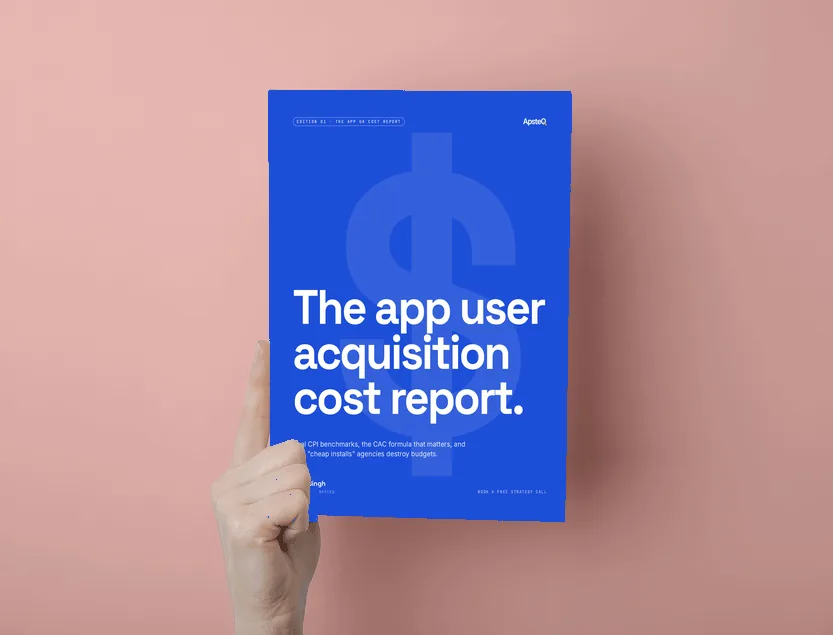
The App UA Cost Report 2026
Free download →
The App Budget Blueprint
Free download →
The App Monetization Playbook
Free download →Want them all in one place? Browse all free resources →
Start your free app marketing audit and see exactly where the ApsteQ AppFlow System can unlock growth for your Mountain View mobile or SaaS product. With 20+ years of growth marketing experience and 300+ brands grown, ApsteQ is ready to build your Mountain View growth engine.