Custom Mobile App Development in 2026: What App Companies Need to Know Before They Build
Only 0.5% of apps submitted to app stores ever reach 1 million downloads (Sensor Tower, 2024), yet mobile app companies keep pouring budgets into builds without a clear acquisition or retention strategy attached. The gap between a launched app and a successful product is rarely a code problem. It is a strategy problem. This post covers what custom mobile app development actually involves for companies building in 2026, how to structure the process for commercial outcomes, where most teams leave money on the table, and what the next two years look like for mobile product investment.
Key Takeaways
- Only 0.5% of apps ever reach 1 million downloads (Sensor Tower, 2024), making post-launch marketing as important as the build itself.
- The global mobile app market is projected to reach $614 billion by 2026 (Statista, 2025), intensifying competition for organic visibility.
- Apps that invest in App Store Optimization see up to 26% more downloads from organic search (Mobile Action, 2024).
- Retention, not downloads, is the real metric: apps lose on average 77% of daily active users within three days of install (Adjust, 2024).
What Does Custom Mobile App Development Actually Include?
Custom mobile app development is the process of designing and engineering a mobile product built specifically for a defined user base and business model, rather than adapting a generic platform or template. Unlike white-label solutions, a custom build gives the product team full control over architecture, UX, data flows, and monetization logic.
For mobile app companies, the distinction matters commercially. A template product might launch faster, but it carries technical debt that becomes expensive the moment you need to scale, integrate a payment layer, or differentiate on onboarding. Custom development front-loads those decisions.
The build itself typically spans five phases: discovery and scoping, UX and UI design, native or cross-platform engineering, quality assurance, and store submission. Each phase carries cost and time implications that vary sharply by platform choice. React Native and Flutter reduce cross-platform duplication, but native Swift (iOS) and Kotlin (Android) still outperform them on graphics-heavy or hardware-dependent features.
Timeline benchmarks from AppsFlyer's 2024 State of App Marketing report show that apps rushed to market in under 12 weeks show measurably higher early churn, because onboarding flows are undertested. That cost shows up in your cost-per-retained-user, not your cost-per-install.
Cost ranges in the US market run from roughly $50,000 for a lean MVP to $500,000+ for a feature-complete product with backend infrastructure (Clutch, 2024). Those numbers shift based on team location, feature complexity, and whether you build in-house or with an external agency. For a detailed breakdown of what drives those figures, the app development cost guide covers each variable with current market rates.
A strong public example of what a focused custom build can produce: EarningsCall, a US fintech app for investors, achieved 60% monthly active rates on its first 5,000+ downloads, reaching 3,000+ MAU before most apps in that cohort had stabilized any retention at all. The full breakdown is published in the EarningsCall case study. The retention result came from deliberate onboarding architecture built at the custom development stage, not patched in post-launch.
How Should App Companies Structure the Custom Development Process?
Getting custom mobile app development right is less about choosing a technology stack and more about sequencing decisions correctly. The companies that ship products with strong commercial outcomes treat development and go-to-market as one continuous process, not two sequential ones.
Here is a practical sequence that holds up in 2026:
- Define a measurable success metric before writing a line of code. Is the target a DAU count, a revenue threshold, a retention rate? The answer changes architecture decisions. A social app optimizing for DAU needs different push notification infrastructure than a subscription app optimizing for monthly revenue.
- Validate the core job-to-be-done with a prototype, not a full build. Figma prototypes and lightweight TestFlight builds cost a fraction of full development and surface UX problems before they are expensive to fix.
- Choose your platform strategy based on your acquisition channel, not just your audience. If your primary growth channel is paid social driving Android installs in a specific country, that changes how you prioritize Android-first vs. iOS-first development sequencing.
- Build ASO metadata in parallel with the product. Screenshot design, keyword architecture, and short descriptions should be drafted during development, not after store submission. Apps that treat ASO as a post-launch task lose the first 30 days of organic visibility.
- Instrument analytics before launch, not after. AppsFlyer and Adjust SDKs should be integrated during development so your attribution is clean from day one. Retroactive attribution is notoriously unreliable.
- Plan the post-launch retention loop before launch. Push notification cadence, in-app messaging triggers, and re-engagement flows should be mapped during QA, because they depend on event tracking that must be set up during development.
The team at ApsteQ structures this as an integrated service: custom app development paired with user acquisition planning from week one. That integration is what separates apps that grow from apps that stall at 500 downloads.
For cost planning at each phase, see the app development cost breakdown, which covers agency vs. in-house tradeoffs, MVP scoping, and what drives cost overruns on custom builds.
The Data Behind App Retention Is Worse Than Most Teams Expect
Retention numbers in mobile are genuinely brutal, and understanding them changes how you allocate your development budget. The problem is not that teams do not know retention is important. It is that they underestimate how fast it degrades and how much the build itself contributes to it.
Key benchmarks from verified sources:
- Apps lose 77% of daily active users within three days of install (Adjust, 2024). By day 30, average retention across categories sits below 6%.
- Push notifications, when well-timed, improve day-30 retention by up to 20% (Adjust, 2024). That improvement is only accessible if the notification infrastructure is built correctly during development.
- The global app market sees over 2 million new apps added annually across iOS and Android combined (data.ai, 2024), meaning organic discoverability degrades every quarter without active ASO investment.
- Apps with strong onboarding flows, specifically those reaching a defined activation event within the first session, retain users at 2x to 3x the rate of apps that skip structured onboarding (AppsFlyer, 2024).
What those numbers mean practically: the development budget for onboarding UX is not a nice-to-have. It is the highest-ROI line item in your entire build. A frictionless first session is cheaper to engineer during development than to fix with paid re-engagement campaigns after launch.
The Enjoy Movies Your Way case study from ApsteQ's published work shows what disciplined retention architecture can produce: 76% of all downloads became monthly active users, reaching 38,000+ MAU on 50,000+ downloads by December 2023, scaling to 100,000+ Google Play downloads since. The Enjoy Movies Your Way case study details the onboarding and activation strategy behind that figure.
The takeaway for app companies planning a custom build: budget explicitly for onboarding flow testing, activation event design, and analytics instrumentation. These are development tasks, not marketing afterthoughts. Teams that treat them as afterthoughts pay for it in customer acquisition costs when paid campaigns have to compensate for poor organic retention.
What Are the Most Expensive Mistakes in Custom App Development?
Most custom app development failures are predictable. The mistakes below come up in the same sequence across product categories, and each one is avoidable if you know what to look for before the build starts.
Mistake 1: Building for both platforms simultaneously without a priority market. iOS and Android audiences behave differently by country, income bracket, and app category. Splitting development resources evenly before you have acquisition data means you optimize for neither. A smarter approach is to ship on the platform where your core audience is densest, instrument everything, then port.
For illustration: Imagine a social app targeting urban professionals in the US. An iOS-first launch would let the team run TestFlight beta cohorts, gather behavioral data, and refine onboarding before the Android build begins. Round numbers: four months of iOS data before Android dev starts. That sequence is not faster in total time, but it produces a better Android product because the onboarding decisions are based on real user behavior.
Mistake 2: Treating the app store listing as a submission form, not a conversion page. Your app store page is the highest-traffic page your product has. Most teams spend 200+ hours on the app and 2 hours on the listing. Mobile Action's research shows that optimized screenshots alone can move conversion rates by 15-25%.
Mistake 3: Choosing a technology stack for the wrong reasons. "We're a React Native shop" is not a product strategy. Stack choices should follow feature requirements. If your app relies on real-time audio processing or AR, native is usually the right call regardless of team familiarity. The refactor cost later exceeds the short-term learning curve.
Mistake 4: Ignoring App Store Optimization until after launch. ASO keyword research should inform feature naming, app descriptions, and even in-app copy during development. Apps that integrate keyword strategy early rank faster post-launch.
Mistake 5: Scoping the MVP too broadly. The most common reason custom builds go over budget and over schedule is scope creep during development. A disciplined MVP has one core user job, one activation event, and one monetization path. Everything else is version 2.
The LunarLinc case study is a useful public reference here: a friendship app that launched Android-first in India and reached 50,000+ Google Play downloads since November 2023. The focused geo and platform strategy meant the team could optimize a single acquisition channel, Meta app campaigns, which drove 41,420 installs via 113 video ads, versus 468 installs from 83 image ads on the same budget. The LunarLinc case study breaks down that creative split in detail.
Where Is Custom Mobile App Development Heading in 2026 and 2027?
Two structural shifts are reshaping custom mobile app development right now, and both have direct budget implications for app companies planning builds in the next 18 months.
AI-native features are becoming a baseline expectation, not a differentiator. Users increasingly expect personalization, predictive suggestions, and conversational interfaces as standard. Apps launching without any AI layer in 2027 will face the same positioning problem that apps without push notifications faced in 2018. The global mobile AI market is projected to grow at a 28.6% CAGR through 2027 (Statista, 2025). For development teams, this means budgeting for model API integration, on-device inference for latency-sensitive features, and data pipelines that feed personalization engines, all of which are architecture decisions made at the custom development stage.
App store algorithm changes are accelerating, making ASO a continuous investment rather than a launch task. Both Apple and Google updated their ranking algorithms in 2025 to weight behavioral signals (session length, return rate, uninstall rate) more heavily than keyword density. This means the product experience directly affects organic discoverability. A poorly retained app ranks worse over time regardless of metadata quality.
For app companies planning builds now, the practical implication is straightforward: budget for post-launch user acquisition and ongoing ASO maintenance as part of the total development investment, not as a separate line item to fund "once the app is profitable." The apps that reach profitability are the ones that treated growth as part of the build from day one.
AI automation is also changing internal development workflows. Teams using AI-assisted code review, automated QA, and LLM-based documentation are shipping faster without proportional headcount increases. ApsteQ's AI automation services cover how these tools integrate into existing mobile development pipelines.
Frequently Asked Questions
How much does custom mobile app development cost in the US in 2026?
Custom mobile app development in the US typically ranges from $50,000 for a lean MVP to $500,000 or more for a full-featured product with backend infrastructure (Clutch, 2024). The biggest cost drivers are feature complexity, platform choice (iOS, Android, or both), team location, and whether you require custom API integrations or AI-powered features. See the full app development cost breakdown for a variable-by-variable analysis.
How long does it take to build a custom mobile app?
A focused MVP with a single core user job typically takes 12 to 20 weeks from discovery to store submission. Full-featured apps with complex backends, multi-platform builds, and third-party integrations commonly run 6 to 12 months. Teams that skip the discovery and prototype phase often extend timelines by 30 to 50% due to mid-build scope changes, according to AppsFlyer's 2024 State of App Marketing research.
What is the difference between native and cross-platform app development?
Native app development means building separately in Swift for iOS and Kotlin for Android, delivering the best performance and hardware access. Cross-platform frameworks like Flutter or React Native share a single codebase across platforms, reducing development time by roughly 30 to 40%. The tradeoff is performance on graphics-heavy or hardware-dependent features. Most B2C apps with standard UI patterns do well with cross-platform; real-time audio, AR, and complex animations typically favor native.
Why do most apps fail after launch despite a good product?
The primary reason is that 77% of daily active users leave within three days of install on average (Adjust, 2024). Most of that churn traces back to onboarding problems, weak activation event design, and no retention loop, all of which are architecture decisions made during development. A technically sound app with poor first-session UX will churn faster than a simpler app with a tight onboarding flow. Retention strategy should be planned before the build starts.
What should a custom mobile app development brief include?
A strong brief covers: the single core user job the app solves, the primary acquisition channel, the target platform and geography, the activation event that defines an engaged user, the monetization model, and the success metric at 90 days post-launch. Including these six elements forces alignment between product and marketing before any development begins, which is the single clearest predictor of on-time, on-budget delivery.
Conclusion
Custom mobile app development in 2026 is not primarily a technology problem. It is a sequencing and strategy problem. The apps that grow treat the build and the go-to-market as one continuous process: retention architecture designed before launch, ASO metadata drafted in parallel with engineering, and analytics instrumented before the first user ever opens the app.
- Only 0.5% of apps reach 1 million downloads (Sensor Tower, 2024): the build alone is never enough.
- Apps lose 77% of DAUs within three days (Adjust, 2024): onboarding is the highest-ROI development investment.
- AI-native features and behavioral ASO signals are the two biggest shifts heading into 2027.
- Focused platform and geo strategy, as shown in the LunarLinc and EarningsCall case studies, consistently outperforms trying to win everywhere at once.
If your team is scoping a custom app build or trying to grow an existing product, the right starting point is a strategy conversation before a single line of code is written. Book a free strategy call with the ApsteQ team to map out the build, the acquisition plan, and the retention architecture together.
Free download
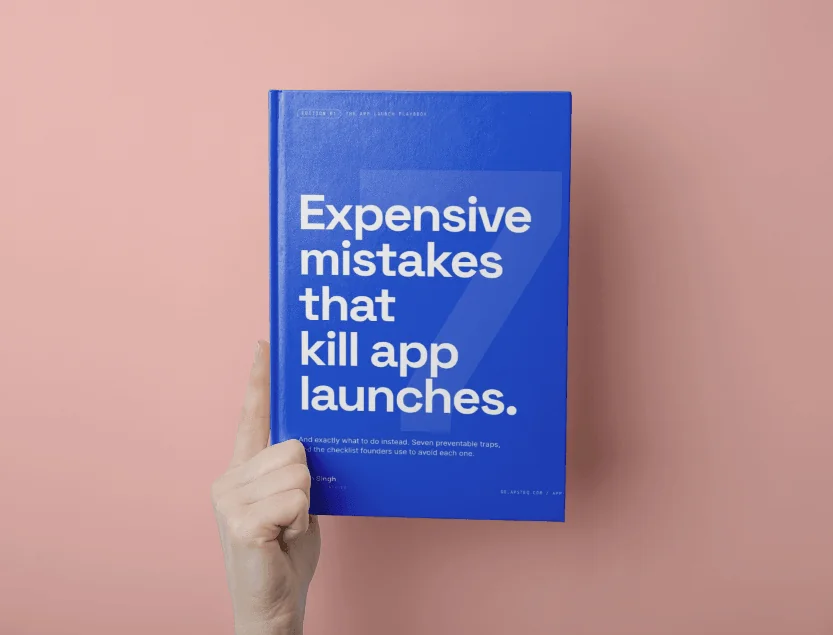
7 Expensive Mistakes That Kill App Launches
The launch errors we see most often across 300+ app engagements, and what to do instead.
Get the Free EbookBrowse all free guides