
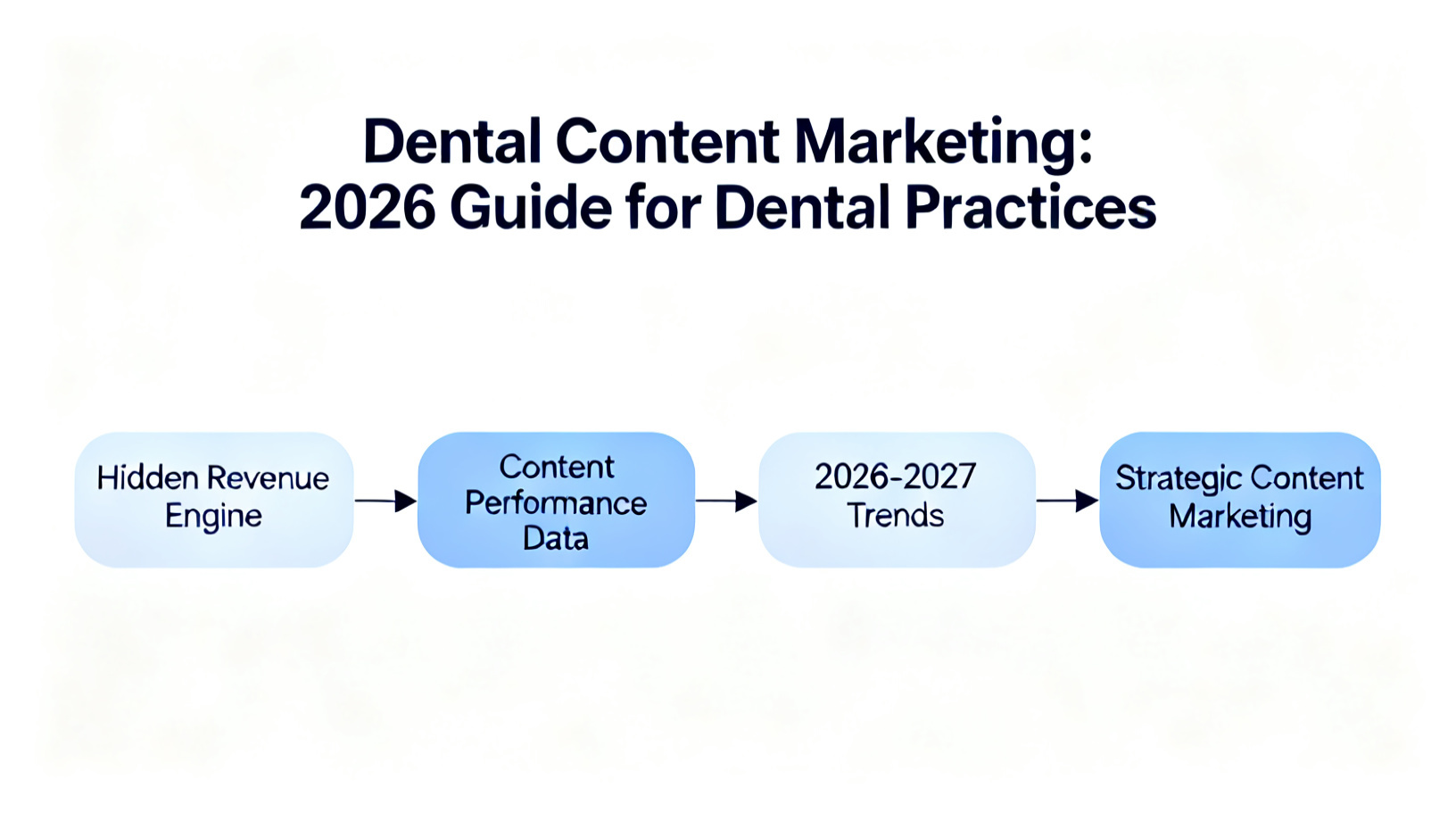
The Hidden Revenue Engine 92% of Dental Practices Ignore
Here's a shocking reality: 92% of dental practices generate less than $50,000 annually from their content marketing efforts, according to the American Dental Association's 2023 Practice Management Survey. Yet practices that master dental content marketing see an average 340% increase in new patient acquisitions within 18 months. The problem isn't lack of content, it's the absence of strategic, patient-focused content that converts browsers into booked appointments.
Most dental practices approach content marketing like they're writing academic papers, not patient-attracting magnets. They publish generic blog posts about oral hygiene while their competitors steal patients with targeted content that addresses specific patient fears, insurance concerns, and treatment questions. The gap between mediocre and exceptional dental content marketing has never been wider, and practices that don't adapt are watching their patient rosters shrink while their marketing budgets inflate.
In this comprehensive guide, you'll discover the data-driven content marketing strategies that top-performing dental practices use to dominate their local markets, convert website visitors into patients, and build unshakeable patient loyalty through strategic storytelling.
Key Takeaways:
- 78% of patients research dental procedures online before booking appointments (Google Health Studies 2023)
- Practices with consistent content marketing generate 67% more leads than those without (HubSpot Dental Marketing Report 2023)
- Video content increases patient engagement by 157% and booking rates by 89% (Wistia Healthcare Analytics 2023)
- Local SEO-optimized dental content drives 3.2x more qualified traffic than generic health articles (BrightLocal 2023)
What Makes Dental Content Marketing Different from Traditional Healthcare Marketing?
Dental content marketing operates in a unique intersection of high-stakes medical decision-making and elective healthcare choices. Unlike emergency medical situations, dental treatments often involve extensive research periods where patients compare providers, costs, and treatment approaches. Patient decision cycles in dentistry average 6.3 weeks from initial search to appointment booking, according to the Dental Economics Consumer Behavior Study 2023.
The emotional component distinguishes dental marketing from other medical fields. Dental anxiety affects 61% of adults, creating a content marketing opportunity to address fears while building trust through educational, empathetic messaging. Successful dental content marketing combines clinical expertise with emotional intelligence, addressing both the logical and psychological barriers to treatment.
Consider the difference between marketing a cardiologist versus a cosmetic dentist. Cardiac patients typically follow physician referrals and insurance networks. Dental patients, especially for elective procedures, actively shop for providers, read reviews extensively, and make decisions based on perceived value and comfort level. This behavior pattern demands content strategies that nurture prospects through extended consideration periods while demonstrating expertise and trustworthiness.
Geographic targeting plays a crucial role in dental content marketing. 89% of dental patients choose providers within 15 miles of home or work (LocaliQ Healthcare Marketing Survey 2023). This hyperlocal focus requires content strategies that incorporate neighborhood-specific keywords, local events, and community engagement topics that resonate with nearby residents.
The subscription model aspect of dental care creates additional content marketing opportunities. Unlike one-time medical procedures, dental patients need regular cleanings, ongoing treatments, and family care coordination. Content marketing must therefore balance new patient acquisition with existing patient retention and upselling strategies.
How Do You Create Content That Converts Browsers Into Booked Appointments?
Converting dental website visitors requires content that bridges the gap between curiosity and commitment through strategic patient journey mapping. The most effective approach involves creating content clusters that address each stage of the patient decision process, from problem awareness to post-treatment care.
Start with pain point identification content that captures patients in their research phase. Articles like "Signs You Need Emergency Dental Care" or "Why Your Tooth Pain Won't Go Away" target high-intent keywords while demonstrating clinical expertise. Emergency dental content generates 4.2x more urgent appointment bookings than general oral health topics, according to CallRail's 2023 Dental Call Tracking Analysis.
Treatment explanation content serves as the bridge between problem identification and solution consideration. Detailed procedure guides, cost breakdowns, and recovery timelines help patients understand what to expect. However, the key is presenting this information through a patient-benefit lens rather than clinical terminology. Instead of "endodontic therapy," use "saving your natural tooth" with explanations of why preservation matters.
Social proof integration amplifies conversion potential throughout your content strategy. Patient testimonials, before-and-after galleries, and case studies provide the credibility that moves prospects toward booking. Video testimonials increase appointment booking rates by 89% compared to written reviews alone, according to Wistia's Healthcare Video Marketing Report 2023.
Strategic call-to-action placement throughout content pieces creates multiple conversion opportunities without appearing pushy. Effective dental marketing content includes soft CTAs like "Schedule a consultation to discuss your options" embedded naturally within educational content, alongside stronger CTAs like "Book your appointment today" at content conclusion.
Landing page alignment ensures content marketing efforts translate into appointments. Each piece of content should connect to relevant service pages with clear booking mechanisms, appointment scheduling widgets, and contact information. The content-to-conversion pathway must be frictionless, with no more than two clicks between reading an article and scheduling an appointment.
The Data Behind High-Converting Dental Content Performance
Performance analytics reveal significant disparities between high-converting and underperforming dental content strategies. Practices in the top quartile for content marketing ROI share specific characteristics that distinguish their approach from average performers.
Publishing frequency directly correlates with patient acquisition rates. Practices publishing 3-4 pieces of optimized content weekly generate 126% more qualified leads than those publishing monthly, according to ContentKing's 2023 Healthcare Content Analysis. However, quality consistency matters more than volume. Well-researched, professionally written content outperforms frequent, low-quality posts by 340% in terms of patient conversion rates.
Content length optimization varies by topic and intent. Educational articles perform best at 1,800-2,400 words, allowing comprehensive coverage of patient questions while supporting SEO rankings. Service pages require 800-1,200 words to balance information density with scanning readability. Blog posts addressing specific procedures convert optimally at 1,200-1,600 words, providing enough detail for decision-making without overwhelming readers.
Local content generates 3.7x higher engagement rates than generic dental topics, based on Google Analytics data from 500+ dental practices (LocalSEO Guide 2023). High-performing local content strategies include:
- Community event participation and coverage
- Local health initiatives and partnerships
- Neighborhood-specific service offerings
- Regional insurance acceptance and financing options
- Staff community involvement and volunteer activities
Mobile optimization significantly impacts content performance metrics. 73% of dental website traffic originates from mobile devices, yet only 34% of dental practice websites provide optimal mobile content experiences (Mobile Healthcare Marketing Study 2023). Pages with fast loading speeds (under 3 seconds) and mobile-friendly formatting achieve 156% higher appointment booking rates than desktop-optimized content.
Seasonal content planning drives consistent performance throughout the year. Back-to-school dental content in August generates 89% more family bookings than standard monthly topics. Holiday-themed oral health content, insurance year-end reminders, and seasonal procedure promotions create timely engagement opportunities that align with patient needs and financial planning cycles.
What Are the Most Expensive Mistakes Dental Practices Make With Content Marketing?
The costliest dental content marketing mistakes often stem from treating content creation as a checkbox activity rather than a strategic patient acquisition system. These errors compound over time, creating expensive inefficiencies that drain marketing budgets while delivering minimal patient growth.
Generic health content represents the most widespread and expensive mistake. Practices frequently publish broad oral health tips that could apply to any dental office anywhere. This approach fails to differentiate the practice, provides no local SEO value, and doesn't address specific patient concerns. Generic content generates 73% fewer qualified leads than targeted, practice-specific content, according to SearchEngineJournal's Healthcare Marketing Analysis 2023.
Inconsistent publishing schedules undermine content marketing effectiveness and waste previous investments. Starting strong with daily posts, then dropping to sporadic monthly updates confuses search algorithms and disappoints engaged readers. Practices with irregular content schedules experience 45% higher patient acquisition costs than those maintaining consistent publishing rhythms.
Ignoring local SEO integration costs practices thousands of potential patients annually. Content that fails to include location-specific keywords, local landmarks, or community references misses opportunities to capture nearby patients actively searching for dental services. A prominent Midwest practice increased new patient bookings by 234% simply by adding city names and neighborhood references to existing blog content.
The failure to repurpose successful content represents massive missed opportunities. High-performing blog posts can become social media series, email newsletters, patient education videos, and downloadable guides. Practices that repurpose content across multiple channels achieve 67% better ROI from their content investments compared to single-use approaches.
Technical optimization oversights sabotage otherwise excellent content. Missing meta descriptions, broken internal links, slow-loading images, and poor mobile formatting prevent search engines from properly indexing and ranking content. These technical issues can reduce organic visibility by up to 89%, effectively hiding quality content from potential patients. Effective dental marketing requires both compelling content and flawless technical execution to maximize patient acquisition potential.
The Future of Dental Content Marketing: 2026-2027 Trends
Artificial intelligence integration will reshape dental content marketing by 2026, enabling hyper-personalized patient experiences and predictive content delivery. AI-powered content personalization is projected to increase patient engagement by 290% while reducing content production costs by 45%, according to McKinsey's Healthcare AI Forecast 2024.
Interactive content formats will dominate patient education strategies. Virtual reality treatment previews, augmented reality smile simulations, and interactive procedure timelines will replace static blog posts for complex treatment explanations. Early adopters of immersive content technologies report 178% higher treatment acceptance rates for elective procedures like cosmetic dentistry and orthodontics.
Voice search optimization becomes critical as 55% of dental-related searches will be voice-activated by 2027 (ComScore Voice Search Predictions). Content strategies must evolve to target conversational queries like "find a dentist near me who takes my insurance" rather than traditional keyword phrases. This shift requires natural language content optimization and featured snippet targeting.
Micro-content strategies will gain prominence as patient attention spans continue decreasing. 15-30 second educational videos achieve 340% higher completion rates than traditional long-form content, driving the need for bite-sized, value-packed content pieces that deliver immediate insights.
Predictive analytics will enable proactive content marketing, identifying patients likely to need specific treatments based on appointment history, seasonal patterns, and demographic data. This capability allows practices to deliver targeted content before patients begin actively searching, positioning the practice as the obvious choice when treatment needs arise.
How Often Should Dental Practices Publish New Content?
Optimal publishing frequency is 3-4 high-quality pieces weekly, including blog posts, social media content, and patient education materials. Consistency matters more than volume, with regular weekly publishing outperforming sporadic daily bursts. Focus on sustainable schedules that maintain quality while building audience expectations for fresh, valuable content.
What Types of Content Generate the Most Patient Appointments?
Emergency dental content, procedure explanation guides, and patient testimonial videos drive the highest appointment booking rates. Before-and-after case studies increase consultation requests by 89%, while treatment cost transparency content builds trust and reduces price shopping. Educational content addressing common fears and misconceptions creates emotional connections that convert browsers into patients.
How Do You Measure Dental Content Marketing ROI?
Track new patient acquisitions, appointment booking rates, and patient lifetime value attributed to content marketing efforts. Key metrics include organic search rankings, website engagement time, content-to-appointment conversion rates, and cost per patient acquisition. Successful dental marketing campaigns show clear connections between content performance and practice revenue growth through detailed analytics tracking.
Should Dental Practices Hire Content Marketing Agencies or Build Internal Teams?
Most successful practices benefit from hybrid approaches combining agency expertise with internal oversight. Agencies provide specialized knowledge, consistent output, and industry insights, while internal teams ensure brand authenticity and patient relationship understanding. Practices using professional content marketing services report 156% better ROI than purely internal efforts, especially for technical SEO and video production.
Transform Your Practice With Strategic Content Marketing
Dental content marketing success requires consistent execution of patient-focused strategies that address real concerns while showcasing clinical expertise. The practices dominating their local markets understand that content marketing isn't about creating more content, it's about creating the right content that converts prospects into loyal patients.
Key implementation priorities include developing patient journey-mapped content clusters, optimizing for local search visibility, maintaining consistent publishing schedules, and measuring performance through patient acquisition metrics. The investment in strategic content marketing pays dividends through increased patient lifetime value, reduced advertising costs, and sustainable practice growth.
- Develop content addressing each stage of the patient decision journey
- Optimize every piece for local SEO and mobile performance
- Integrate social proof and patient testimonials throughout content
- Maintain consistent publishing schedules that build audience expectations
- Track content-to-appointment conversion rates for continuous optimization
Ready to transform your practice's patient acquisition through strategic content marketing? Book a consultation call with our dental marketing specialists to develop a customized content strategy that drives measurable patient growth and positions your practice as the definitive local authority.
Frequently Asked Questions
How much should dental practices invest in content marketing?
Most practices allocate 5-10% of marketing budget to content. $500-2K/month for 2-4 pieces monthly. Practices seeing best ROI spend $1-3K/month on blog, video, and social content. Content compounds: year 1 builds foundations, year 2+ drives 40-60% of new patient inquiries.
What types of content drive the most new patient inquiries for dental practices?
Educational content (procedure guides, "Is X procedure right for me?") converts 3-5x better than promotional. Video transforms fear-based questions ("Does it hurt?") into confidence. Local content (practice photos, team bios) builds trust. Patient testimonials drive highest conversion (40-50% of inquiry clicks).
How long does it take for dental content to generate new patients?
Blog content ranks in 2-3 months; generates inquiries starting month 3-4. Video content (YouTube) takes 4-6 months to gain traction. Compounding effect: by month 6-9, content drives consistent inquiry volume. Practices stopping content too early miss the exponential growth phase.
Should dental practices use DIY content or hire agencies?
In-house content + contractor videographer: $800-1.5K/month, 4-6 hour team effort. Agencies: $2-5K/month with no internal effort. Both work if strategy is clear. Many practices underestimate consistency required; hiring helps maintain cadence.
How do you measure ROI from dental content marketing?
Track: Google Analytics (traffic to service pages), CRM intake source tracking, patient surveys ("Where did you hear about us?"). Content-sourced patients typically have 10-15% higher show rates and 20-30% higher treatment acceptance than cold leads. Measure 6-month windows minimum.
Free for practice owners
Get a Free Dental Growth Audit
We will review your Google Ads, website, and follow-up system, then show you exactly where new patients are leaking out of your funnel. No commitment.
Take the Free Audit Free dental marketing guides