
What Does It Actually Cost to Hire Mobile App Developers in 2026?
Hiring the wrong mobile app developer costs more than the project itself. A 2023 study by the Standish Group found that 31.1% of software projects are cancelled before completion, and of those that finish, 52.7% cost nearly double their original estimates. If you are a mobile app company evaluating whether to hire in-house, use a freelancer, or bring in a specialist agency, the decision carries real financial weight. This post breaks down what developers actually cost in 2026, how to evaluate candidates beyond a GitHub portfolio, the most expensive hiring mistakes app companies make, and what the talent market looks like heading into 2027.
Key Takeaways
- The average US hourly rate for a senior mobile app developer ranges from $120 to $200 per hour (Statista 2025), making annual fully-loaded costs exceed $200,000 for a single in-house hire.
- Only 31% of software projects finish on time and on budget (Standish Group 2023), which is why vetting process matters as much as technical skill.
- App store rejection rates for first-time submissions run around 40% on Apple and 25% on Google Play (Apple Developer Documentation 2024; Google Play Console Help 2024), problems that experienced developers prevent before launch.
- Cross-platform frameworks like Flutter and React Native now power more than 40% of new consumer app builds (Statista 2025), shifting what "mobile developer" actually means in a job brief.

What Do Mobile App Developers Actually Cost in 2026?
Developer rates vary more by specialization and engagement model than by geography alone. A staff augmentation contract with a US-based senior iOS developer costs roughly $150 to $200 per hour (Statista 2025), but the same skill set hired through a specialized agency with project management included often delivers a lower effective hourly rate when you factor in rework, QA cycles, and missed release windows.
Here is a benchmark table that maps engagement model to realistic 2026 cost ranges for the US market:
| Engagement Model | Typical Rate or Cost | Best For | Key Risk |
|---|---|---|---|
| US in-house senior developer | $140,000 to $200,000 salary + 30% benefits | Long-term product teams | High fixed cost, slow to hire |
| US freelancer (senior) | $120 to $200/hr | Short-term feature sprints | Availability gaps, no PM layer |
| Nearshore agency (LatAm) | $60 to $110/hr blended | Cost-conscious builds with US time zones | Coordination overhead |
| Offshore agency (South/SE Asia) | $25 to $60/hr blended | Budget MVP builds | Asynchronous delays, quality variance |
| Specialist app agency (US) | $150,000 to $500,000 per project | Full-lifecycle apps with marketing integration | Higher upfront, lower total cost of ownership |
The "cheapest hourly rate" trap is real. App companies frequently underestimate the cost of integration bugs, App Store compliance failures, and performance issues that surface post-launch. Apple rejects roughly 40% of first-time app submissions for guideline violations (Apple Developer Documentation 2024), and fixing those issues after launch costs three to five times more than addressing them during development.
For companies that need reliable cost modeling before committing, the full breakdown of app development costs on ApsteQ's site maps common project types to realistic budgets. The short version: a consumer-facing app with authentication, push notifications, and a backend typically runs $80,000 to $250,000 when built by an experienced team in 2026.
One data point worth anchoring on: EarningsCall, a US fintech app for retail investors, achieved 60% monthly active user rates on its first 5,000 downloads, meaning 3,000+ users were genuinely engaged every month. That outcome did not come from cheap development. It came from building the product with performance and retention baked in from the start. You can read the full details in the EarningsCall case study. The lesson is straightforward: developer cost is a line item, but developer quality determines whether users ever return.
How Should You Evaluate and Hire Mobile App Developers?
Evaluating mobile app developers well is a process problem, not a talent shortage problem. The US market has hundreds of thousands of developers, but most hiring failures happen because companies assess the wrong signals: they over-index on years of experience and under-index on platform-specific judgment.
Here is a step-by-step evaluation process that filters for the signals that actually predict launch success:
- Define the platform requirement first. iOS (Swift/SwiftUI), Android (Kotlin/Jetpack Compose), and cross-platform (Flutter, React Native) require genuinely different skill sets. Flutter and React Native now power more than 40% of new consumer app builds (Statista 2025), so cross-platform fluency is no longer a compromise; it is often the right call.
- Request a live App Store or Google Play link, not just screenshots. Any published app you can download and test reveals far more than a portfolio PDF. Test for cold-launch speed, crash behavior under network switching, and dark mode compliance.
- Run a small paid technical audit before signing a full contract. Give candidates a real codebase problem, pay for two to four hours of work, and evaluate their written reasoning alongside the code. This screens out contractors who interview well but deliver inconsistently.
- Ask specifically about App Store and Google Play submission experience. Google Play's first-submission pass rate is around 75% (Google Play Console Help 2024), which means experienced developers know the common rejection triggers. Ask for examples of how they handled a rejection, not just whether they have been through one.
- Assess their understanding of analytics and retention hooks. A developer who has never thought about session depth, push notification opt-in rates, or in-app event tracking will ship a technically functional app that your growth team cannot optimize. These are not marketing concerns; they are architecture decisions made at the code layer.
- Check team composition for agency hires. Understand who writes the code versus who manages the account. Some agencies use junior developers on the actual build and senior developers only for sales calls. Ask for the specific team members' LinkedIn profiles and recent projects before signing.
If you want an outside team to handle the full build, the app development services page explains how ApsteQ structures development engagements, including the discovery sprint model that maps user flows before a single line of code is written.
The Developer Hiring Market: What the Data Shows in 2026
Understanding the current supply-demand picture helps you make smarter hiring decisions and set realistic timelines. The talent market has shifted since 2022, and the shifts are not all in the same direction.
Three structural facts now define the US mobile developer market:
- Supply has grown but specialization has fragmented. There are more developers in the US than ever, but the skills that mattered in 2020 (Objective-C, Java for Android) are declining, while SwiftUI, Jetpack Compose, and Flutter are growing fast. A developer with five years of experience in older frameworks is not automatically a good fit for a modern app build.
- Remote work normalized global competition. US companies hiring remotely now compete with companies in Canada, the UK, and Australia for the same LatAm and Eastern European developer pools. This has compressed some offshore rates while keeping US senior rates high.
- AI-assisted development changes output expectations. Tools like GitHub Copilot and Cursor have raised the expected output of a single developer. A mid-level developer using AI tools can now produce what used to require a senior developer. That changes the calculus on hiring junior versus senior talent for specific project types.
On the marketing side of app launches, the numbers are just as instructive. LunarLinc, a friendship app targeting Android users in India, ran Meta app campaigns that delivered 41,420 installs through 113 video ads, compared to just 468 installs from 83 image ads across the same period (ApsteQ, LunarLinc case study). The development quality made those installs stick; a poorly built app would have seen uninstall rates spike immediately after the paid campaign ended.
Hiring timelines in 2026 average 45 to 90 days for in-house senior developers when you include sourcing, interviewing, offer negotiation, and onboarding. Agencies can typically start in two to four weeks. For companies with a launch deadline, the math often favors an agency engagement over an in-house hire on timeline alone, before you factor in cost.

What Are the Most Expensive Mistakes Companies Make When Hiring App Developers?
The most expensive hiring mistakes in mobile app development are predictable, and they show up at the same three points: before the contract is signed, during development, and at launch.
Mistake 1: Hiring for technology stacks instead of product judgment. A developer who knows SwiftUI but has never shipped a consumer app is a different hire than one who has shipped five. Stack knowledge is learnable in weeks; product judgment takes years. Companies that screen only for framework familiarity routinely hire developers who cannot make basic UX architecture calls without escalating every decision.
Mistake 2: Skipping the discovery phase to save money. Discovery sprints, where the team maps user flows, API dependencies, and third-party integrations before writing production code, typically cost $10,000 to $25,000. Companies that skip them to save money frequently rebuild core screens two or three times during development. The Standish Group's research shows 52.7% of projects cost double their estimate (Standish Group 2023), and a missing discovery phase is one of the most common causes.
Mistake 3: Treating post-launch support as optional. App stores update their guidelines multiple times per year. Apple's App Store Review Guidelines have changed more than a dozen times since 2020. An app that passes review today may trigger a warning or forced update requirement six months from now. Companies that hire developers on a fixed-scope, no-support contract often find themselves scrambling for emergency resources when a guideline change threatens their store listing.
Mistake 4: Not aligning development with user acquisition from the start. Enjoy Movies Your Way, a US family streaming filters app, reached 76% monthly active user rates on 50,000 downloads by December 2023, meaning 38,000+ users returned every month (ApsteQ, Enjoy Movies Your Way case study). That retention rate came partly from the development team instrumenting the right in-app events so the marketing team could optimize acquisition toward high-retention user segments. If development and user acquisition strategy are planned separately, you lose this feedback loop entirely.
Mistake 5: Over-relying on NDA-protected portfolio claims. Many agencies claim case studies they cannot share due to client confidentiality. Some of those claims are legitimate. Others are not. Ask for App Store links, app names, or at minimum a verifiable download milestone. Published apps you can test are far more reliable than redacted PDFs.
What Will Hiring Mobile App Developers Look Like in 2027?
Two structural shifts are already underway that will reshape how companies hire mobile app talent by 2027.
First, AI-native development workflows will become a baseline expectation. Developers who cannot use AI coding tools efficiently will be at a measurable productivity disadvantage. This does not mean junior developers replace senior ones; it means senior developers who adopt AI tools will handle larger scopes, and companies will start requiring demonstrated AI-tool proficiency in job briefs the same way they now require Git fluency. Expect "AI-augmented output per developer" to appear in agency pricing conversations within 18 months.
Second, cross-platform dominance will continue to grow. Flutter and React Native already power more than 40% of new consumer app builds (Statista 2025), and that share is trending upward. By 2027, a developer who insists on native-only builds for projects that do not require it will be a harder sell to cost-conscious app companies. Hiring briefs will shift from "iOS developer or Android developer" to "cross-platform developer with native debugging fluency."
Third, ASO and growth integration will move into the development brief. As AI Overview and generative search surfaces change how users discover apps, the technical metadata layers of an app listing, including screenshot rendering speed, keyword-indexed descriptions, and structured data in the app binary, will require developer involvement. Growth and development will converge into a single discipline for the most competitive app companies.
Companies that treat developer hiring as separate from App Store Optimization and app marketing strategy will fall behind teams that plan both together from day one.
Frequently Asked Questions
How much does it cost to hire a mobile app developer in the US in 2026?
US senior mobile app developers charge $120 to $200 per hour as freelancers, or $140,000 to $200,000 annually as full-time employees before benefits (Statista 2025). Specialist app agencies typically price full project engagements between $150,000 and $500,000 depending on scope, platform, and post-launch support requirements.
What is the difference between hiring a freelancer and hiring an app development agency?
Freelancers offer flexibility and lower per-hour rates but come without project management, QA, or post-launch support built in. Agencies carry higher upfront costs but typically include discovery, design, testing, and submission management. For apps with a hard launch deadline or complex backend needs, an agency reduces total cost of ownership despite the higher headline rate.
How long does it take to hire and onboard a mobile app developer?
In-house senior developer hiring in the US averages 45 to 90 days from posting to first commit, including sourcing, interviews, offer negotiation, and onboarding. Agency engagements typically start in two to four weeks. For companies with a firm launch date, agency timelines are meaningfully faster than building an in-house team from scratch.
What should I look for when evaluating a mobile app developer's portfolio?
Request live App Store or Google Play links for at least two published apps. Test each for cold-launch speed, crash behavior on network switches, and accessibility compliance. Ask specifically about App Store rejection history. Apple rejects around 40% of first-time submissions (Apple Developer Documentation 2024), so experienced developers have a track record of navigating and resolving those reviews.
How do I make sure my app developer's work supports my marketing goals?
Align your developer with your growth team before the first sprint. Developers need to instrument in-app events, configure deep links for paid campaigns, and build ASO-friendly metadata structures from the start, not as afterthoughts. Learn how ApsteQ's integrated app development approach connects build decisions to user acquisition outcomes from day one of the project.
Conclusion
Hiring mobile app developers well comes down to a few consistent principles. Match the engagement model to your timeline and risk tolerance, not just your hourly budget. Evaluate developers on published, testable work rather than portfolio claims. Run a paid technical audit before committing to a full contract. And plan development alongside marketing from the start, because retention and acquisition outcomes are shaped by architecture decisions made in the first sprint.
- US senior developers cost $120 to $200/hr; in-house fully-loaded costs exceed $200,000 annually.
- 31.1% of software projects are cancelled; another 52.7% double in cost (Standish Group 2023).
- Apple rejects 40% of first-time submissions; experienced developers prevent the most common triggers.
- Cross-platform frameworks now power 40%+ of new builds; your hiring brief should reflect that.
- Development and user acquisition must be planned together to hit retention benchmarks like 76% MAU rates.
Ready to stop guessing and start building with a team that ties code quality to growth outcomes? Book a free strategy call with ApsteQ and get a plain-language project scope within 48 hours.
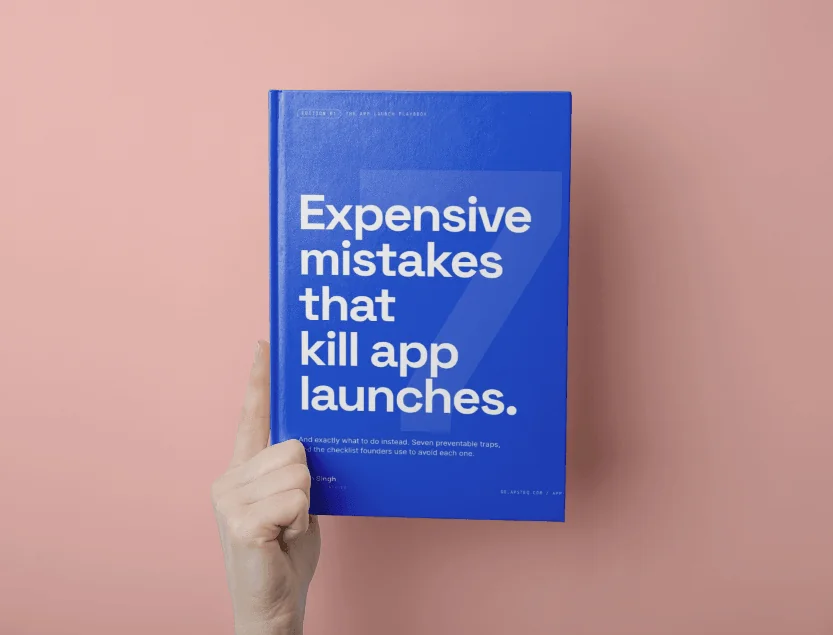
Free download
7 Expensive Mistakes That Kill App Launches
The launch errors we see most often across 300+ app engagements, and what to do instead.
Get the Free EbookBrowse all free guides