What Makes an iOS App Development Company Worth Hiring in 2026?
An iOS app development company is a specialized agency or studio that designs, builds, tests, and launches applications for Apple's iPhone, iPad, and related platforms. Choosing the right one is one of the highest-stakes decisions a mobile product team makes, because the wrong partner costs far more than their invoice. Apple's App Store now hosts over 1.8 million apps (Statista 2025), and fewer than 0.5% of consumer apps ever become financially successful (Gartner 2023). This post walks you through what actually separates strong iOS development partners from mediocre ones, how to evaluate them before signing a contract, where budgets typically go, and which 2026 trends should shape your vendor conversation right now.
Key Takeaways
- Apple's App Store generates over $1.1 trillion in developer billings and sales annually (Apple Newsroom 2024), making iOS the highest-revenue mobile platform.
- Apps built with native Swift outperform cross-platform builds on Core ML tasks by roughly 20-30% in benchmarks (Apple Developer Documentation 2025), a gap that matters for AI-heavy products.
- Post-launch user retention drops to a median of 25% by day 30 across mobile categories (Adjust Mobile App Trends 2024), so development quality and onboarding design directly affect long-term revenue.
- ApsteQ's Enjoy Movies Your Way reached 76% monthly active rate on 50K+ downloads, far above the 25% industry median, showing that architecture and UX decisions made during development compound over time.
What Should You Actually Look for in an iOS App Development Company?
The single most predictive quality signal is retained engagement on past products, not portfolio screenshots. Any agency can produce polished mockups; what matters is whether real users kept opening the app three months after install.
Start by asking every candidate for their clients' day-30 retention rates. The industry median sits at 25% (Adjust Mobile App Trends 2024), so a company that consistently delivers 40%+ is doing something structurally different in onboarding architecture and feature sequencing. If they cannot produce that number, or pivot immediately to download totals, treat it as a yellow flag.
Beyond retention, evaluate five dimensions:
- Swift and SwiftUI proficiency: Apple deprecated Objective-C for new frameworks years ago. A team still writing primary business logic in Objective-C is carrying technical debt into your codebase from day one.
- App Store Connect expertise: Submissions, TestFlight management, phased rollouts, and responding to reviewer rejections require hands-on experience with Apple's review process, which rejects roughly 17% of first submissions (Apple Developer Documentation 2025).
- Backend integration depth: Most iOS apps are thin clients over complex APIs. Ask specifically about their experience with GraphQL, REST versioning, and offline-first architectures.
- ASO and launch strategy: Development does not end at the binary. A company that hands off a polished IPA and disappears has completed maybe 40% of the work needed for commercial success.
- Post-launch SLA: iOS updates on a roughly annual major cycle. Verify contractually who owns compatibility fixes after each new OS release.
A useful public benchmark comes from EarningsCall, a US fintech app for retail investors. Its development and growth team prioritized active-user quality over raw installs. The result: 60% of downloads became monthly active users in the 2022-2023 campaign, reaching 3,000+ MAU on just 5,000+ downloads before scaling to 100K+ total downloads today (ApsteQ case study, EarningsCall). The architecture decisions made in development, specifically lightweight data sync and a frictionless onboarding flow, were the reason retention held at those levels. A development company that shaped those choices early created compounding value that no amount of paid acquisition could replicate.
Finally, check technical ownership structure. Some agencies subcontract iOS work to offshore pools while billing onshore rates. Ask for the GitHub contribution graph or ask to meet the actual lead engineer in a technical screen before signing. That one conversation usually reveals more than six reference calls.
How Do You Evaluate Cost and Scope Before Signing a Contract?
Scope definition is where most mobile project budgets collapse. A well-scoped iOS project arrives at a fixed-fee or milestone-based contract; a vaguely scoped one balloons 60-80% over initial estimates because every ambiguous requirement becomes a change order.
Before any vendor conversation, document:
- Core user flows: Map every screen a new user will touch from install to first value moment. Anything outside that map is phase two.
- Third-party dependencies: Payment processors, analytics SDKs, authentication providers, push notification services. Each one adds integration time that agencies frequently exclude from initial quotes.
- Apple-specific constraints: Sign-in with Apple is mandatory if you offer social login (Apple Developer Documentation 2023). App Tracking Transparency affects ad attribution. These are not optional compliance items; budget for them explicitly.
- Device and OS range: Supporting iOS 15 through iOS 18 on twelve device sizes is a different project than targeting iOS 17+ on iPhone 14 and later. Be explicit.
On budget ranges, a professional iOS app development company in the US typically prices a well-scoped consumer app at $75,000 to $250,000 for a v1.0, depending on feature complexity, backend requirements, and design depth. Offshore agencies quote $15,000-$40,000 for nominally similar scopes, but that gap usually reflects missing items, not efficiency. You can explore the full breakdown of what drives those numbers on the app development cost page and learn more about the full build process on the iOS and Android app development service page.
A structured evaluation process helps too. Run a paid discovery sprint, typically $5,000-$15,000 for two weeks, before committing to full development. A credible company will produce a technical specification, wire-frame set, and risk register. Any company unwilling to scope before building is either inexperienced or optimizing for contract lock-in.
Payment milestones matter as much as total price. Structure contracts around deliverable gates: completed design system, approved architecture document, TestFlight build passing QA, App Store submission. Never pay more than 30% upfront on a project over $50,000.
The Data Behind iOS vs. Cross-Platform: What the Numbers Actually Show
Native iOS development consistently outperforms cross-platform frameworks on performance-critical and monetization metrics. The evidence is specific and worth reviewing before a company talks you into Flutter or React Native purely on cost grounds.
Key data points:
- Apps built natively in Swift show 20-30% better performance on Core ML inference tasks compared to equivalent cross-platform implementations (Apple Developer Documentation 2025). For apps using on-device AI, that gap is not cosmetic.
- iOS users generate significantly higher revenue per user than Android in the US market. App Annie's (data.ai) 2024 State of Mobile report found iOS consumer spend in the US roughly 2x Android on equivalent app categories (data.ai State of Mobile 2024).
- Apple's StoreKit 2 and in-app purchase framework, available only to native apps, reduces subscription churn through better recovery flows. Subscription apps using StoreKit 2's grace periods see measurable retention improvements over older payment architectures (Apple Developer Documentation 2024).
| Dimension | Native iOS (Swift) | Cross-Platform (Flutter/RN) |
|---|---|---|
| Core ML performance | Baseline (fastest) | 20-30% slower (Apple Dev Docs 2025) |
| US revenue per user | Higher (approx. 2x Android) | Depends on Android parity |
| App Store review pass rate | Higher, native APIs expected | Framework-specific rejection risks |
| Access to latest Apple APIs | Day-one availability | Weeks to months lag |
| Initial development cost | Higher ($75K-$250K for v1) | Lower ($40K-$150K for v1) |
| Long-term maintenance cost | Lower (no framework translation layer) | Higher (framework update dependencies) |
Cross-platform makes genuine sense for content-driven apps with no heavy computation, teams that truly need simultaneous iOS and Android launches with a single codebase, and MVPs where speed-to-market outweighs performance. For subscription apps, fintech, health tech, or anything using on-device ML, the native case is strong and the numbers above explain why.
What Mistakes Do Companies Make When Hiring an iOS App Development Partner?
The most expensive mistakes happen before a single line of code is written. They cluster around five patterns, each of which is preventable with the right process.
1. Choosing on portfolio aesthetics instead of technical references. Visual design is largely decoupled from engineering quality. Ask specifically: "Can I speak to the lead engineer on your last two shipped projects?" A confident team says yes immediately.
2. Skipping App Store Optimization in the development brief. App Store Optimization (ASO) is the practice of improving an app's discoverability and conversion rate within the App Store through metadata, screenshots, and ratings strategy. It is not a marketing afterthought; it starts at naming and category selection, which are baked into the App Store Connect setup during development. Companies that treat ASO as a post-launch activity regularly leave 20-40% of organic install volume on the table. The ASO service page explains how metadata and creative decisions made at launch affect long-term visibility.
3. Underinvesting in analytics instrumentation. If the app ships without event tracking for every meaningful user action, the product team is flying blind post-launch. Specify Mixpanel, Amplitude, or equivalent event schemas in the development contract, not in a follow-up sprint six months later.
4. No explicit ownership of App Store assets. Screenshots, preview videos, and App Store metadata are time-consuming to produce well. Many development contracts exclude them. Clarify in writing who delivers submission-ready creative assets and in what format.
5. Ignoring the feedback loop between user acquisition and app architecture. LunarLinc, a friendship app targeting Android users in India, scaled to 50,000+ Google Play downloads from November 2023 with Meta app campaigns delivering 41,420 installs, where 113 video ads drove nearly all of those versus just 468 installs from 83 image ads (ApsteQ case study, LunarLinc). The lesson for iOS teams: the creative formats that drive installs must be designed in parallel with the onboarding experience those ads lead into. A mismatch between ad promise and in-app experience spikes early uninstalls and destroys paid acquisition ROI before the campaign gets a fair test.
Where Is iOS App Development Heading in 2026 and 2027?
Three forces are reshaping what iOS development companies need to deliver, and they are accelerating fast.
On-device AI is moving from feature to baseline expectation. Apple Intelligence, introduced with iOS 18 and expanding through iOS 19, brings on-device large language model capabilities to every modern iPhone. Apps that do not expose relevant Apple Intelligence entry points, writing tools, image generation hooks, Siri intents, will feel dated by late 2026. A development company should be able to show you their App Intents implementation experience today, not promise to learn it on your project.
Privacy architecture is becoming a hard technical requirement. Apple's continued tightening of ATT, the expansion of Private Click Measurement, and increasing enforcement of privacy manifests in App Store review mean that apps built without privacy-first data architecture face both review rejections and user trust penalties. The App Store now requires a privacy nutrition label for every data type collected (Apple Developer Documentation 2025). Development companies that treat privacy as a legal checkbox rather than an architectural constraint produce apps that require expensive rework within 12-18 months.
Subscription monetization is standardizing around StoreKit 2. By 2027, StoreKit 2's server-side transaction validation and improved subscription management APIs will be the expected standard. Apps still running legacy receipt validation will face increasing friction at the App Store review level. Mobile subscription revenue reached $171 billion globally in 2023 (data.ai State of Mobile 2024), and the companies capturing that spend are mostly running modern payment architectures.
Development companies worth hiring in 2026 are actively shipping App Intents integrations, writing privacy manifests correctly from day one, and have engineers who can articulate the difference between StoreKit 1 and StoreKit 2 transaction flows without looking it up.
Frequently Asked Questions
How long does it take to build an iOS app with a professional development company?
A well-scoped consumer iOS app typically takes 16 to 24 weeks from signed contract to App Store approval, including discovery, design, development, and QA. Complex apps with custom backend infrastructure or hardware integrations can run 32 to 40 weeks. Apps that rush past the 2-week discovery phase almost always take longer overall due to rework cycles.
What is the typical cost range for hiring an iOS app development company in the US?
US-based iOS development companies generally price a consumer app v1.0 between $75,000 and $250,000, depending on feature complexity, design requirements, and backend scope. Offshore agencies quote $15,000 to $40,000 for similar-sounding scopes, but those quotes routinely exclude QA, App Store submission assets, and post-launch support. See the full breakdown on the app development cost page.
Should I choose native iOS development or a cross-platform framework?
Native Swift is the stronger choice for subscription apps, fintech, health tech, or any app using on-device AI, because Core ML performance runs 20-30% faster natively (Apple Developer Documentation 2025) and iOS users in the US spend roughly 2x more than Android users on equivalent apps (data.ai 2024). Cross-platform makes sense for content apps or MVPs where simultaneous Android launch is a priority.
How do I verify that an iOS development company's work actually retains users?
Ask directly for day-30 retention rates on their last three shipped products. The industry median is 25% (Adjust Mobile App Trends 2024). A company consistently delivering 40% or above is doing something demonstrably different in onboarding and architecture. If they cannot produce those numbers or redirect to download totals, that is a meaningful signal about how they measure success.
What happens after the app launches, and who is responsible for iOS update compatibility?
Apple releases one major iOS version annually, typically in September, and each release can break existing functionality. A professional iOS development company should provide a post-launch SLA covering at minimum 12 months of OS compatibility maintenance. Confirm in the contract who owns the fix, at what cost, and what the turnaround SLA is when Apple ships a breaking change.
Conclusion
Hiring an iOS app development company is a product decision, not just a procurement one. The right partner shapes retention, revenue architecture, and App Store visibility from the very first technical choices, and those choices compound over years. To summarize what matters most:
- Evaluate on retention data, not portfolio screenshots.
- Scope precisely before signing: flows, dependencies, and Apple-specific constraints all affect budget.
- Native Swift outperforms cross-platform on performance and monetization for most high-value app categories.
- ASO and analytics instrumentation belong in the development brief, not the marketing retainer.
- In 2026, App Intents, privacy manifests, and StoreKit 2 are baseline competencies, not premium differentiators.
If you are evaluating development partners and want a second opinion on scope, architecture, or vendor proposals, book a free strategy call with the ApsteQ team. We have built and scaled iOS and Android apps across fintech, social, and entertainment, and we will give you a straight read on what your project actually needs.
Free download
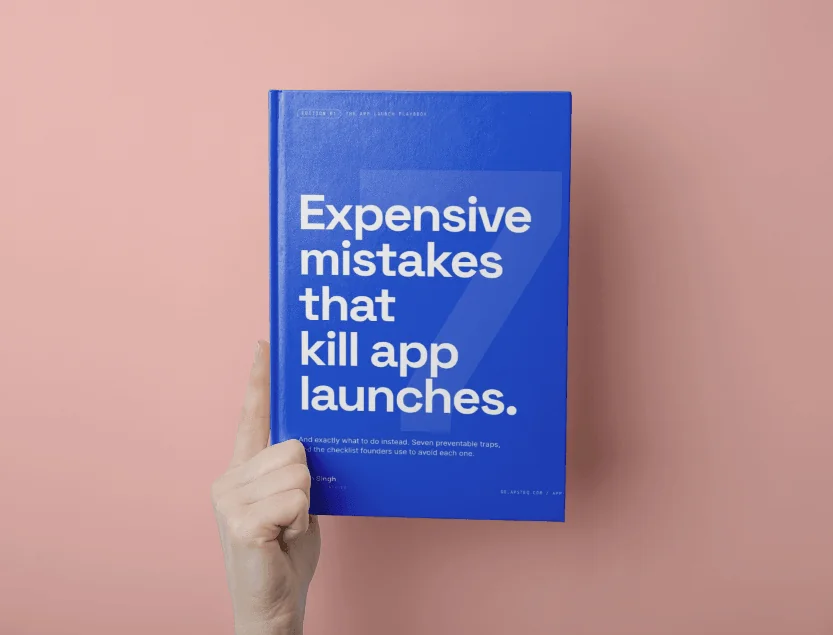
7 Expensive Mistakes That Kill App Launches
The launch errors we see most often across 300+ app engagements, and what to do instead.
Get the Free EbookBrowse all free guides