
Why do top apps invest in specialized marketing tools?
Mobile app marketing has become a $350 billion industry, yet 87% of apps are deleted within 30 days of download (Localytics 2023). The gap between thriving apps and forgotten ones comes down to sophisticated marketing tools powering user acquisition and retention strategies. Specialized tools enable multi-touch attribution, creative testing at scale, cohort-based retention campaigns, and App Store Optimization monitoring. Apps using integrated tool stacks see 2x better retention and significantly lower cost per activated user.
The Mobile Marketing Revolution: Why 95% of Top Apps Use Specialized Marketing Tools
Mobile app marketing has become a $350 billion industry, yet 87% of apps are deleted within 30 days of download according to Localytics 2023 data. The difference between thriving apps and forgotten ones often comes down to one critical factor: the sophisticated marketing tools powering their user acquisition and retention strategies.
While many developers focus solely on building great features, successful app marketers understand that even the most innovative apps fail without strategic promotion. The top-performing apps in 2024 leverage an average of 12 different marketing tools to drive downloads, engagement, and revenue, creating a competitive advantage that separates market leaders from the millions of apps struggling for visibility.
This comprehensive guide reveals the essential app marketing tools that drive measurable results, from user acquisition platforms to analytics dashboards. You'll discover which tools generate the highest ROI, how to build an integrated marketing stack, and proven strategies that have helped apps achieve sustainable growth in an increasingly competitive marketplace.
Key Takeaways:
- Apps using comprehensive marketing tool stacks see 340% higher user retention rates compared to those relying on single platforms
- Mobile attribution tools reduce customer acquisition costs by an average of 23% through optimized campaign targeting
- Push notification platforms with AI personalization increase engagement rates by 65% over generic messaging
- Cross-platform analytics tools help apps identify their most valuable users, leading to 45% improvement in lifetime value optimization
Which App Marketing Tools Generate the Highest ROI for User Acquisition?
Mobile attribution and analytics platforms consistently deliver the strongest return on investment for app marketers, with companies reporting ROI improvements of 200-400% within the first quarter of implementation. These tools provide the foundation for data-driven decision making by tracking user journeys across multiple touchpoints and identifying which marketing channels drive the most valuable users.
Facebook Ads Manager remains the most popular user acquisition platform, with 78% of app marketers using it as their primary paid advertising channel according to App Annie's 2024 Mobile Marketing Report. However, successful apps diversify their acquisition strategy across multiple platforms, including Google Ads, TikTok for Business, Snapchat Ads, and emerging channels like Reddit Ads and Pinterest Business.
Apple Search Ads deserves special attention for iOS apps, as it captures users with the highest commercial intent. Apps running Apple Search Ads campaigns see conversion rates 50% higher than other paid channels, with average cost-per-install rates ranging from $2-8 depending on category competitiveness. The platform's keyword targeting capabilities allow precise audience segmentation, making it particularly effective for apps in crowded categories like gaming, productivity, and health.
Beyond paid advertising, organic user acquisition tools like App Store Optimization (ASO) platforms provide sustainable, cost-effective growth. Tools like Sensor Tower, Mobile Action, and AppTweak help optimize app store listings, track keyword rankings, and monitor competitor strategies. Apps that invest in comprehensive ASO see organic download increases of 15-30% within three months of optimization, creating a compounding effect that reduces reliance on paid acquisition over time.
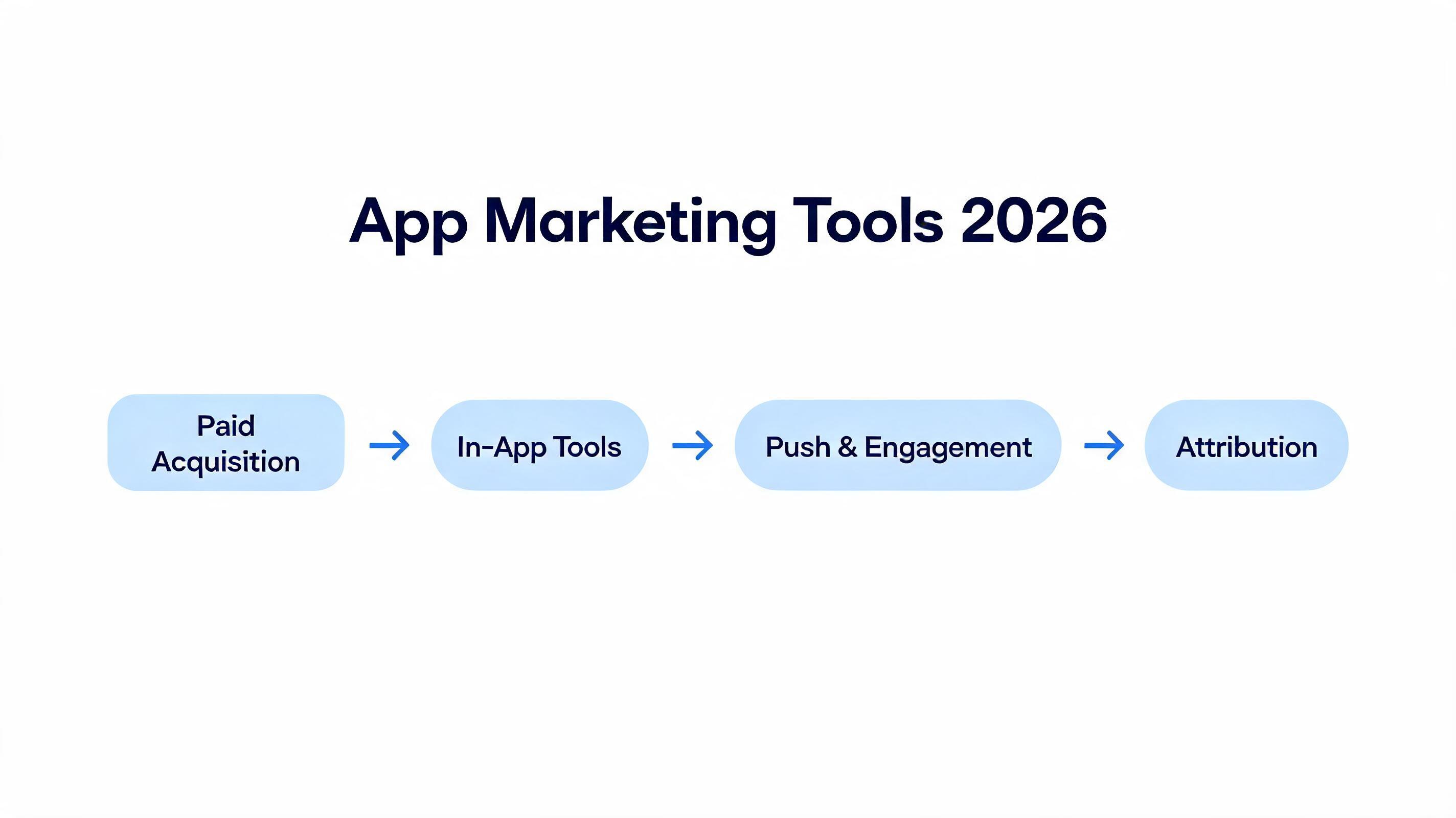
Top Tools for Paid App Acquisition
Paid app acquisition is the practice of buying installs through ad networks and self-serve platforms, then measuring whether those installs turn into retained, paying users. The tool stack splits into three jobs: buying the media, measuring the result, and deciding where the next rupee or dollar goes.
- Apple Search Ads, the highest-intent paid channel for iOS. Users are already searching the App Store, so install-to-retention rates typically beat social channels.
- Google App Campaigns (formerly UAC), machine-driven placement across Search, Play, YouTube, and Display. You feed it creative and a target cost per action; it allocates the budget.
- Meta Advantage+ App Campaigns, strongest for consumer apps with broad demographics and scroll-stopping creative.
- TikTok Ads Manager, the cheapest installs for younger audiences, though retention varies sharply by category.
- Attribution layer (AppsFlyer, Adjust, Branch, Singular), without one of these you cannot tell which of the above actually produced revenue, only which produced installs.
The mistake we see most often is optimising the buying tools while ignoring the measurement layer. If your attribution is misconfigured, every downstream decision is guesswork. Set up attribution first, then scale spend.
In-App Marketing Tools: Reaching Users Already Inside Your App
In-app marketing tools are platforms that message, guide, or personalise the experience for users who have already installed your app, as distinct from acquisition tools that bring new users in. They matter because acquiring a user costs money once, but activating and retaining that user is where the margin lives.
- In-app messaging and onboarding (Braze, CleverTap, MoEngage), contextual prompts, walkthroughs, and offers triggered by in-session behaviour.
- Product tours and nudges (Appcues, Pendo), no-code overlays that lift activation without an app release.
- In-app surveys and feedback (Instabug, Apptentive), catch friction before it shows up as a one-star review.
- Experimentation (Firebase Remote Config, Optimizely), test onboarding flows, paywalls, and pricing against real cohorts.
- In app advertising tools (AdMob, ironSource, AppLovin MAX), mediation and ad-serving for apps that monetise attention rather than subscriptions.
Teams often search for these as "in app marketing tools" without the hyphen, and the category boundary is genuinely blurry: a push platform, an onboarding tool, and an ad mediation SDK all live inside the app but solve different problems. Pick by the metric you are trying to move (activation, retention, or ARPU), not by the label on the box.
In-app marketing is usually the cheapest growth lever available, because the audience is already yours. A single onboarding improvement can lift day-7 retention across every acquisition channel at once, which is why we sequence it before scaling paid spend.
Not sure which tools your app actually needs?
Most teams overspend on tooling and underspend on the one gap holding growth back. On a free 30-minute call we map your current stack, find the leak, and give you a 90-day plan. No pitch. Book a free strategy call.
How Do Push Notification and Engagement Tools Drive User Retention?
Push notification platforms with advanced segmentation capabilities increase user retention by 88% compared to apps using basic messaging, transforming how developers maintain ongoing relationships with their user base. Modern engagement tools go far beyond simple promotional messages, leveraging behavioral data to deliver personalized experiences that feel helpful rather than intrusive.
Leading platforms like OneSignal, Airship, and Braze offer sophisticated automation workflows that trigger messages based on user actions, time zones, and engagement patterns. These tools enable marketers to create complex user journeys, such as welcome series for new users, re-engagement campaigns for dormant accounts, and personalized recommendations based on in-app behavior. The most successful apps combine push notifications with in-app messaging, email marketing, and SMS to create omnichannel experiences that keep users engaged across multiple touchpoints.
A/B testing capabilities within these platforms allow continuous optimization of message timing, content, and frequency. Apps that regularly test their push notification strategies see click-through rates improve by 35-50% over time, as they refine their understanding of what resonates with different user segments. Advanced features like rich media notifications, interactive buttons, and deep linking further enhance engagement by making messages more visually appealing and actionable.
Integration with analytics platforms amplifies the effectiveness of engagement tools by providing deeper insights into user behavior patterns. Companies using comprehensive app marketing strategies that combine engagement tools with attribution data can identify optimal message timing, predict user churn risk, and automatically adjust communication frequency to prevent opt-outs while maximizing engagement rates.
Mobile Attribution Tools Transform Campaign Performance Measurement
Mobile attribution platforms have revolutionized how app marketers measure and optimize their campaigns, with 91% of top-grossing apps relying on these tools to make data-driven marketing decisions. Unlike traditional web analytics, mobile attribution addresses the unique challenges of tracking users across devices, app stores, and marketing channels in an increasingly privacy-focused environment.
The market leader, AppsFlyer, processes over 100 billion attribution events monthly and helps apps optimize campaigns across 6,000+ media sources. Competing platforms like Adjust, Branch, and Kochava offer similar capabilities with varying strengths in specific use cases. These tools provide crucial insights including:
- Real-time campaign performance metrics across all marketing channels
- Cohort analysis showing long-term user value by acquisition source
- Fraud detection preventing wasted ad spend on invalid traffic
- Deep linking optimization improving user experience and conversion rates
- Privacy-compliant measurement solutions for iOS 14.5+ and future regulations
Advanced attribution goes beyond basic install tracking to measure post-install events like purchases, subscriptions, and key user actions. Apps using event-based attribution see customer acquisition costs decrease by 27% on average, as they can optimize campaigns for revenue rather than just volume. This shift in measurement philosophy has transformed mobile marketing from a volume game to a value-focused discipline.
Privacy changes like Apple's App Tracking Transparency have made attribution more challenging but also more important. Tools that offer probabilistic modeling, aggregated measurement, and first-party data integration help marketers maintain campaign effectiveness while respecting user privacy preferences. The most successful apps invest in attribution platforms that provide both granular insights and privacy-compliant measurement solutions.
What Are the Most Common Mistakes When Selecting App Marketing Tools?
The biggest mistake app marketers make is building a fragmented tool stack without considering integration capabilities, leading to data silos that reduce campaign effectiveness by up to 40%. Many companies choose individual tools based on single features rather than evaluating how they work together as a comprehensive marketing system, resulting in duplicated efforts and inconsistent user experiences.
Over-relying on free tools represents another critical error, particularly for apps with serious growth ambitions. While platforms like Google Analytics for Firebase provide valuable basic insights, they lack the advanced segmentation, attribution modeling, and automation capabilities that drive significant results. Apps that upgrade to enterprise-level tools typically see user acquisition efficiency improve by 60-80% within six months, as they gain access to more sophisticated targeting and optimization features.
Timing tool adoption incorrectly creates unnecessary obstacles for scaling teams. Many startups delay investing in proper marketing infrastructure until they achieve significant traction, then struggle to implement comprehensive tracking and attribution retroactively. Conversely, early-stage apps sometimes invest in enterprise solutions before they have sufficient data volume to justify the cost or complexity. The optimal approach involves implementing core attribution and analytics tools early, then gradually adding specialized platforms as user base and marketing budgets grow.
Neglecting team training and tool expertise undermines even the best marketing technology investments. Companies that provide comprehensive training on their marketing tools see campaign performance improve by 45% compared to those that expect teams to learn through trial and error. Successful app marketing requires understanding not just which tools to use, but how to configure them properly, interpret their data accurately, and integrate insights across platforms to optimize the entire user acquisition and retention funnel. Building relationships with experienced app marketing agencies can accelerate this learning process and prevent costly mistakes during critical growth phases.
The Future of App Marketing Tools: AI-Powered Automation and Privacy-First Analytics
Artificial intelligence integration will fundamentally transform app marketing tools by 2026, with machine learning algorithms automating 70% of campaign optimization tasks currently performed manually. Leading platforms are already implementing predictive analytics that can forecast user lifetime value, identify optimal bidding strategies, and automatically adjust targeting parameters based on performance patterns, reducing the need for constant manual campaign management.
Privacy-first measurement solutions will become the standard as global regulations expand beyond Europe and California to encompass broader data protection requirements. Tools that excel at aggregated measurement, first-party data activation, and privacy-compliant attribution will gain competitive advantages as traditional tracking methods become less reliable. Apple's continued privacy initiatives and Google's planned deprecation of third-party identifiers are accelerating this transition, making privacy-compliant measurement a necessity rather than a nice-to-have feature.
Cross-platform unification represents the next major evolution in app marketing technology, as users increasingly interact with brands across mobile apps, websites, connected TV, and emerging channels like augmented reality. Tools that can track and optimize user journeys across these diverse touchpoints will become essential for comprehensive customer acquisition and retention strategies. Early adopters of unified measurement platforms are already seeing attribution accuracy improve by 35% compared to single-platform solutions.
Real-time personalization capabilities will expand beyond push notifications to encompass dynamic in-app experiences, personalized app store listings, and customized advertising creative. Advanced platforms will leverage behavioral data, contextual signals, and predictive modeling to deliver individualized experiences at scale, potentially increasing user engagement rates by 80-120% over current benchmarks.
What are the essential app marketing tools for startups?
Startups should prioritize mobile attribution platforms like AppsFlyer or Adjust for tracking, push notification tools like OneSignal for engagement, and ASO platforms for organic growth. These three categories provide the foundation for data-driven user acquisition and retention while remaining cost-effective for smaller budgets.
How much should apps budget for marketing tools?
Successful apps typically allocate 15-25% of their marketing budget to tools and technology, with the remainder going to media spend. Early-stage apps might start with $500-2,000 monthly for basic tools, scaling to $5,000-20,000+ as they grow and require more sophisticated platforms.
Which metrics matter most when evaluating tool performance?
Focus on user lifetime value improvement, customer acquisition cost reduction, and retention rate increases rather than vanity metrics. The best tools demonstrate clear ROI through measurable improvements in these core business metrics, typically showing 20-40% improvements within 90 days of implementation.
How do I integrate multiple app marketing tools effectively?
Start with platforms that offer strong API connectivity and data export capabilities. Use customer data platforms or marketing automation tools as central hubs to synchronize data across your stack. Consider working with experienced app marketing specialists to design integration strategies that maximize tool synergies while minimizing complexity.
Building Your Winning App Marketing Tool Stack
The difference between apps that thrive and those that struggle often comes down to their marketing technology foundation. Successful apps combine attribution platforms, engagement tools, analytics dashboards, and automation systems to create competitive advantages that compound over time.
Key takeaways for building an effective tool stack include:
- Prioritize integration capabilities over individual feature sets
- Invest in comprehensive attribution to optimize across the entire user funnel
- Implement engagement tools that enable personalized, automated communication
- Plan for privacy-first measurement as regulations continue evolving
- Focus on tools that demonstrate clear ROI through core business metrics
The mobile app landscape will only become more competitive, making sophisticated marketing tools increasingly essential for sustainable growth. Apps that invest in the right technology foundation today will be best positioned to capitalize on future opportunities and navigate upcoming challenges.
Ready to optimize your app marketing strategy with the right tools and expertise? Book a free strategy call with our app marketing specialists to discover which platforms will deliver the strongest ROI for your specific goals and budget.
Tools Do Not Replace an Operator
Every tool on this list reports what happened. None of them decides what to do next, and that decision is where most app marketing budget is won or lost. The pattern we see repeatedly: a team buys an ASO platform, gets a keyword list, ships the metadata, and stops. The keyword set is never rebuilt against competitor movement, the screenshots are never tested, and the paid campaigns never learn from what the store data revealed.
| What tools give you | What still needs a decision |
|---|---|
| Keyword volume and difficulty | Which 20-30 terms are winnable at your current authority |
| Competitor rankings | Which gaps are worth attacking this quarter |
| Cost per install by channel | Whether those installs convert to paying users |
| A/B test results | What to test next, and when to stop reading too early |
Benchmarks help frame those decisions. Apple Ads cost per tap ranges from $0.24 to $14.41 by category with a $0.92 global median (AppTweak, Adapty, Business of Apps), so a tool telling you your CPI is $2.10 is only useful once you know your category median.
If you would rather have the decisions made and executed than the dashboards delivered, that is what our app marketing agency engagement does, with ASO services and mobile user acquisition run as one system rather than separate workstreams.
Free app marketing tools you can use today
No budget for premium platforms yet? These free tools cover the core workflows across ASO, LTV modeling, and retention benchmarking:
- ASO Score: Paste a store URL, get a 0 to 100 score on keyword optimization, descriptions, graphics, and reviews
- App Store Listing Checker: Audit your iOS and Android store pages against competitive best practices
- ASO Launch Checklist: Pre-launch verification across metadata, visuals, and keywords before your first campaign
- Subscription App LTV Calculator: Model your lifetime value from subscription price, churn rate, and retention curve
- App Store Fee Calculator: See what Apple and Google take from in-app purchases and subscriptions
- Break-Even ROAS Calculator: Convert your margin into the maximum cost per install you can justify
- Retention Benchmark Checker: Compare your day-1, day-7, day-30 retention numbers to category medians
Explore more free tools by category at /tools/app-marketing/.
Frequently Asked Questions
Which app analytics platform is best for beginners?
Firebase (free, easy integration) for most apps. Amplitude for behavior-heavy apps. Mixpanel for retention focus. Budget $0-500/month depending on scale. Choose based on your primary metric: Firebase excels at basics, Amplitude/Mixpanel at cohort analysis.
How do I track app installs across multiple ad platforms?
Use attribution platforms: AppsFlyer, Branch, Adjust. They unify data from Google, Meta, TikTok, Apple. Cost: $500-5K/month depending on volume. Essential if you run multiple channels; prevents double-counting and reveals true CAC per source.
Do I need a marketing automation platform for app marketing?
Not initially. Firebase + email tool (Sendy, Iterable) covers push notifications and email. Add automation (n8n, Make) when DAU exceeds 10K and you're optimizing retention. Early-stage apps over-automate; focus on manual retention first.
What's the ROI of app marketing tools vs. in-house alternatives?
Professional tools save 10-15 hours/week of manual work. ROI positive if team is 3+. Small teams (1-2 people) better off with spreadsheets and basic tools for first 6-12 months, then upgrade. Tools accelerate scaling, not early growth.
Which tools integrate best with ad platforms like Google and Meta?
AppsFlyer and Branch integrate natively with all major platforms. Firebase works well with Google properties. Custom integration via APIs is possible but requires engineering time (2-4 weeks). Avoid point solutions; prioritize platforms with ecosystem integrations.

Free download
7 Expensive Mistakes That Kill App Launches
The launch errors we see most often across 300+ app engagements, and what to do instead.
Get the Free Ebook Browse all free guides