Most Apps Are Invisible on Google Play. Here Is How to Fix That.
App store optimization for Google Play is the process of improving an app's visibility, conversion rate, and organic download volume within the Google Play Store through strategic metadata, creative assets, and behavioral signals. If your app is not ranking on page one for its core keywords, it is effectively invisible to the majority of users who never scroll past the first few results.
Consider this: 65% of all app downloads begin with a search inside the app store (Apple Developer documentation, 2024). Yet most mobile app companies spend the bulk of their budgets on paid user acquisition while leaving organic search entirely unoptimized. The result is a leaking funnel where paid installs prop up rankings that could, with the right strategy, sustain themselves organically.
In this guide you will learn how Google Play's ranking algorithm actually works, which ASO levers move the needle fastest in 2026, what mistakes are silently killing your conversion rate, and where the discipline is heading over the next 12 to 24 months.
Key Takeaways
- 65% of app downloads start with a store search (Apple Developer documentation, 2024), making organic ASO your highest-leverage acquisition channel.
- Apps that A/B test their store listing creatives see conversion rate lifts of up to 25% through Google Play's Store Listing Experiments (Google Play Console docs, 2024).
- The Google Play algorithm weighs ratings, review velocity, and uninstall rate as behavioral ranking signals alongside keyword relevance (Adjust blog, 2024).
- Top-grossing apps refresh their metadata every 4 to 6 weeks to stay competitive with shifting keyword trends (Sensor Tower, 2025).
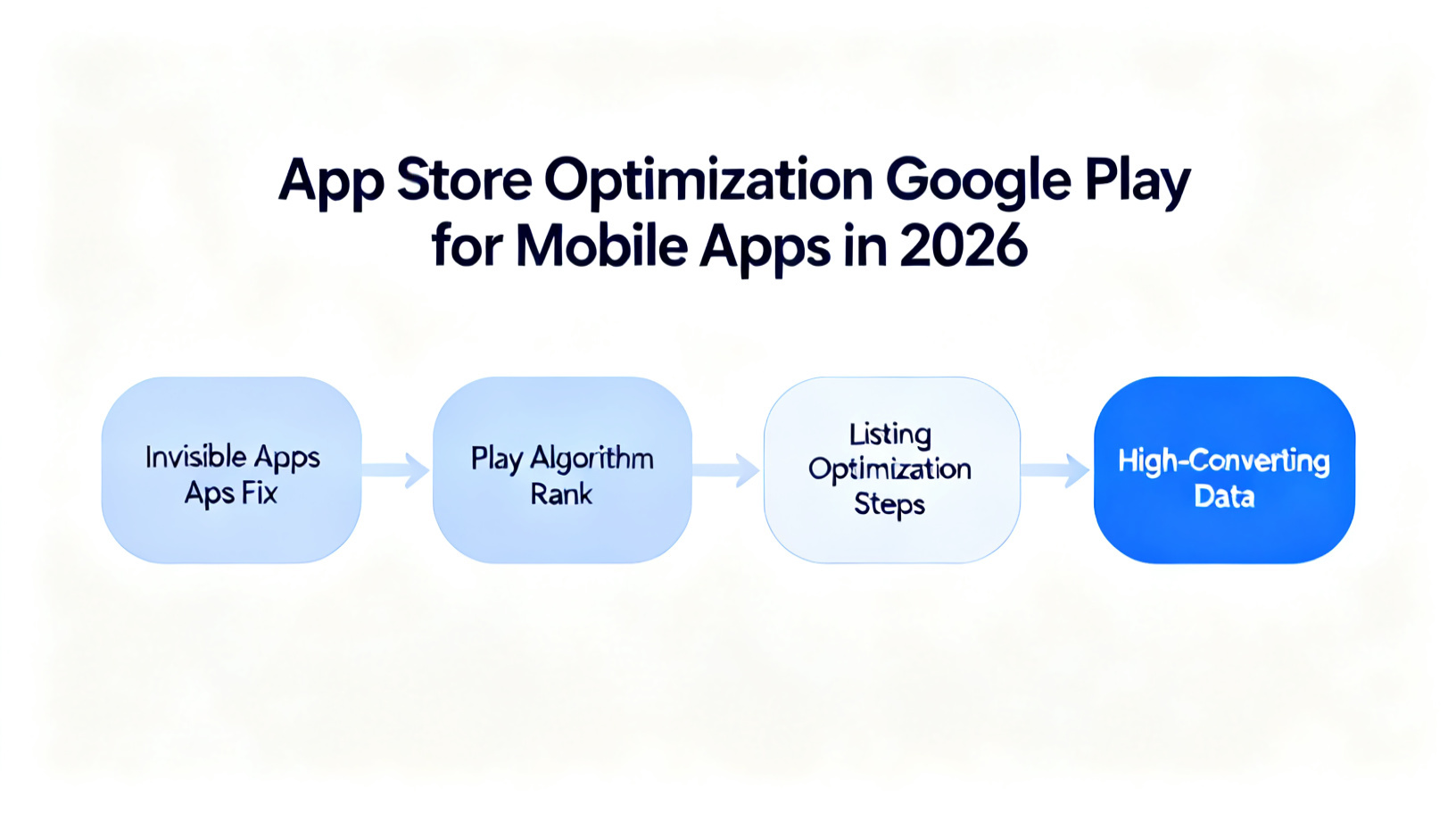
How Does the Google Play Algorithm Actually Rank Apps?
The Google Play ranking algorithm evaluates both relevance and quality signals simultaneously, meaning keyword placement alone will never be enough. Understanding the two-layer system is the foundation of any effective ASO strategy.
Relevance signals are the textual and categorical cues Google uses to decide which queries your app is eligible to rank for. These include your app title (the single highest-weighted metadata field), your short description (80 characters, indexed and displayed prominently), your long description (4,000 characters, fully crawled by Google's indexer), and your app's category and subcategory selection. Google's natural language processing is sophisticated enough in 2026 to understand semantic relationships, so keyword stuffing no longer helps and often triggers demotion.
Quality signals are behavioral and reputational. Google Play's algorithm tracks average star rating, review velocity (how many new ratings arrive per day), crash rate, Android vitals scores (battery drain, ANR rate, crash rate), uninstall-to-install ratio, and session length. Apps with an average rating below 4.0 stars are algorithmically suppressed in browse and search placements (Google Play Console docs, 2024). This is a hard threshold many teams do not realize exists until they wonder why their keyword rankings have plateaued.
A concrete example makes this tangible. Imagine two fitness apps targeting the keyword "home workout no equipment." App A has a perfect title match, a well-structured description, and a 4.7-star rating with 2,000 reviews. App B has slightly better keyword density but a 3.8-star average and a high uninstall rate. App A will rank higher almost every time because quality signals override marginal relevance advantages. Google has been explicit that its goal is to surface apps users will actually keep, not just download.
Install velocity is a third, often underappreciated factor. When an app receives a burst of installs over a short period, Google interprets this as a demand signal and temporarily elevates rankings, creating a flywheel. This is why coordinated launch campaigns, product launches, and feature press coverage can produce lasting organic ranking gains when timed correctly. Organic keyword rankings improve an average of 12 positions in the two weeks following a paid install campaign that doubles baseline install rate (AppsFlyer research, 2024).
The practical implication: treat your app's technical health, review management, and paid acquisition strategy as part of your ASO program, not separate workstreams. They feed the same algorithm.
What Is the Step-by-Step Process for Optimizing a Google Play Listing?
Effective Google Play ASO follows a repeatable four-phase cycle: research, implement, experiment, and iterate. Skipping any phase is the most common reason optimization efforts stall after an initial ranking bump.
Phase 1: Keyword Research
Start by building a keyword universe of at least 50 to 100 terms across three tiers: head terms (high volume, high competition), mid-tail terms (moderate volume, moderate competition), and long-tail terms (lower volume, lower competition but higher intent). Use tools like Mobile Action or Sensor Tower to pull volume estimates, difficulty scores, and competitor keyword gaps. Prioritize terms where you have a realistic chance of reaching page one within 60 to 90 days, typically mid-tail and long-tail terms at launch.
Phase 2: Metadata Implementation
Place your single most important keyword in the first 30 characters of your app title. This placement is weighted more heavily than any other field. Write a short description that leads with a user benefit and naturally incorporates a secondary keyword. In your long description, use your top three to five keywords in the first 167 characters (visible without "read more" expansion), then distribute remaining terms naturally throughout the body. Never repeat the same keyword phrase more than two to three times or Google will interpret it as spam.
Phase 3: Creative Asset Optimization
Your icon, screenshots, and feature graphic drive conversion rate, not keyword ranking, but conversion rate is a quality signal that feeds rankings. A/B test icon variants using Store Listing Experiments before committing. For screenshots, lead with your strongest value proposition in the caption of screenshot one. Apps that use Store Listing Experiments see conversion rate improvements of up to 25% (Google Play Console docs, 2024).
Phase 4: Review and Rating Management
Proactively prompt satisfied users for reviews using in-app review prompts triggered at moments of delight (level completion, successful task, positive onboarding milestone). Respond to every negative review within 48 hours. A developer response signals to Google that your app is actively maintained.
For mobile app companies looking for a more comprehensive acquisition strategy that combines ASO with paid channels, the team at ApsteQ's app marketing services builds integrated programs that connect organic and paid efforts into a single growth engine.
The Data Behind High-Converting Google Play Listings
Data from app intelligence platforms consistently shows that the gap between a median store listing and a top-quartile one is smaller than most teams assume, but the ranking and revenue difference is enormous. A handful of optimization decisions drive the vast majority of performance variance.
Here is what the data shows about the elements that matter most:
- App title length: Google Play caps the app name at 30 characters (Play Console Help), so the real decision is how much of that 30 goes to your brand and how much to a descriptor a buyer would actually search.
- Screenshot count and orientation: Apps using all eight available screenshot slots and leading with landscape (16:9) orientation in games, or portrait in utility apps, convert at higher rates than those using fewer slots.
- Localization impact: Apps localized into five or more languages see an average 128% increase in downloads compared to English-only listings (App Annie / data.ai, 2024). This is one of the most underused levers in the entire ASO toolkit.
- Review volume threshold: Apps with fewer than 100 reviews struggle to rank on competitive keywords regardless of metadata quality, because Google lacks sufficient social proof signals to surface them confidently (Adjust blog, 2024).
- Update frequency: Apps that publish updates at least once every 30 days receive a freshness signal that modestly improves rankings, particularly in fast-moving categories like productivity and health.
| Optimization Element | Primary Impact | Difficulty |
|---|---|---|
| App Title (keyword placement) | Keyword ranking | Low |
| Short Description | Keyword ranking + CVR | Low |
| Screenshots (A/B tested) | Conversion rate | Medium |
| Ratings and Reviews | Ranking quality signal | Medium |
| Localization (5+ languages) | Download volume | High |
| Android Vitals (crash rate, ANR) | Ranking quality signal | High |
ApsteQ Insight: Most ASO audits reveal that 80% of ranking gains are available through just three changes: a keyword-rich title rewrite, screenshot A/B testing, and a structured review-request flow. Start there before investing in localization or deep technical work.
What ASO Mistakes Are Quietly Destroying Your Google Play Rankings?
The most damaging Google Play ASO mistakes are not obvious errors. They are plausible-sounding decisions that feel correct but actively suppress rankings and conversion rates. Recognizing them is half the battle.
Mistake 1: Keyword Cannibalization Across Metadata Fields
Many teams repeat the same primary keyword in the title, short description, and long description opener, believing repetition reinforces the signal. Google's algorithm actually penalizes this as keyword stuffing. The correct approach is to use your primary keyword in the title, a secondary keyword in the short description, and a third distinct keyword in the first paragraph of your long description. Breadth of keyword coverage outperforms depth of repetition.
Mistake 2: Setting and Forgetting the Listing
ASO is not a one-time task. Keyword search volumes shift with seasonality, competitor apps enter and exit rankings, and Google updates its ranking model. Top-grossing apps on Google Play refresh their metadata every 4 to 6 weeks (Sensor Tower, 2025). Teams that optimize once at launch and never revisit typically see their rankings decay by 30 to 40% within six months as the competitive landscape shifts around them.
Mistake 3: Ignoring Android Vitals
Your app's technical performance is surfaced directly to Google through the Play Console's Android Vitals dashboard. High ANR (Application Not Responding) rates and crash rates trigger algorithmic suppression in addition to damaging user trust. Many teams treat these as purely engineering concerns and never connect them to their ASO strategy. They are the same problem.
Mistake 4: Using the Same Creative Assets for All Countries
A screenshot layout optimized for US users may perform poorly in Japan, Brazil, or Germany due to cultural visual preferences, text length in localized captions, and color psychology differences. Running the same creative globally is a conversion rate leak that compounds at scale.
Mistake 5: Treating ASO and Paid UA as Separate Budgets
Paid user acquisition campaigns that drive install velocity directly improve organic keyword rankings through Google's demand signals. Teams that manage these in silos miss the compounding effect. The strongest mobile growth programs use paid campaigns strategically to seed keyword rankings that then sustain themselves organically, dramatically lowering long-term cost per install.
If your team is unsure where your current listing stands, an ASO audit is the fastest way to prioritize fixes. The specialists at ApsteQ's app marketing team conduct full listing audits, competitor gap analyses, and creative testing roadmaps for mobile app companies at every stage.
Where Is Google Play ASO Heading in 2026 and 2027?
Google Play ASO is undergoing its most significant structural shift in years, driven by three converging forces: AI-powered search within the Play Store, expanded personalization signals, and the growing weight of post-install behavioral data in ranking models.
AI-Generated Search Summaries in the Play Store
Google has begun rolling out AI-generated summaries of app reviews directly within search results pages inside the Play Store. These summaries pull sentiment and key themes from user reviews and display them before a user ever clicks into a listing. The implication for ASO is significant: teams must now manage the narrative quality of their reviews, not just their volume and star rating. Reviews that use natural language matching common search queries (for example, "great for tracking macros" for a nutrition app) are more likely to surface in these summaries and influence click-through decisions.
Deeper Personalization Reduces Universal Rankings
Google Play's search results are increasingly personalized by device type, past download history, location, and behavioral patterns. Personalized app recommendations now account for a growing share of installs on Android devices (Google Play Console docs, 2024), meaning the concept of a single universal ranking position is becoming less meaningful. ASO strategies in 2027 will need to focus on signaling relevance to specific audience segments, not just broad keyword categories.
Post-Install Retention as a Primary Signal
Google has made clear through its Play Console communications that session depth, Day 1 and Day 7 retention rates, and in-app engagement quality are increasingly factored into algorithmic placement. Building onboarding flows that maximize early retention is no longer just a product decision; it is an ASO decision.
The teams that will win on Google Play in 2026 and 2027 are those that treat ASO as a living, cross-functional program connecting marketing, product, and engineering, rather than a one-time metadata task.
Frequently Asked Questions
How long does it take to see results from Google Play ASO?
Most apps begin seeing measurable keyword ranking improvements within 2 to 4 weeks of a metadata update, assuming the app has at least 100 reviews and stable Android Vitals. Conversion rate improvements from creative A/B tests typically reach statistical significance within 4 to 8 weeks, depending on install volume. Full organic growth compounding usually becomes visible within 3 months of consistent optimization.
Is the Google Play app title the most important ASO field?
Yes, the app title is the single highest-weighted metadata field in Google Play's ranking algorithm. Keywords placed in the title receive significantly more ranking authority than the same keywords placed in the short or long description. Best practice is to place your primary target keyword within the first 30 characters of your title, followed by a compelling brand or category descriptor to support click-through rate.
How many keywords should I target in my Google Play listing?
Target 3 to 5 primary keywords distributed across your title and short description, and 10 to 20 secondary keywords woven naturally into your 4,000-character long description. Tools like Sensor Tower and Mobile Action show that top-ranking apps in competitive categories typically rank for 50 or more related keywords organically, most of which were never explicitly placed but arise from semantic indexing of the full description text.
Do Google Play ratings actually affect keyword rankings?
Yes, ratings have a direct impact on rankings. Google Play's algorithm suppresses apps rated below 4.0 stars in both search and browse placements, according to Google Play Console documentation (2024). Beyond the 4.0 threshold, each incremental improvement in average rating correlates with higher placement in competitive keyword sets. Review velocity, meaning the rate of new incoming ratings, is an additional signal that indicates active and satisfied users.
How does paid user acquisition connect to organic ASO on Google Play?
Paid install campaigns create install velocity, which Google interprets as a demand signal and uses to temporarily elevate keyword rankings. When managed strategically, these ranking gains can persist organically after the paid campaign ends, compounding return on ad spend. The ApsteQ app marketing team structures paid and organic campaigns together to maximize this flywheel effect for mobile app companies.
Take Your Google Play Rankings From Invisible to Dominant
Google Play ASO is not a mystery. It is a system with knowable inputs and measurable outputs. The apps winning organic search in 2026 are not the ones with the biggest budgets; they are the ones treating ASO as a continuous, data-driven program rather than a launch checklist item.
Here is what to do starting this week:
- Audit your app title for primary keyword placement in the first 30 characters.
- Check your average star rating and ANR/crash rate in the Play Console dashboard.
- Set up a Store Listing Experiment to A/B test at least one screenshot variant.
- Build a keyword refresh calendar with 4 to 6 week review cycles.
- Connect your paid UA and ASO teams so install velocity campaigns are timed to support ranking goals.
If you want a team that has built and executed these programs for mobile app companies across dozens of categories, we are ready to help. Book a free strategy call with ApsteQ and we will audit your current Google Play listing, identify your fastest-path ranking opportunities, and map out a 90-day ASO roadmap tailored to your app and market.
Working through this and want an operator rather than a checklist? See how our App Store Optimization services engagement works.
Free download
The 47-Point ASO Audit Checklist
The exact checklist we run before touching any app store listing. Find the gaps costing you organic installs.
Get the Free Ebook Browse all free guides